

Spain's student visa is defined as a long-stay authorization issued by Spanish consulates to non-EU nationals who have secured enrollment at a recognized Spanish educational institution. Spain student visa university enrollment are inseparable: you cannot apply for the visa without first holding an official acceptance or enrollment letter from your chosen university. The Spanish consulate, along with universities like the Universidad de Barcelona or Universidad Autónoma de Madrid, are the two central institutions in this process. This guide walks you through every requirement, step, and common mistake so you arrive in Spain on time and fully prepared.
What are the key Spain student visa requirements tied to university enrollment?
The most critical document in your Spain student visa application is the official university acceptance letter. According to Spanish consulate guidelines, the acceptance letter must indicate full-time enrollment status, program duration, and proof of paid enrollment fees from a recognized institution. A conditional offer letter does not qualify. You need the final, confirmed enrollment document.
Beyond the acceptance letter, here is what the consulate requires:
- Proof of financial means: You must demonstrate at least 100% of Spain's IPREM per month, which equals approximately €600.53 excluding tuition and accommodation costs. Bank statements, scholarship letters, or sponsor declarations are all accepted formats. For a full breakdown of accepted documents, the financial proof guide from Epic-residency covers each format in detail.
- Health insurance: Your policy must cover at least €30,000 and provide benefits equivalent to Spain's National Health System, with no co-payments or deductibles. The insurer must be registered with Spain's General Directorate of Insurance and Pension Funds.
- Valid passport: Your passport must remain valid for the entire duration of your program, plus a buffer of at least three months beyond your planned departure.
- Recent passport photographs: Two color photos meeting Schengen photo standards.
- Completed visa application form: Signed and dated, submitted in the language required by your consulate.
| Document | Requirement |
|---|---|
| University acceptance letter | Full-time status, program duration, paid fees confirmed |
| Financial proof | Min. €600.53/month (IPREM 100%), excluding tuition |
| Health insurance | Min. €30,000 coverage, no deductibles, registered insurer |
| Passport | Valid for full program duration plus 3-month buffer |
| Visa application form | Completed, signed, submitted in required language |
Pro Tip: Request your enrollment letter in both Spanish and English. Some consulates outside Spain require a certified translation, and having both versions ready saves you two to three weeks.
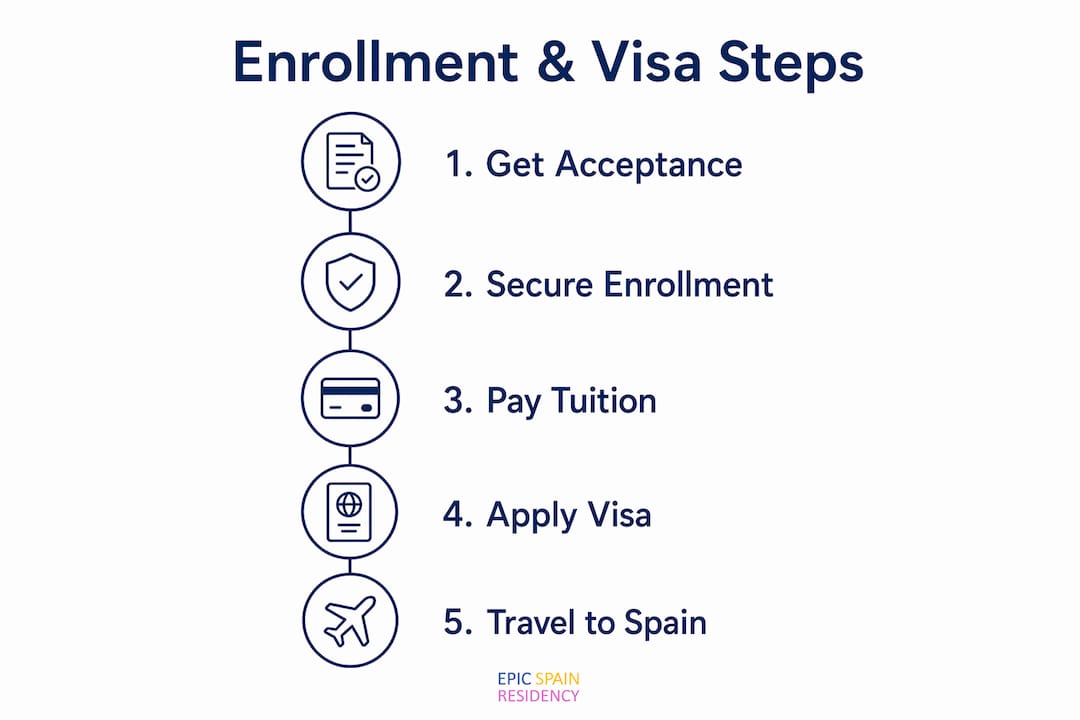
How to prepare and secure your university enrollment in Spain
Securing enrollment is the step most students underestimate. Spain's university admission process involves multiple stages, and the timeline is longer than many students expect.
- Research accredited institutions. Spain's Ministry of Universities maintains a public registry of recognized institutions. Degrees from unaccredited schools do not satisfy visa requirements. Focus your search on public universities, private universities with official recognition, and accredited language schools if you plan a short-term program.
- Submit your application for admission. Most Spanish universities open applications for the following academic year between january and june. Private universities often accept rolling applications. Submit all required academic transcripts, language certificates (typically B2 Spanish or equivalent English proficiency for English-taught programs), and any entrance exam results.
- Receive and confirm your acceptance. Once accepted, you will receive a conditional acceptance letter. This is not sufficient for the visa. You must complete the next step.
- Formalize enrollment by paying fees. Formalizing enrollment requires paying tuition and enrollment fees, after which the university issues certified payment confirmation. This certified document, combined with your acceptance letter, forms your official proof of enrollment.
- Collect all enrollment documents. Gather the acceptance letter, the payment receipt, and any additional confirmation from the university's international office. Some universities issue a single consolidated enrollment certificate. Confirm the exact format your consulate accepts before requesting documents.
Common pitfalls at this stage include applying to programs that start in september but not requesting enrollment documents until july, leaving no time for certified translations or apostilles. Another frequent error is assuming an email confirmation from the admissions office counts as official enrollment proof. It does not.
Pro Tip: Contact your university's international student office directly and ask which specific document format the Spanish consulate in your country accepts. Formats vary by consulate, and getting this wrong delays your entire application.

How to apply for a Spain student visa after securing enrollment
Once your enrollment is confirmed and your documents are assembled, the visa application process follows a clear sequence.
- Book your consulate appointment. Applications must be submitted in person at the Spanish consulate or an authorized center such as BLS International, within your consular jurisdiction. Appointment slots fill quickly, especially between june and august. Book as early as possible.
- Apply within the correct window. The application window is 30–90 days before your course start date. Most consulates recommend applying at least 60 days in advance. Applying too early or too late results in automatic rejection.
- Compile your full document package. Your package must include: the official enrollment letter with paid fees, financial proof meeting IPREM requirements, health insurance policy, valid passport and copies, completed application form, and passport photographs.
- Pay the visa fee. Fees vary by consulate and nationality. Confirm the exact amount and accepted payment methods when booking your appointment.
- Track your application. Processing takes at least one month. Check the visa processing timeline guide for country-specific expectations. Follow up with your consulate if you have not received a decision within six weeks.
After arriving in Spain, students enrolled in programs longer than six months must apply for a TIE (Foreigner Identity Card). The TIE must be requested within one month of arrival. This card serves as your annual stay authorization and is required for banking, housing contracts, and other administrative tasks in Spain.
What common mistakes can derail your Spain student visa and enrollment?
Most visa rejections and delays trace back to a small set of avoidable errors.
- Applying outside the recommended window. Submitting your application more than 90 days before your start date, or fewer than 30 days before, results in rejection regardless of document quality.
- Insufficient financial proof. Many students submit bank statements that show the required balance only briefly. Consulates look for consistent, sustained funds. A single large deposit made days before your appointment raises red flags.
- Incomplete enrollment documentation. An acceptance email, a conditional offer, or an unpaid enrollment confirmation does not meet the standard. The consulate requires certified proof that fees are paid and enrollment is finalized.
- Health insurance gaps. Policies purchased from providers not registered with Spain's General Directorate of Insurance and Pension Funds are rejected outright, even if the coverage amount exceeds €30,000.
- Work authorization misunderstandings. Students on higher education programs can work up to 30 hours per week without a separate work permit. Language course students, however, require a separate authorization to work. Misunderstanding this distinction can create compliance problems after arrival.
"The student visa process rewards preparation. Every document the consulate requests exists for a specific legal reason. Treat each requirement as a checklist item, not a bureaucratic obstacle, and your application will reflect that discipline."
For students navigating regional application nuances, the Asian students visa guide from Epic-residency covers country-specific document standards in detail.
Key Takeaways
Successful Spain student visa university enrollment requires confirmed enrollment with paid fees, sustained financial proof at IPREM levels, compliant health insurance, and a consulate application submitted 30–90 days before your course start date.
| Point | Details |
|---|---|
| Enrollment comes first | Secure official, paid enrollment before starting your visa application. |
| Financial proof must be consistent | Show sustained funds at €600.53/month minimum, not a single recent deposit. |
| Health insurance must be compliant | Policy must cover €30,000 with no deductibles and a registered Spanish insurer. |
| Apply within the correct window | Submit your visa application 30–90 days before your course start date. |
| TIE is required after arrival | Students in programs over 6 months must register for a TIE within one month of arriving. |
What I've learned from watching students get this wrong
I have seen students with strong academic profiles, full scholarships, and genuine excitement about studying in Spain lose months of time because of a single document error. The most common one is not the financial proof or the health insurance. It is the enrollment letter itself.
Universities issue multiple types of letters during the admissions process: conditional acceptance, unconditional acceptance, pre-enrollment confirmation, and final enrollment certification. Students frequently submit the wrong one. The consulate does not call you to clarify. It simply rejects the application.
My honest advice: treat the enrollment letter as the anchor of your entire application. Before you book your consulate appointment, call the Spanish consulate in your country and ask exactly which enrollment document format they accept. Then call your university's international office and ask them to issue that exact format. This single conversation eliminates the most common rejection reason.
The financial proof requirement also trips up more students than it should. The IPREM standard sounds straightforward, but consulates scrutinize the source and consistency of funds. A bank account that shows €10,000 deposited three days before your appointment does not satisfy the requirement the way six months of consistent statements does. Start building your financial paper trail early.
Spain is worth the effort. The student visa pathway is well-defined once you understand the logic behind each requirement. Approach it systematically, verify every document format before you request it, and give yourself at least three months of lead time from enrollment confirmation to consulate appointment.
— Living
How Epic-residency supports your Spain student visa process
Navigating Spain's student visa and university enrollment requirements is manageable, but the margin for error is small. Epic-residency specializes in exactly this process for non-EU students and families relocating to Spain.
Epic-residency's education services in Spain cover university enrollment support, visa application preparation, document verification, and post-arrival compliance including TIE registration. The team works with students from initial school selection through to long-term residency planning. For students who later want to extend their stay beyond their studies, Epic-residency also handles pathways like the Non-Lucrative Visa for those transitioning to longer-term residence in Spain. Get in touch with Epic-residency to start your application with expert guidance behind you.
FAQ
What documents prove enrollment for a Spain student visa?
The consulate requires an official acceptance letter specifying full-time status and program duration, plus certified proof that enrollment fees have been paid. An email confirmation or conditional offer does not qualify.
How far in advance should I apply for a Spain student visa?
Submit your application 30–90 days before your course start date. Most consulates recommend at least 60 days in advance to allow for the minimum one-month processing period.
Can I work in Spain on a student visa?
Students enrolled in higher education programs can work up to 30 hours per week without a separate permit. Language course students require a separate work authorization to work legally in Spain.
What happens after I arrive in Spain on a student visa?
Students in programs lasting longer than six months must apply for a TIE (Foreigner Identity Card) within one month of arriving. This card functions as annual stay authorization and is required for most administrative tasks in Spain.
What financial amount do I need to show for a Spain student visa?
You must demonstrate at least 100% of Spain's IPREM per month, approximately €600.53, not including tuition or accommodation costs. Consistent bank statements over several months are the most accepted form of proof.