

The Spain student visa is the mandatory long-stay authorization that allows non-EU international students to study legally in Spain for any program exceeding 90 days. Without it, you cannot enroll in a full degree, language immersion, or professional course at a recognized Spanish institution and remain in the country legally for the duration. This guide covers the full Spain student visa pathway explained in plain terms: what you need, how to apply, what happens after you land, and how to avoid the mistakes that get applications denied.
What are the key requirements for a spain student visa?
The student visa is formally classified as a Type D long-stay visa, issued specifically for academic or training programs at institutions recognized by the Spanish government. Every requirement below is non-negotiable. Missing even one document is enough for the consulate to reject your application outright.
Enrollment confirmation is the foundation of your application. You must hold an official letter of acceptance from a recognized Spanish educational institution before you submit anything else. This letter must state the program name, start and end dates, and the institution's official registration details.
Passport validity follows strict rules. Your passport must have at least one year remaining and include at least two blank pages. Passports older than 10 years are not accepted, regardless of the expiration date printed inside. You must submit both the original and a copy of the biometric data page.
Financial proof is calculated using Spain's IPREM formula, which stands for the Public Indicator of Multiple Effects Income. The IPREM financial formula requires you to show 100% of the monthly IPREM for yourself, 75% for your first accompanying family member, and 50% for each additional member. Bank statements, scholarship letters, or sponsor declarations are all accepted formats, but they must be recent and officially translated if not in Spanish or English.
Health insurance is where many applications fail. The policy must:
- Cover the full duration of your stay in Spain
- Provide minimum €30,000 coverage with no co-payments or deductibles
- Be issued by a provider registered with Spain's General Directorate of Insurance and Pension Funds
- Be comparable in scope to Spain's National Health System
This is not a standard travel insurance policy. Most off-the-shelf travel plans do not meet these criteria. Read the full breakdown of Spain's health insurance standards before purchasing a policy.
Additional documents include a medical certificate issued within three months of application, a police clearance certificate from every country you have lived in during the past five years, and two recent passport-sized photos.
Pro Tip: Get your documents apostilled and officially translated before you book your consulate appointment. Translation and apostille services often take two to four weeks, and consulates will not accept unauthenticated foreign documents.
How do you apply for the spain student visa step by step?
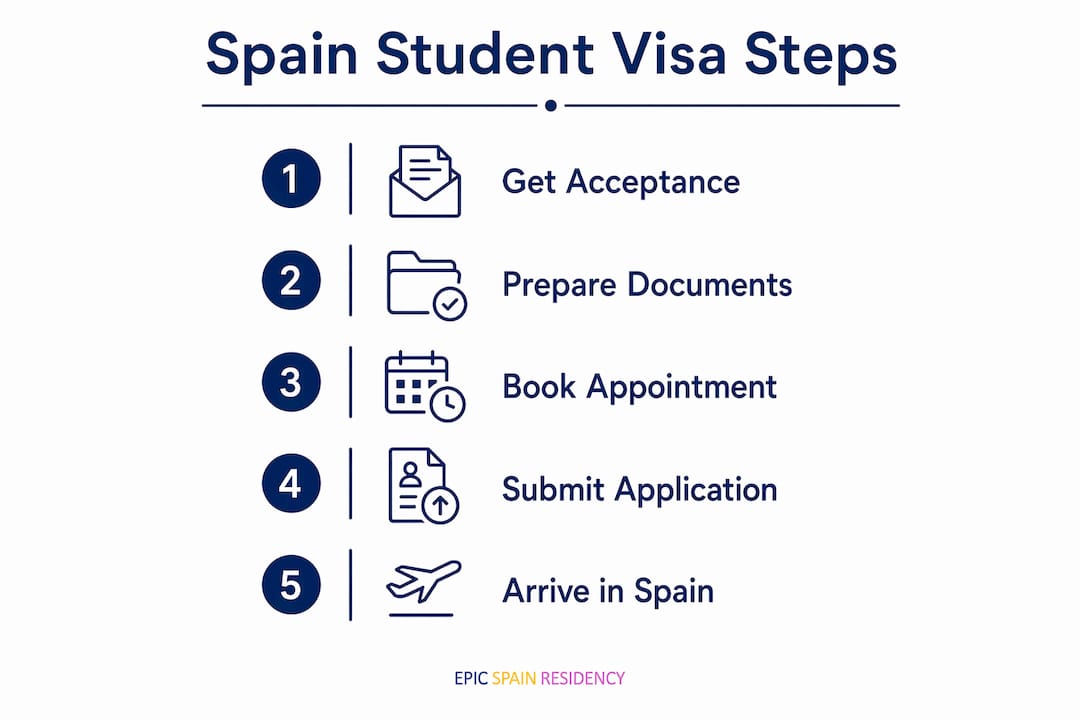
The Spain study visa process runs through the Spanish consulate or embassy in your country of legal residence. You cannot apply from a third country, and you cannot apply inside Spain on a tourist visa. Here is the sequence:
- Confirm your enrollment. Secure your official acceptance letter from a Spanish institution before anything else. The consulate will not process an application without it.
- Gather and authenticate all documents. Allow four to six weeks for apostilles, official translations, police clearances, and insurance procurement. Consulates require strict document validity standards, and expired or improperly certified documents are rejected on the spot.
- Book your consulate appointment. Applications must be submitted between six months and at least 60 days before your program starts. Popular consulates in cities like New York, Los Angeles, and Chicago fill appointment slots weeks in advance, especially from june through september.
- Submit in person or via authorized representative. Most consulates require the applicant to appear personally for biometric data collection. Some locations use third-party platforms like BLS International to manage appointment scheduling and document intake. Check your specific consulate's current procedure before assuming you can send a representative.
- Pay the visa fee. Fees vary by nationality and are set by bilateral agreements. Payment is typically required at the time of submission. Ask your consulate about accepted payment methods, as some do not accept cash or foreign cards.
- Wait for processing. Processing typically takes 4–8 weeks, with no priority lane available. Consulates consult other Spanish authorities during this period, which is why the 60-day minimum lead time exists. For a detailed breakdown of timelines by consulate, see this Spain visa processing guide.
- Collect your visa sticker. Once approved, you return to the consulate to collect your passport with the visa sticker affixed. This sticker is your entry permit, not your residence authorization.
Pro Tip: Set a calendar reminder for exactly six months before your program start date. That is the earliest you can apply, and booking on that day gives you the widest window to manage delays.
What happens after you arrive in spain?
Arriving in Spain with your visa sticker is not the end of the process. The visa sticker grants you entry. Your legal residence is formalized through a separate document called the Tarjeta de Identidad de Extranjero, or TIE. Think of the visa as your boarding pass and the TIE as your residency card.
The TIE application is mandatory for any student staying longer than six months. You must apply within 30 days of arriving in Spain. Missing this deadline is not a minor administrative slip. It creates a gap in your legal status that can trigger fines or complications when you later try to renew your authorization.
Key facts about the TIE process:
- Apply in person at your local Immigration Office or designated National Police Station
- Book your appointment through the official Spanish government appointment system as soon as you land
- Bring your passport, visa, enrollment confirmation, photos, and proof of address in Spain
- The TIE is issued for the duration of your study program, up to one year per cycle
The TIE renewal cycle is capped at one year per renewal and must align with your active enrollment. If your program runs three years, you renew the TIE each year. Gaps between your program end date and your renewal submission can leave you without valid status, so plan renewals at least 60 days before your current authorization expires.
Your NIE, or Foreigner Identification Number, is printed on the TIE. This number is your legal identifier in Spain for everything from opening a bank account to signing a lease.
Spain student visa vs. other visa options: what non-eu students should know
The student visa is not the only way to be in Spain, but it is the only legal route for full-time study programs exceeding 90 days. Here is how it compares to the alternatives most relevant to non-EU students:
| Feature | Student Visa | Schengen Short-Stay Visa | Non-Lucrative Visa |
|---|---|---|---|
| Maximum stay | Program duration, renewable | 90 days per 180-day period | 1 year, renewable |
| Work rights | Part-time, 20–30 hours/week | None | None |
| Study allowed | Yes, full-time | Short courses only | Yes, informally |
| Path to residency | Yes, via long-term permit | No | Yes |
| Family accompaniment | Limited, case by case | No | Yes, via reunification |
| Separate work permit needed | No | Not applicable | Yes |
The post-2022 reform that allows student visa work rights without a separate permit is a significant advantage. Students on Schengen short-stay visas have no legal right to work at all. The Non-Lucrative Visa, which Epic-residency also handles, prohibits any employment but offers more flexibility for those who are not enrolled in a formal program.
After graduation, students can apply for a job-seeker permit, which gives you additional time to find employment in Spain without leaving the country. This pathway eventually leads to long-term residency and, after ten years of legal residence, Spanish citizenship. For a full picture of Spain's visa categories for non-EU nationals, the differences between each route matter significantly for long-term planning.
Key takeaways
The Spain student visa pathway requires early preparation, precise documentation, and a clear understanding of the legal steps both before and after arrival.
| Point | Details |
|---|---|
| Start at least 3–4 months early | Apostilles, translations, and consulate appointments all take time you cannot rush. |
| Health insurance must be exact | Policies need €30,000 minimum coverage, no co-payments, and a registered Spanish provider. |
| The TIE is a legal obligation | Apply within 30 days of arrival or risk gaps in your legal residency status. |
| Renewals align with enrollment | Each TIE renewal is capped at one year and must match your active program dates. |
| Work rights are built in | Post-2022 rules allow 20–30 hours per week of work without a separate permit. |
What i have learned watching students navigate this process
Most application problems are not caused by missing documents. They are caused by documents that are technically present but fail on a technicality. A health insurance policy that has a €50 co-payment buried in the fine print. A bank statement that is 91 days old instead of 90. A police clearance that was apostilled in the wrong country.
The consulate does not give you a second chance to fix these things on the day of your appointment. The application is rejected, and you start over. That is why I tell every student to begin document preparation 3–4 months before their program start, not 60 days. The 60-day rule is the consulate's minimum. Your minimum should be much earlier.
The TIE timeline catches people off guard more than any other step. Students arrive, they are busy settling in, and 30 days passes faster than expected. Booking your TIE appointment before you even board your flight to Spain is not excessive. It is the only way to guarantee you hit the deadline in cities where appointment slots fill up weeks in advance.
One more thing: do not assume your consulate operates the same way as the one a friend used in a different country. Spanish consulates have significant procedural variation. The Chicago consulate's requirements are not identical to those in London or Singapore. Always verify directly with your specific consulate before finalizing your document package.
— Living
How Epic-residency supports your spain student visa application
Preparing a Spain student visa application correctly the first time saves months of delays and the cost of restarting a rejected process.
Epic-residency specializes in Spain visa and residency applications for non-EU individuals and families. The team handles document checklists, insurance verification, financial proof structuring, and consulate appointment strategy so nothing falls through the cracks. For students who need support beyond the visa itself, Epic-residency's education services in Spain cover school admissions, housing assistance, and family residency planning. If you are weighing your long-term options in Spain after graduation, the full visa service overview is the right place to start.
FAQ
What is the spain student visa and who needs it?
The Spain student visa is a Type D long-stay visa required for any non-EU national enrolling in a study program that exceeds 90 days in Spain. EU citizens do not need a visa but must register with local authorities.
How long does the spain student visa application take?
Processing typically takes 4–8 weeks from the date of submission. You must apply at least 60 days before your program starts, and earlier is strongly recommended due to consulate appointment backlogs.
Can i work in spain on a student visa?
Yes. Post-2022 reforms allow student visa holders to work approximately 20–30 hours per week without obtaining a separate work permit, as long as the work is compatible with your studies.
What is the TIE and when do i need to apply for it?
The TIE is the Tarjeta de Identidad de Extranjero, the physical residency card that formalizes your legal status in Spain. Students on programs longer than six months must apply for the TIE within 30 days of arriving in Spain.
What health insurance do i need for the spain student visa?
Your policy must provide at least €30,000 in coverage, have no co-payments or deductibles, cover your full stay, and be issued by a provider registered with Spain's General Directorate of Insurance and Pension Funds. Standard travel insurance does not meet these requirements.