
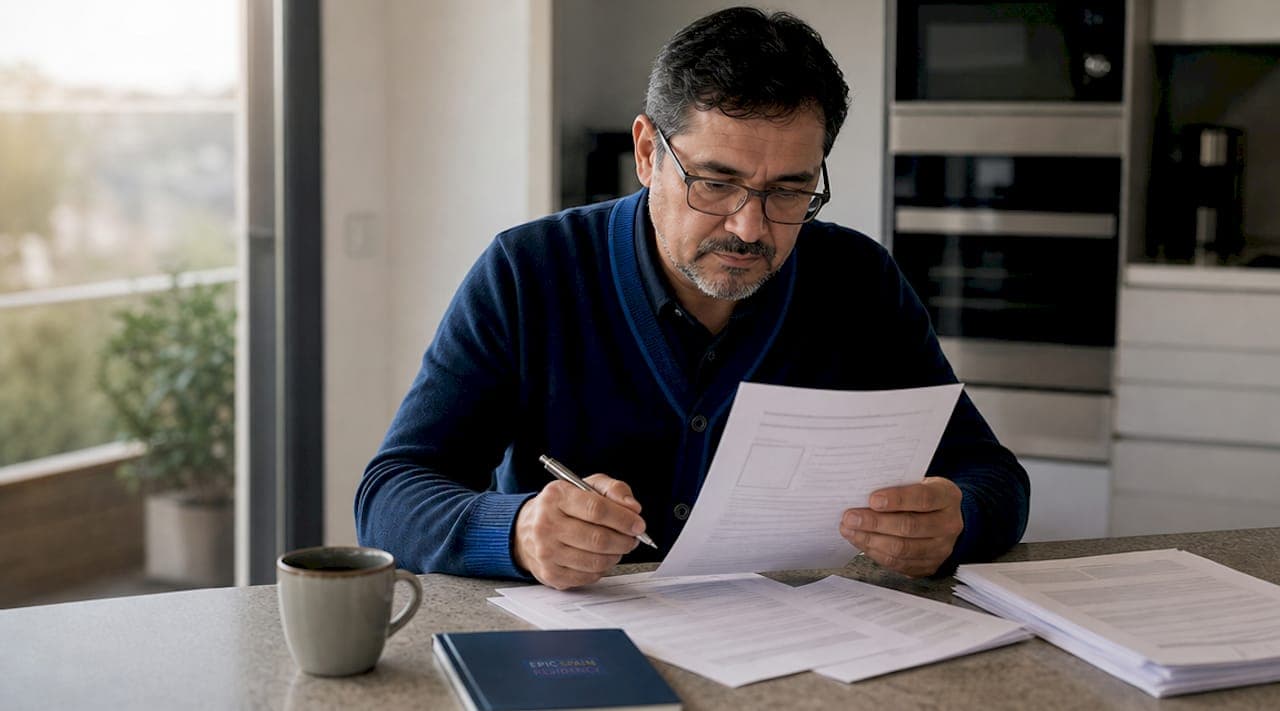
Spain's family reunification visa, formally known as the reagrupación familiar, is the legal mechanism that allows non-EU residents in Spain to bring their immediate family members to live with them permanently. The spain family reunification visa requirements are specific and non-negotiable: the sponsor must hold valid legal residence, meet income thresholds tied to Spain's IPREM index, provide a certified housing report, and submit a complete two-sided dossier covering both sponsor and family member. Miss any one of these pillars and the application stalls. This guide breaks down every requirement in plain terms so you can prepare correctly from day one.
1. Spain family reunification visa requirements at a glance
The reagrupación familiar process sits inside Spain's broader immigration framework, governed primarily by Artículo 67 and Artículo 68 of the Reglamento de Extranjería. Four core requirements determine eligibility before a single form is filed.
- Legal residence: The sponsor must hold a valid Spanish residence permit.
- Financial means: Monthly income must clear IPREM-based thresholds.
- Adequate housing: A certified municipal housing report must confirm the home is suitable.
- Complete documentation: Both sponsor and family member must submit a coordinated dossier.
Stable financial resources and an up-to-date housing report are the most critical initial hurdles to clear. Every other element of the application depends on these two being solid before submission.
2. Residency prerequisites for the sponsor

The sponsor's residency status is the foundation of the entire application. Under Artículo 68 del Reglamento de Extranjería, the sponsor must have resided legally in Spain for at least one year and must have applied for or obtained a residence extension for at least one additional year. This means a sponsor on their first short-term permit cannot yet apply. The clock starts only once that renewal is secured or in process.
There are meaningful exceptions worth knowing:
- Long-term residents (holders of a long-term EU residence permit) are exempt from the one-year waiting period and can apply immediately.
- EU long-term residents who transferred their status to Spain under Directive 2003/109/EC face no minimum residence duration requirement.
- Refugees recognized under Spanish law have a simplified pathway with reduced waiting periods.
Understanding which residency category you hold before starting the process saves weeks of wasted preparation. If you hold a Non-Lucrative Visa or a similar long-stay permit, confirm your renewal status with your immigration advisor before assembling any documents.
Pro Tip: Request a copy of your NIE registration and current residence card validity dates before starting the dossier. Authorities will cross-check these against your application date, and a permit that expires mid-process can trigger a suspension.
3. Financial means requirements and IPREM thresholds
Income is the requirement that trips up the most applicants. Spain calculates financial eligibility using IPREM (Indicador Público de Renta de Efectos Múltiples), the country's official public income reference index. The income threshold structure requires 150% of IPREM for the sponsor plus one family member, then an additional 50% of IPREM for each subsequent family member added to the application.
| Family unit size | IPREM multiple required | Approximate monthly threshold (2026) |
|---|---|---|
| Sponsor + 1 member | 150% IPREM | ~€1,100/month |
| Sponsor + 2 members | 200% IPREM | ~€1,465/month |
| Sponsor + 3 members | 250% IPREM | ~€1,830/month |
| Parent reunification | Higher threshold + dependency proof | ~€1,830/month+ |
Parent reunification carries stricter rules. Parents being reunited must typically be over 65, the sponsor must have at least five years of residence in Spain, and the income threshold is approximately 25% higher than standard cases, with documented proof of dependency required. This is one of the most frequently misunderstood aspects of the Spain immigration family reunification process.
Accepted income evidence includes employment contracts, recent payslips (typically the last three months), annual tax returns (Declaración de la Renta), pension statements, and bank statements showing consistent deposits. A common practical mistake is miscalculating income against IPREM units. Sponsors who tally household units incorrectly before submission often receive a request for additional documentation, which adds weeks to the timeline.
Pro Tip: If your income fluctuates, use your annual tax return as the primary proof rather than monthly payslips. Authorities average annual figures, which can work in your favor if recent months were lower than your yearly norm.
4. Adequate housing: the official report requirement
The housing report (informe de idoneidad de la vivienda) is issued by the local ayuntamiento (town hall) and must confirm that your home meets legal occupancy standards. Under Artículo 67 del Reglamento de Extranjería, the report must be no older than six months at the time of application and must certify legal occupancy, room count, habitability, and compliance with current housing laws, including standards aligned with Spain's Law 12/2023 on housing.
What the report must confirm:
- The property is legally occupied by the sponsor (owned or rented with a valid contract).
- The number of rooms is sufficient for the total number of people who will live there.
- The property meets minimum habitability standards set by the municipality.
- There are no outstanding violations or condemnation orders on the property.
Under RD 1155/2024, if the local authority fails to issue the housing report within the legally required 30-day window, the sponsor may submit alternative evidence of housing adequacy in its place. This is a significant protection, but it requires knowing the rule exists before the deadline passes.
The housing report's detailed content matters deeply. Any deviation from the standard format by authorities requires explicit written justification, which underscores why quality documentation prevents denials. Practitioners consistently recommend initiating the housing inspection request well in advance, precisely because of the strict six-month validity window. If the report expires before you submit, you must start the inspection process again.
5. Complete documentation checklist for sponsor and family members
Applicants often underestimate the two-sided nature of the dossier, needing coordinated and complete documentation from both sponsor and family member to avoid rejection. Here is what each party must prepare.
Sponsor documents:
- Valid Spanish residence card (TIE or NIE with residence status)
- Proof of income: payslips, tax return, pension, or bank statements
- Housing report (informe de idoneidad) issued within the last six months
- Private health insurance valid in Spain with no co-pays and full coverage for the family member
Family member documents:
- Completed visa application form EX-02
- Valid passport (minimum six months validity beyond the intended stay)
- Proof of family relationship: marriage certificate, birth certificate, or legal dependency documentation
- Medical certificate confirming no public health risk conditions
- Criminal record certificate from the country of origin and any country of residence in the past five years
Authentication requirements are where many applications fall apart. Documents issued outside Spain must carry either an Apostille stamp (for countries party to the Hague Convention) or full legalization through the Spanish consulate in the issuing country. All non-Spanish documents must be accompanied by a sworn translation (traducción jurada) into Spanish. The sworn translator must be officially recognized by Spain's Ministry of Foreign Affairs.
| Document type | Authentication method | Translation required |
|---|---|---|
| Marriage certificate (Hague country) | Apostille | Yes, sworn translation |
| Birth certificate (non-Hague country) | Consular legalization | Yes, sworn translation |
| Criminal record certificate | Apostille or legalization | Yes, sworn translation |
| Foreign payslips or tax returns | No apostille needed | Yes, sworn translation |
For spousal or partner reunification, Epic-residency also recommends reviewing the partner visa pathway if the couple is not formally married, as the Pareja de Hecho (registered partnership) route has distinct documentation requirements.
6. Application process, timelines, and common denial pitfalls
The Spain family reunification process runs in two parallel tracks that must be coordinated carefully. The sponsor submits the application personally at the Oficina de Extranjería in the province where they reside. No third-party submission is accepted for this initial filing. Once the Spanish authority approves the sponsor's application, the family member applies for the actual visa at the Spanish consulate in their home country.
Total processing time typically runs four to eight months across both stages. The Oficina de Extranjería has up to three months to resolve the sponsor's application. The consulate then has up to two months to issue the visa once the family member submits their documents. Factor in document preparation time and you should plan for a minimum of six months from start to finish.
Common reasons for denial include:
- Insufficient income: The most frequent cause. Sponsors who fail to meet IPREM thresholds or submit inconsistent financial documents face automatic refusal.
- Inadequate housing: A report that does not confirm sufficient room count or habitability is grounds for rejection.
- Incomplete documentation: Missing apostilles, expired documents, or unsigned forms trigger procedural denials that delay the process by months.
Visa denial grounds in Spain are well-documented, and financial and housing deficiencies account for the majority of refusals in family reunification cases. The Spain visa processing timeline also shows that incomplete application packages are the single biggest cause of avoidable delays.
Pro Tip: After submitting at the Oficina de Extranjería, request a stamped copy of your submission receipt (resguardo de presentación). This document is your proof of filing date and is required if you need to follow up or appeal a delayed decision.
Key takeaways
Spain's family reunification visa approval depends on four non-negotiable pillars: verified legal residence, IPREM-compliant income, a current housing report, and a fully authenticated two-sided dossier.
| Point | Details |
|---|---|
| Sponsor residency requirement | At least one year of legal residence with a renewal applied for or granted before filing. |
| IPREM income threshold | 150% of IPREM for sponsor plus one member, plus 50% per additional family member. |
| Housing report validity | Must be issued within six months of application and confirm habitability and legal occupancy. |
| Two-sided dossier | Both sponsor and family member must submit complete, authenticated, and translated documents. |
| Parent reunification rules | Stricter: five years of residence, parents typically over 65, higher income threshold, dependency proof required. |
What I've learned from watching families navigate this process
After working with dozens of non-EU families through the reagrupación familiar process, the pattern I see most often is not ignorance of the requirements. It is underestimating how unforgiving the timing is. The housing report expires in six months. Documents need apostilles that take weeks to obtain. Sworn translations require certified translators who are often booked out. When these elements are not coordinated in parallel, the whole dossier can expire before it is complete.
The financial calculation is the other consistent stumbling block. Sponsors who earn just above the threshold on paper often fall below it when authorities apply the IPREM calculation correctly. I always recommend that sponsors calculate their income against the current IPREM figure before gathering a single document. If the numbers are borderline, address that first. There is no point assembling a perfect dossier around an income that will not clear the threshold.
The two-track nature of this process also catches families off guard. The sponsor files in Spain. The family member applies at a consulate abroad. These two tracks must be coordinated, not sequential. Delays on one side ripple into the other. Families who treat this as a relay race rather than a parallel operation consistently face longer timelines.
One more thing: the legal definition of "family member" under Spanish immigration law is narrower than most people assume. Spouses, registered partners, minor children, and dependent parents under specific conditions qualify. Adult children, siblings, and extended family generally do not. Knowing this before you start prevents painful surprises mid-process.
— Living
How Epic-residency simplifies your family reunification application
The reagrupación familiar process has real consequences for getting it wrong. A missing apostille or a borderline income calculation can mean months of delay or an outright denial. Epic-residency specializes in exactly this kind of high-stakes application for non-EU families moving to Spain. The team handles document preparation, IPREM income verification, housing report coordination, and appointment scheduling at the Oficina de Extranjería. For families where the sponsor holds a Non-Lucrative Visa or is exploring related residency pathways, Epic-residency provides personalized case management that accounts for your specific permit type and family structure. You get a clear checklist, a realistic timeline, and expert oversight from first filing to visa issuance.
FAQ
Who qualifies as a family member for Spain reunification?
Spain's immigration law covers spouses or registered partners, minor children of the sponsor or spouse, and dependent parents (typically over 65 with proof of dependency). Adult children and extended family members generally do not qualify under the standard reagrupación familiar pathway.
How long does the Spain family reunification process take?
The total process typically takes four to eight months. The Oficina de Extranjería has up to three months to decide on the sponsor's application, and the consulate has up to two months to process the family member's visa once documents are submitted.
What income do I need for a family visa in Spain?
The income requirement is 150% of IPREM for the sponsor plus one family member, roughly €1,100 per month in 2026, plus an additional 50% of IPREM for each additional family member included in the application.
Does health insurance need to cover the whole family?
Yes. Private health insurance valid in Spain with no co-pays and full coverage is mandatory for both the sponsor and each family member being reunited. The policy must be active at the time of application.
What happens if the housing report is not issued in time?
Under RD 1155/2024, if the local authority does not issue the housing report within 30 days of the inspection request, the sponsor may submit alternative evidence of housing adequacy. This protects applicants from delays caused by municipal backlogs, but you must document the request date to invoke this right.