

Spain visa financial proof documents are official records that demonstrate you have enough stable income or savings to support yourself in Spain without relying on public funds. Spanish consulates use these documents to verify financial sufficiency before granting any long-stay visa, from the Non-Lucrative Visa to the Digital Nomad Visa. The standard the Spanish government applies is the IPREM index, a public income reference updated annually. Getting this documentation right is the single most controllable factor in your application outcome.
What are the required financial proof documents for a Spain visa?
The core Spain visa financial proof documents fall into three categories: bank statements, income verification letters, and tax returns. Each plays a distinct role in building the financial picture consulates need to approve your application.
- Bank statements: Consulates require 3 to 12 months of bank statements, with 6 to 12 months preferred to demonstrate consistent income deposits rather than a one-time balance. Statements must show your account number, your name, and regular credits that align with your declared income sources.
- Income verification letters: Official letters from pension authorities, employers, or investment firms confirm the source and amount of income shown in your bank statements. These letters must be apostilled and translated if issued outside Spain.
- Tax returns: The most recent federal tax return (for US applicants, IRS Form 1040 with official seals) corroborates the income you declare. Consulates treat tax returns as universal proof of declared income.
- Supporting documents: Rental income applicants should include property lease agreements and corresponding bank deposit records. Scholarship recipients applying for student visas should attach the award letter.
- Apostilles and sworn translations: Financial documents issued outside Spain require an apostille under the Hague Convention and a sworn translation by a translator certified by the Spanish Ministry of Foreign Affairs. A non-sworn translation is grounds for immediate rejection.
Pro Tip: Request your bank statements directly from your branch with a wet-ink stamp or an official bank-issued verification letter. Digital printouts downloaded from an app carry a higher rejection risk unless accompanied by that verification letter.
How is the financial sufficiency amount calculated for different Spain visa types?
Spain's financial thresholds are set as multiples of the IPREM (Indicador Público de Renta de Efectos Múltiples), the country's public income reference index. As of 2026, the IPREM stands at €600.53 per month.
| Visa type | Main applicant requirement | Per dependent |
|---|---|---|
| Non-Lucrative Visa (NLV) | 400% IPREM = €2,402.12/month (€28,825.44/year) | 100% IPREM = €600.53/month |
| Student Visa | 100% IPREM = €600.53/month | 100% IPREM per dependent |
| Digital Nomad Visa (DNV) | 200% IPREM = €1,201.06/month | 75% IPREM per dependent |
| Highly Qualified Professional | Employment contract covers requirement | N/A |
The Non-Lucrative Visa requires 400% of IPREM for the main applicant, which translates to €28,825.44 annually. Each dependent added to the application increases the total by one additional 100% IPREM unit per year. A couple applying together would need approximately €36,031.80 annually. A family of four would need roughly €50,444.52. These are minimums. Consulates in cities like Los Angeles and Miami have historically applied stricter scrutiny, so presenting figures comfortably above the threshold strengthens your case.
Certain employment-based visas such as the Highly Qualified Professional and intra-company transfer visas do not require standard financial proof because an employment contract guarantees income. This exception does not apply to the NLV or DNV.
Pro Tip: Do not present exactly the minimum amount. Consulates view applications that barely clear the threshold with more skepticism. Aim to show 20 to 30 percent above the required figure wherever possible.
What income sources and financial proofs are accepted by Spanish consulates?
Spanish consulates rank income sources by reliability. Understanding this hierarchy helps you present the strongest possible financial case.
The most credible sources, in order of preference, are:
- Government pensions and Social Security benefits: These carry the highest weight because they are guaranteed, recurring, and government-verified. US Social Security award letters are widely accepted across Spanish consulates.
- Retirement account distributions: Regular distributions from a 401(k) or IRA, supported by distribution statements and 12 months of brokerage records, rank closely behind government pensions.
- Investment dividends: Dividend income from a brokerage account is accepted when supported by 12 months of brokerage statements showing consistent payouts. A letter from the investment firm confirming the income stream adds credibility.
- Rental income: Rental income is accepted when backed by a valid lease agreement, proof of property ownership, and bank records showing regular rent deposits. The lease must be current and match the deposit amounts.
- Remote work salary: For Digital Nomad Visa applicants, a current employment contract or client service agreements showing monthly income satisfy the requirement. The contract must confirm the work is performed remotely for a non-Spanish company.
- Savings as a lump sum: Some consulates accept a savings balance equivalent to one year of the required income. This is a weaker proof type than recurring income and works best when combined with other sources.
Cryptocurrency gains are generally not accepted as reliable financial evidence. Alimony income may be accepted but requires a court order and consistent deposit history. The key principle is that every income source must be traceable, documented, and consistent. Consulates assess the narrative told by your financial documents. Unexplained income spikes or irregular deposits raise flags regardless of the total balance shown.
For applicants from outside the US, the same logic applies. Epic-residency's guide on proof of funds standards for different applicant profiles covers how consulates assess document credibility across various income structures.
How to properly prepare and present your financial proof documents
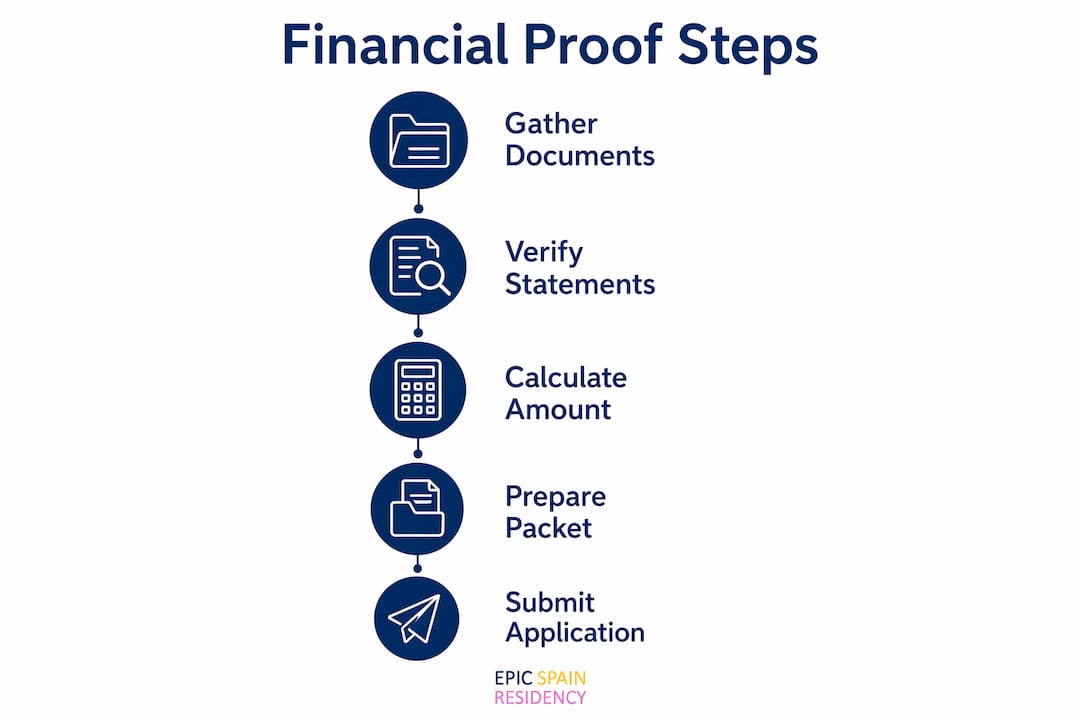
Preparation quality separates approved applications from rejected ones. Follow this sequence when assembling your financial documentation package.
- Gather original or bank-verified statements. Most consulates prefer wet-ink stamped originals but accept digital copies accompanied by a bank-issued verification letter. Never submit unverified digital printouts alone.
- Obtain apostilles for all foreign documents. Every financial document issued outside Spain needs an apostille. In the US, apostilles are issued by the Secretary of State's office in the state where the document was issued. Processing times vary by state, so start this step at least four to six weeks before your appointment.
- Commission sworn translations. Strict rules require sworn translations by translators certified by the Spanish Ministry of Foreign Affairs. Standard certified translations from services like Transperfect or Lionbridge are not sufficient unless the translator holds Ministry authorization.
- Write a summary cover letter. A cover letter listing all income sources and their corresponding documents makes the consular officer's review faster and more favorable. Include the total monthly and annual income, the document type proving each source, and a brief explanation of any irregular entries.
- Review for suspicious patterns. Legal review of financial documents before submission identifies red flags like sudden large deposits or unexplained transfers that commonly cause denials. A sudden lump sum deposited shortly before the application is a known rejection trigger. Gradual, consistent account growth reads as credible financial health.
- Check document validity dates. Bank statements should be no older than three months at the time of your consulate appointment. Tax returns should be the most recent filed year. Income letters should be dated within 90 days of submission.
Pro Tip: Organize your financial packet in the same order as the consulate's checklist. Label each document with a tab or header page. Consular officers process dozens of applications daily. A clearly organized file signals professionalism and reduces the chance of a document being overlooked.
A comparison of weak versus strong financial proof packets illustrates the difference clearly.
| Weak packet | Strong packet |
|---|---|
| 3 months of digital bank printouts, no verification | 12 months of stamped originals with bank verification letter |
| No income source letters | Apostilled pension award letter and investment firm income letter |
| No tax return included | IRS Form 1040 with official seal and sworn translation |
| No cover letter | Summary cover letter listing all sources with totals |
| Lump sum deposit one month before application | Consistent monthly deposits over 12 months |
For a detailed breakdown of the documents that most often cause rejections, Epic-residency's analysis of common visa denial reasons is worth reviewing before you finalize your packet.
Key takeaways
Spain visa financial proof documents must demonstrate consistent, traceable income above the IPREM threshold, supported by apostilled originals and sworn translations from Ministry-authorized translators.
| Point | Details |
|---|---|
| Core documents required | Bank statements (6 to 12 months), income letters, and tax returns form the foundation of every application. |
| IPREM sets the threshold | The Non-Lucrative Visa requires €28,825.44/year for the main applicant, plus €7,206.36 per dependent in 2026. |
| Income source hierarchy | Government pensions and retirement distributions carry more weight than savings balances or investment income. |
| Apostille and sworn translation | All foreign financial documents must be apostilled and translated by a Spanish Ministry-certified translator. |
| Presentation matters | A summary cover letter and logically organized packet improve approval odds beyond just meeting the numbers. |
What I've learned from watching financial documentation make or break Spain visa applications
The most common misconception I see is that financial proof is purely a numbers exercise. Applicants focus entirely on hitting the IPREM threshold and miss the bigger picture. Consulates are not just checking a balance. They are reading a story about your financial life and deciding whether it is credible.
A client once presented a spotless application on paper: the right income level, the right documents, the right translations. But their bank account showed a €40,000 transfer from a family member two weeks before the appointment. The consulate asked for a full explanation and additional documentation. The application was delayed by three months. The numbers were fine. The story was not.
The applicants who sail through are the ones whose documents tell a coherent, consistent narrative. Their income sources are obvious, their deposits are regular, and their paperwork is organized as if they expected every question before it was asked. That level of preparation does not happen by accident. It comes from understanding what consular officers are actually looking for, not just what the checklist says.
Small errors in translation or a missing apostille are not minor inconveniences. They are automatic grounds for rejection at most consulates. I have seen applications with six months of preparation fall apart because one income letter was translated by a non-certified translator. The fix was simple. The delay was not.
If you are serious about your Spain visa application, treat the financial documentation as the most important part of the file, not an afterthought. Get a legal review before submission. The cost of that review is a fraction of the cost of a rejection and a reapplication cycle.
— Living
How Epic-residency helps you get your financial documentation right

Epic-residency specializes in exactly the kind of detailed, consulate-ready financial documentation preparation that turns applications from uncertain to approved. The team reviews your income sources, identifies gaps or red flags before submission, coordinates apostille processing, and connects you with Spanish Ministry-certified sworn translators. For applicants pursuing the Non-Lucrative Visa, Epic-residency provides a full document review against current IPREM thresholds and consulate-specific requirements. If the Digital Nomad Visa is your path, the team verifies that your remote income documentation meets the specific evidentiary standards Spanish consulates apply to self-employed and contractor income. Every application is handled by specialists who know Spain's immigration system from the inside.
FAQ
What documents prove financial means for a Spain visa?
The primary documents are 6 to 12 months of bank statements, income verification letters from pension authorities or employers, and your most recent tax return. All foreign documents must be apostilled and translated by a Ministry-certified sworn translator.
How much money do you need for a Spain Non-Lucrative Visa?
The Non-Lucrative Visa requires €28,825.44 per year for the main applicant in 2026, calculated at 400% of the monthly IPREM of €600.53. Each dependent adds €7,206.36 annually.
Are US bank statements accepted for a Spain visa application?
Yes, US bank statements are accepted when they carry a wet-ink bank stamp or are accompanied by a bank-issued verification letter. They must also be apostilled and translated by a Spanish Ministry-certified translator before submission.
Can cryptocurrency be used as proof of funds for a Spain visa?
Cryptocurrency gains are generally not accepted as reliable financial evidence by Spanish consulates. Stable, recurring income sources such as pensions, dividends, or salaries are required to meet financial sufficiency standards.
What happens if my financial documents are not properly translated?
Documents translated by non-certified translators are rejected outright. Sworn translations by Ministry-authorized translators are mandatory for all financial documents issued outside Spain. This rule applies without exception across all Spanish consulates.