

Planning a move to Spain requires more than booking flights and finding an apartment. The spain visa processing timeline explained in official consulate guides often paints an optimistic picture that doesn't match reality. Published decision windows rarely account for appointment scarcity, document legalization delays, or post-arrival registration steps. If you're seriously considering relocating, understanding the full picture from document preparation through TIE card registration is what separates a smooth move from a costly, stressful one.
Table of Contents
- Key takeaways
- Spain visa processing timeline explained: the full step-by-step
- Processing times by visa type: what to realistically expect
- Seasonal bottlenecks and how to avoid common delays
- Post-visa approval: from collection to TIE card
- My honest take on Spain's visa timeline
- How Epic-residency helps you manage your Spain visa timeline
- FAQ
Key takeaways
| Point | Details |
|---|---|
| Total timeline is longer than advertised | Realistic timelines for long-term visas run 6 to 10 months from preparation to TIE card receipt. |
| Appointments are the real bottleneck | Consulate appointment waits, not processing decisions, drive most of the delay in the Spain visa timeline. |
| Document errors cause costly restarts | Expired apostilles, incorrect health insurance, and missing translations can reset your entire application clock. |
| Post-arrival steps add months | TIE card appointments in Madrid and Barcelona typically take 2 to 3 months after you arrive. |
| Early preparation is your best tool | Starting document collection and appointment booking 6 to 9 months before your target move date gives you the most control. |
Spain visa processing timeline explained: the full step-by-step
Most people focus on the consulate's decision window and assume that's the timeline. It isn't. The Spain visa processing timeline has five distinct phases, and each one adds real time to your calendar.
Phase 1: Document preparation (2 to 14 weeks)
This is where the clock starts, and where most people underestimate the work. You'll need background checks from every country you've lived in for the past five years, apostilles on official documents, certified translations into Spanish, and proof of financial means. Background checks from the U.S. Federal Bureau of Investigation can take 8 to 12 weeks alone. Apostilles add another week or two depending on your state. Expired apostilles and background checks are one of the most common reasons applicants have to restart the process entirely.

Phase 2: Appointment booking (1 to 6 months)
The Cita Previa, Spain's consulate appointment system, is where timelines fall apart for most applicants. Appointment wait times can stretch up to 6 months at peak summer 2026 demand. You cannot submit your application without one. This means the appointment itself, not the visa decision, often defines when you can actually move.
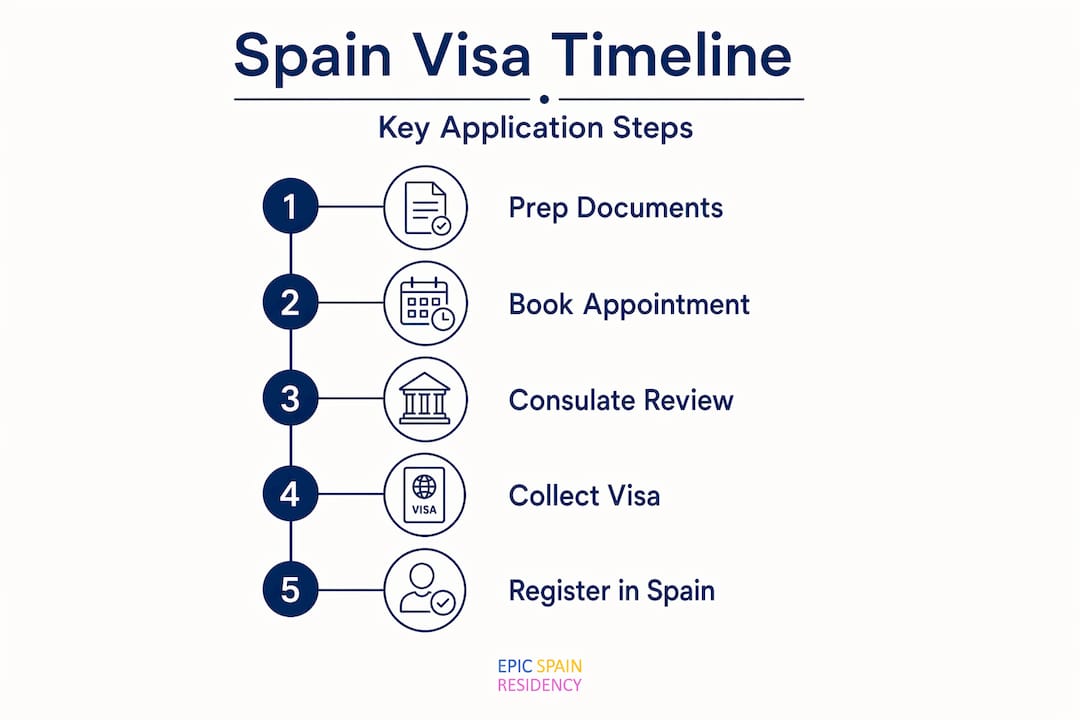
Phase 3: Consulate processing (10 days to 3 months)
Once you submit your documents, the consulate begins its review. Highly qualified worker visas can receive a decision in around 10 days. Student visas typically take about one month. Non-lucrative and digital nomad visas commonly run 4 to 12 weeks depending on consulate workload and document completeness.
Phase 4: Visa collection and travel planning (1 to 2 weeks)
After approval, you return to the consulate to collect your visa. You then have a defined entry window, typically 30 days from visa issuance, to enter Spain. Missing this window means starting over.
Phase 5: Post-arrival registration (1 to 3 months)
Within 30 days of arrival, you must register on the Padrón Municipal (empadronamiento) at your local town hall. You then apply for your TIE (Tarjeta de Identidad de Extranjero) residency card. TIE appointments in major cities like Madrid and Barcelona regularly take 2 to 3 months, extending the total timeline well past what most people planned for.
Pro Tip: Start collecting documents the moment you decide to move to Spain. Don't wait until you have a target date. Background checks and apostilles take the longest, and they expire, so time them to be valid when you finally submit.
Processing times by visa type: what to realistically expect
Not all Spain visas move at the same speed. Here's how the major categories compare, with both legal maximums and real-world experience factored in.
| Visa type | Legal decision window | Real-world processing | Key bottleneck |
|---|---|---|---|
| Schengen short-stay | 15 days (up to 45) | 15 to 45 days | Appointment availability |
| Student visa | ~1 month | 4 to 6 weeks | Document submission window |
| Non-Lucrative Visa (NLV) | 1 to 3 months | 6 to 12 weeks | Document completeness |
| Digital Nomad Visa (DNV) | 20 business days | 6 to 14 weeks | High demand, document errors |
| Highly Qualified Worker | 10 business days | 2 to 4 weeks | Employer documentation |
| Family Reunification | 3 months | 3 to 5 months | Sponsor documentation |
A few things stand out from this comparison. First, short-stay Schengen visa decisions technically happen within 15 to 45 days, but the appointment wait is not included in that figure. Second, the Digital Nomad Visa demand tripled in 2026, creating processing bottlenecks that push real timelines well beyond the legal window. Third, student visas have a strict submission window: you must apply no earlier than 2 months before your course start date, but also with enough lead time to actually receive the visa.
Several factors consistently affect how long your specific application takes:
- Consulate location: Some consulates process significantly faster than others. New York and Miami tend to move quicker than Los Angeles in peak season.
- Document completeness: A single missing or incorrect document triggers an additional information request, which pauses the processing clock entirely.
- Health insurance compliance: Zero-deductible coverage is mandatory. Policies with co-pays or deductibles are rejected outright, forcing you to resubmit.
- Peak season: Summer applications and those tied to the academic calendar face the longest waits. Processing times run 6 to 8 weeks in peak season versus 3 to 5 weeks in shoulder months.
If you're researching the Non-Lucrative Visa specifically, expect the full process from document preparation to visa in hand to take 3 to 6 months at minimum, before you even factor in post-arrival steps.
Seasonal bottlenecks and how to avoid common delays
The Cita Previa system is the single most misunderstood part of the Spain visa process. Most applicants assume they can book an appointment when they're ready. The reality is that appointment slots at busy consulates disappear within minutes of becoming available, and appointment scarcity drives most real-world delays rather than the consulate's actual review time.
Here's what that looks like in practice. An applicant in New York who decides to move to Spain in September and starts the process in June will likely find no available appointments until October or November. By that point, some documents gathered in June may have already expired.
Practical strategies that actually help:
- Check the consulate appointment portal daily, ideally at the same time each morning when cancellations tend to reappear.
- Use a secondary email address to set up a second account as a backup slot tracker where the system allows it.
- Consider whether your consulate jurisdiction allows you to apply at a different location. Some applicants have flexibility based on residence, not just nationality.
- If you're eligible for in-country filing, this route can cut processing to around 20 business days, but it requires arriving with a perfect, complete document package already in hand.
Incomplete documentation is the other major delay trigger. When a consulate sends an additional information request, the processing clock stops. You then have a defined window to respond, and the clock restarts only after you do. This can add weeks or months to your timeline. The role of the consulado in reviewing documents is non-negotiable, so precision matters more than speed at the submission stage.
Pro Tip: Experts recommend adding a 6-week buffer beyond published Schengen processing times. For long-term visas, build in 3 to 4 months of buffer beyond your target move date to account for appointment waits and document requests.
Post-visa approval: from collection to TIE card
Getting your visa approved is not the finish line. What happens after approval is where many people's timelines quietly fall apart, and where planning for post-arrival TIE procedures is often overlooked entirely.
Here's the sequence you need to plan for:
- Collect your visa at the consulate. You typically have a few days to a week to pick it up after notification. Your entry window, usually 30 days from issuance, starts from the visa issue date, not collection.
- Enter Spain within your visa validity window. Missing this window invalidates the visa. You cannot extend it from outside Spain.
- Register on the Padrón Municipal within 30 days of arrival. This is your local town hall registration and is required before you can apply for your TIE card. Bring your passport, visa, and proof of address.
- Apply for your TIE card at the Oficina de Extranjería. This is your formal residency card. You must submit Form EX-17 along with supporting documents, photos, and payment of the Tasa 790 fee.
- Attend your TIE appointment and wait for the card. In Madrid and Barcelona, TIE appointment waits run 2 to 3 months. Smaller cities like Valencia or Seville tend to move faster. Until your TIE is issued, your visa stamp in your passport serves as proof of legal status.
One concept worth knowing: silencio administrativo is the Spanish legal principle that if the administration does not respond within the legal decision window, the application is considered approved by default. In practice, consulates rarely let this happen, but it's useful to know your rights if a decision is significantly overdue.
My honest take on Spain's visa timeline
I've worked with hundreds of people planning moves to Spain, and the pattern I see most often is this: people research the official processing times, feel reassured, and then start the process too late. The official numbers are technically accurate. They just don't tell the whole story.
The appointment booking problem is the one that catches people off guard most. I've seen applicants with perfectly prepared documents wait four months just to submit them. That's not a processing problem. That's a planning problem, and it's entirely avoidable.
What I've found actually works is treating the appointment booking as the first task, not the last. Start checking for slots before your documents are even finished. A slot that opens up two weeks from now gives you a deadline to work toward. Waiting until everything is "ready" before you look for appointments is how people miss their target move dates by months.
The other thing I'd push back on is the assumption that the in-country route is always faster. It can be, but only if your documents are genuinely complete and compliant before you arrive. I've seen people fly to Spain to file in-country, discover a document error, and then face a much harder situation than they would have from their home country. The common reasons for visa denial are predictable and preventable. The applicants who avoid them are the ones who treat document preparation as seriously as the application itself.
Plan for 6 to 9 months from start to TIE card in hand. If it goes faster, great. If it doesn't, you won't be scrambling.
— Epic-residency
How Epic-residency helps you manage your Spain visa timeline
Understanding the Spain visa processing timeline is one thing. Executing it correctly under real-world conditions is another. Epic-residency works with non-EU individuals and families at every stage of the process, from initial document review through post-arrival registration, to make sure nothing falls through the cracks.

Epic-residency's consultants help you identify exactly which documents you need, flag expiry risks before they become problems, and monitor appointment availability so you're not refreshing the consulate portal every morning. For applicants pursuing the Non-Lucrative Visa or the Digital Nomad Visa, Epic-residency provides dedicated support tailored to each visa's specific documentation and timeline requirements. Partner visa applicants can also get structured guidance through the partner visa process. The earlier you engage, the more options you have. Reach out to Epic-residency before you start collecting documents, not after you've hit your first wall.
FAQ
How long does Spain visa processing actually take?
The total realistic timeline for long-term visas runs 6 to 10 months from document preparation through TIE card receipt. Short-stay Schengen visas typically receive a decision within 15 to 45 days, but appointment wait times are not included in that figure.
What causes the most delays in Spain visa applications?
Consulate appointment scarcity is the primary cause of delays, often adding months before you can even submit your application. Document errors, particularly incorrect health insurance and expired apostilles, are the second most common cause.
Is there a faster route for Spain visa processing?
In-country filing can reduce processing to around 20 business days, but it requires arriving in Spain with a complete and fully compliant document package. For most applicants, the consulate route with early preparation and proactive appointment booking is more reliable.
When should I start the Spain visa process?
Start at least 6 to 9 months before your target move date. Begin document collection and appointment booking simultaneously. Waiting until documents are complete before looking for appointments is one of the most common and costly mistakes applicants make.
Do I need zero-deductible health insurance for a Spain visa?
Yes. Health insurance policies with any co-pay or deductible are rejected. You must have zero-deductible coverage from an approved provider to meet Spain's visa health insurance requirement.