
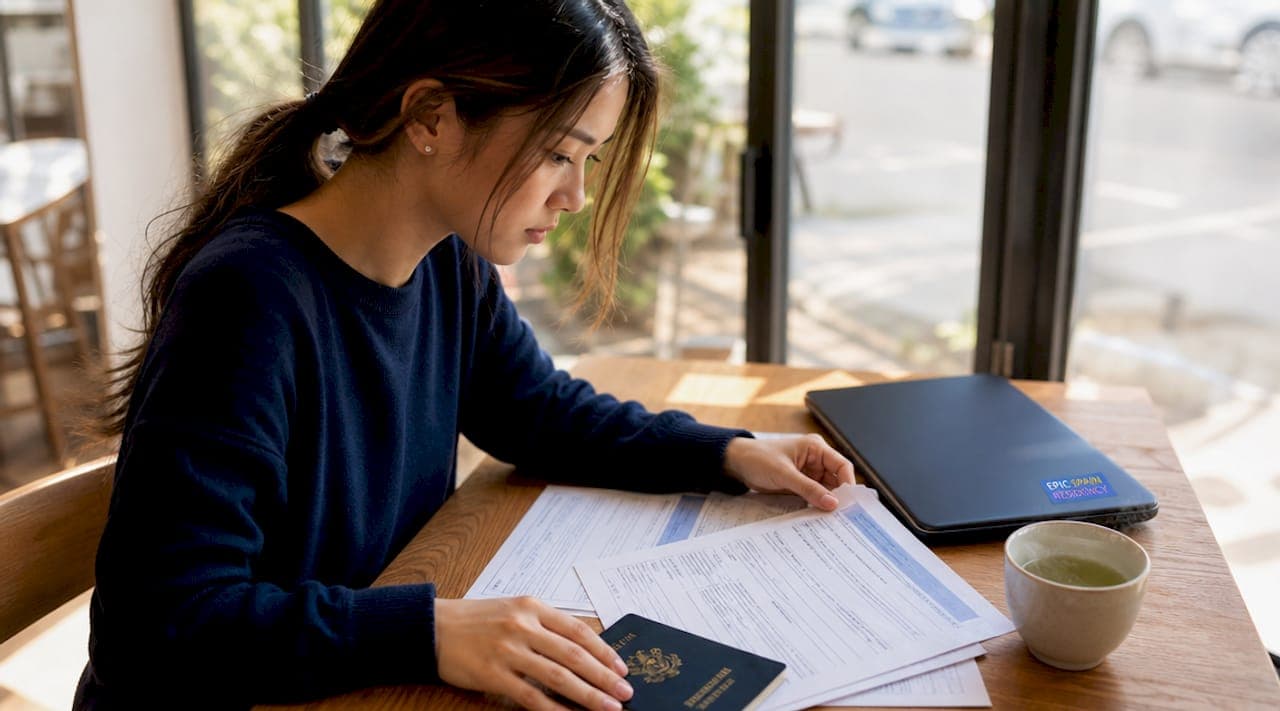
Spain's student visa requirements for Asian applicants define the eligibility, documentation, and procedural steps needed to study legally in Spain for longer than 90 days. The official visa category is the Visado de estudios, and every non-EU student planning a program beyond three months must hold one before entering the country. Spanish consulates, BLS International service centers, and Spain's Oficina de Extranjería each play a distinct role in the process. Getting this right from the start saves weeks of delays and protects your legal status from day one.
1. Spain student visa requirements for Asian students: who must apply
The student visa requirement applies to any non-EU national studying in Spain for more than 90 days. Students from countries like India, the Philippines, Vietnam, or Indonesia have no visa-free pathway for long-term study. South Korean and Japanese nationals can enter Spain without a short-stay visa for under 90 days, but they still need the full Visado de estudios for any program that runs longer.
Your program must be at an institution recognized by the Spanish government, and it must carry a minimum study load of 20 hours per week. Language schools, universities, and vocational training centers all qualify, provided they issue an official acceptance letter. The consulate with jurisdiction over your region handles your application, so a student in Mumbai applies through a different consulate than one in Seoul.

Pro Tip: Check your consulate's jurisdiction before booking any appointment. Some Asian countries have multiple Spanish consulates, and applying at the wrong one will get your application rejected outright.
2. Eligibility criteria you must meet before applying
Spain's visa policy focuses on ensuring students have financial stability, health coverage, and legal compliance. Meeting these three pillars is the foundation of a successful application.
- Enrollment confirmation: You must hold an unconditional acceptance letter from a Spanish educational institution before applying. Conditional offers are not accepted.
- Study load: Your program must require at least 20 hours of attendance per week. Part-time or online-only programs typically do not qualify.
- Age and legal capacity: Minors require additional parental consent documentation and a designated legal guardian in Spain.
- No criminal record: You must demonstrate a clean criminal history in every country where you have lived for the past five years.
- Medical fitness: A medical certificate confirming you carry no contagious diseases is required at most Spanish consulates serving Asian applicants.
Understanding Spain's visa categories helps you confirm you are applying for the correct type before gathering documents.
3. Documents needed for your Spain student visa application
The documentation list for Asian applicants is specific, and missing even one item causes rejection. Here is what every applicant must submit:
- Completed Modelo EX-00 form: The official national visa application form, signed and dated.
- Valid passport: Must be valid for at least one year beyond your intended stay and contain at least two blank pages.
- Official acceptance letter: Must state the institution's name, program title, start and end dates, and weekly study hours.
- Proof of financial means: You must show €600 per month for the duration of your stay, equivalent to 100% of Spain's IPREM. Bank statements, scholarship letters, or notarized sponsor letters all qualify. This threshold means a one-year program requires documented access to at least €7,200.
- Compliant health insurance: Coverage must reach a minimum of €30,000, carry no deductibles or co-payments, and cover your entire stay in Spain. Travel insurance does not meet this standard. Read more about insurance compliance before purchasing a policy.
- Criminal record certificate: Must be apostilled under the Hague Convention and translated into Spanish by a certified translator.
- Medical certificate: Issued by a licensed physician and confirming freedom from contagious diseases.
- Passport-sized photographs: Typically two recent photos meeting biometric standards.
- Proof of accommodation: A rental contract, university housing confirmation, or a host family letter.
Pro Tip: Apostilling documents in countries like India, China, or the Philippines can take two to four weeks. Start this process the moment you receive your acceptance letter, not after you book your consular appointment.
| Document | Common pitfall |
|---|---|
| Health insurance | Travel insurance submitted instead of a compliant health policy |
| Criminal record | Missing apostille or untranslated certificate |
| Financial proof | Bank statements showing insufficient balance or unexplained large deposits |
| Acceptance letter | Letter missing weekly hours or exact program dates |
Common visa denial reasons in 2026 still center on non-compliant insurance and missing apostilles, both of which are entirely preventable.
4. How and when to apply for your Spain student visa
Timing is the single most controllable factor in a successful application. Submit your application at least two months before your program start date. Processing typically takes four to eight weeks, and can stretch to ten weeks during peak season. No expedited service exists, so late applicants simply miss their program start.
Here is the step-by-step process:
- Book your consular appointment early. Spanish consulates and BLS International centers in countries like India, China, and South Korea often have appointment slots that fill up weeks in advance. Book as soon as you have your acceptance letter.
- Pay the visa fee. The fee is non-refundable regardless of outcome. Confirm the current amount with your specific consulate, as it varies slightly by location.
- Submit your complete file in person. Most consulates require personal attendance for biometric data collection. Incomplete files are rejected on the spot.
- Track your application. Some consulates provide a reference number for status checks. Follow up if you have not received a decision within eight weeks.
- Collect your visa and verify the details. Check the visa type, validity dates, and number of entries before leaving the consulate. Errors must be corrected before you travel.
The Spain visa processing timeline varies by consulate location across Asia, so build in extra buffer time if you are applying from a country with a single Spanish consular post.
5. Post-arrival requirements every Asian student must complete
Arriving in Spain with your visa is not the final step. Within 30 days of entering the country, you must apply for the TIE (Tarjeta de Identidad de Extranjero) at your local Oficina de Extranjería or National Police station. The TIE is your physical residence card and replaces the visa sticker as your primary proof of legal status.
Failing to apply for the TIE within this 30-day window creates administrative complications that can affect your ability to open a bank account, sign a lease, or access university services. The NIE (Número de Identidad de Extranjero) is your tax identification number and is printed on the TIE. You will need it for virtually every legal transaction in Spain.
Key facts about your rights and obligations as a student visa holder:
- Work rights: Student visa holders can work up to 20 hours per week, but only after obtaining separate work authorization from the Oficina de Extranjería. Working without this authorization violates your visa conditions.
- Schengen travel: With your TIE card, you can travel freely within the Schengen Area for up to 90 days in any 180-day period.
- Visa renewal: If your program extends beyond your initial visa period, you must apply for renewal before the current authorization expires.
- Address registration: Register at your local town hall (empadronamiento) within the first few weeks. This registration is required for many public services and supports your TIE application.
Pro Tip: Book your TIE appointment online before you even board your flight to Spain. Appointment slots at busy Oficina de Extranjería offices in cities like Madrid and Barcelona fill up fast, and the 30-day clock starts the moment you land.
Key takeaways
Securing a Spain student visa as an Asian applicant requires meeting financial, medical, and documentation standards well before your program begins.
| Point | Details |
|---|---|
| Visa is mandatory over 90 days | All non-EU Asian students studying longer than 90 days must hold a Visado de estudios before arrival. |
| Health insurance must be specific | Only policies with €30,000 coverage and no deductibles qualify; travel insurance is rejected. |
| Financial proof threshold | Bank statements or sponsor letters must show at least €600 per month for the full study period. |
| Apply at least two months early | Processing takes four to ten weeks with no expedited option, so late submissions miss program starts. |
| TIE application is time-sensitive | Students must apply for the TIE residence card within 30 days of arriving in Spain. |
What I have learned from helping Asian students navigate Spain's visa process
The most consistent mistake I see from Asian applicants is treating the Spain student visa as a straightforward paperwork exercise. It is not. It is a compliance exercise, and the Spanish consular system has very little tolerance for documents that are technically present but substantively wrong.
The health insurance issue is the clearest example. Applicants from India, China, and Southeast Asia regularly submit travel insurance policies because they look similar to health insurance on the surface. Spanish consulates reject these immediately. The policy must explicitly state no deductibles, no co-payments, and a minimum of €30,000 in coverage. Any ambiguity in the policy wording is treated as non-compliance.
The apostille requirement also catches many applicants off guard, particularly those from countries where document authentication is slow or bureaucratically complex. In the Philippines, for instance, the Department of Foreign Affairs handles apostilles, and the queue can stretch for weeks during busy periods. Students who start this process late end up scrambling, and rushed documents often contain errors that trigger rejection.
My honest advice: treat your program acceptance letter as the starting gun, not the finish line. The moment you receive it, begin your apostille process, book your consular appointment, and purchase compliant health insurance. Students who do these three things in the first week after acceptance almost never miss their start date.
The post-arrival TIE step also deserves more attention than most guides give it. I have seen students arrive in Spain, settle into their accommodation, and delay the TIE application because they feel legally covered by their visa sticker. They are not. The 30-day window is firm, and missing it creates a paper trail that complicates every subsequent interaction with Spanish immigration authorities.
— Epic-residency
How Epic-residency helps Asian students get their Spain student visa right
Epic-residency works directly with Asian students at every stage of the Spain student visa application process. The team reviews your full documentation file before submission, identifies non-compliant health insurance policies, and confirms your financial proof meets the IPREM standard your specific consulate requires. For post-arrival support, Epic-residency guides you through the TIE application process so you meet the 30-day deadline without stress. Whether you are applying from Singapore, India, South Korea, or anywhere else in Asia, the team's education services cover everything from initial eligibility checks to residence card registration. You can also explore the full range of Spain visa options to confirm the student visa is the right pathway for your situation.
FAQ
Who needs a Spain student visa from Asia?
Any non-EU Asian national studying in Spain for more than 90 days must hold a Visado de estudios. Nationals from visa-exempt countries like South Korea still need this visa for programs longer than 90 days.
What health insurance is required for a Spain student visa?
The policy must provide a minimum of €30,000 in coverage with no deductibles or co-payments and must cover the entire duration of your stay. Travel insurance does not qualify.
How long does Spain student visa processing take?
Processing takes between four and eight weeks under normal conditions and can extend to ten weeks during peak application seasons. No priority or expedited processing is available.
What is the TIE and when must I apply for it?
The TIE (Tarjeta de Identidad de Extranjero) is your Spanish residence card. You must apply for it within 30 days of arriving in Spain at your local Oficina de Extranjería or National Police station.
Can Asian students work while studying in Spain?
Student visa holders may work up to 20 hours per week, but only after receiving separate work authorization from the Oficina de Extranjería. Working without this authorization violates visa conditions.