
If you're a Singaporean student planning to study in Spain, the spain student visa singapore explained process is less straightforward than it first appears. Your Singapore passport gets you far, but not far enough for a full degree program. The visa-free access that feels like a green light is actually a 90-day ceiling, and anything beyond that requires a national student visa with documents, appointments, and strict timelines. This guide breaks down exactly what you need, what changed in 2025, and how to position yourself for approval.
Table of Contents
- Key takeaways
- Spain student visa Singapore explained: when you actually need one
- How to apply for Spain student visa from Singapore
- Financial and legal requirements you need to meet
- What happens after you arrive in Spain
- What I've learned helping students navigate this from Singapore
- How Epic-residency helps Singapore students move to Spain
- FAQ
Key takeaways
| Point | Details |
|---|---|
| Visa-free has a hard limit | Singapore passport holders can visit Spain without a visa, but only for 90 days within any 180-day period. |
| Type D student visa is required | Any study program longer than 90 days requires a formal national student visa applied for in Singapore. |
| Apply 3 to 4 months early | Processing takes 4 to 8 weeks at minimum, and consulate appointment slots fill up fast during peak months. |
| No visa conversion inside Spain | Since May 2025, you cannot arrive on a tourist visa and switch to a student visa while in Spain. |
| Financial proof is mandatory | You must show a minimum of €600 per month for the full duration of your intended stay. |
Spain student visa Singapore explained: when you actually need one
Many Singaporean students get tripped up by the same assumption. They know Singapore passport holders can enter Spain visa-free for 90 days within any 180-day period and assume they can figure out the formalities once they arrive. That works for a short language course or a summer program. It does not work for a semester abroad, a full degree, or any structured study lasting longer than three months.
Spain uses a two-tier visa system. The Schengen short-stay visa covers visits up to 90 days across all Schengen countries combined, not just Spain. Once your program crosses that threshold, you move into national long-stay visa territory. For students, that means the Type D student visa, which is specific to Spain and grants you the legal right to study and reside there for the duration of your program.
The Schengen rules also matter in a less obvious way. Even if your academic year is only nine months, those 90 visa-free days do not stack or carry forward. If you arrive in Spain on a tourist basis and stay past 90 days without a proper student visa, you are out of status regardless of your enrollment status.
Here is what determines whether you need the student visa:
- Your program lasts longer than 90 days
- You are enrolled in a Spanish university, language school, or accredited institution
- You plan to work part-time during your studies
- You want access to healthcare, a bank account, or long-term housing contracts
Pro Tip: Spain offers over 1,800 English-taught programs, so language barrier is rarely the real obstacle. The paperwork is.
How to apply for Spain student visa from Singapore
The application process runs through the Spanish Consulate General in Singapore. There is no online submission portal and no third-party visa center for Spain student visas. You book your appointment, show up in person, and present your documents in a specific format.
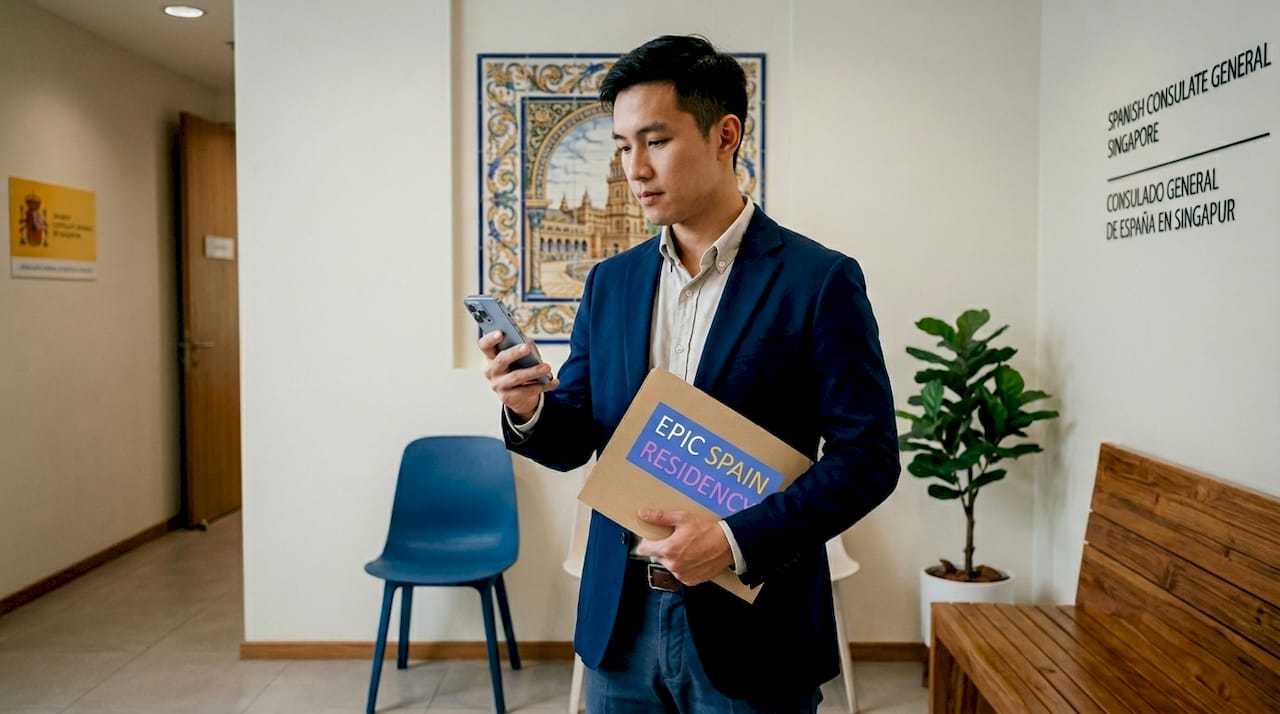
Since May 2025, a critical rule applies: no visa conversion is allowed after you enter Spain. If you arrive in Spain on your visa-free 90 days and think you can sort out your student visa locally, you cannot. The application must be submitted from Singapore, before you travel.
Here is the step-by-step process:
- Secure your acceptance letter. You need a formal letter from a recognized Spanish educational institution confirming your enrollment, program dates, and full-time or part-time study status.
- Gather your supporting documents. This includes proof of financial means, health insurance, a criminal background certificate, a medical certificate, and your passport. All foreign documents must be apostilled and translated into Spanish.
- Complete the national visa application form. Spain requires a typed, not handwritten, application form. Download the official form, fill it in digitally, and print it for submission.
- Book your consulate appointment. Slots at the Spanish Consulate in Singapore are limited. Do not wait until your documents are ready to start looking for an appointment. Book as early as possible, then finalize your paperwork in parallel.
- Attend your appointment and submit documents. Bring all originals and photocopies. The consular officer may ask questions about your program, funding, and plans after graduation.
- Wait for processing. Standard processing takes 4 to 8 weeks but can extend to three months during peak periods like June and August.
- Collect your visa and travel. Your visa will be issued as a sticker in your passport, valid for one year and renewable from within Spain.
Pro Tip: Apply to the consulate 3 to 4 months before your intended departure date. Delays are common and the consequences of a late arrival (missed orientation, housing problems, deferred enrollment) are completely avoidable with early planning.
Financial and legal requirements you need to meet
Spain does not issue student visas on good faith. You need documented proof that you can support yourself financially for the entire duration of your studies without relying on public funds. The minimum is €600 per month, which is benchmarked against Spain's IPREM index. For a 10-month academic year, that means demonstrating access to at least €6,000.
Here is what counts as acceptable financial proof, and what else you need to prepare:
- Bank statements showing consistent funds. Three to six months of statements are typical. The balance should comfortably exceed the minimum, not just scrape past it.
- Scholarship letters from recognized institutions or government bodies. A Singaporean government scholarship for overseas study, for example, will carry weight.
- Sponsorship documents if a parent or guarantor is funding your studies. Include their bank statements, a signed sponsorship letter, and proof of relationship.
- Pre-paid accommodation. If you have already paid for a student residence or apartment, this reduces the financial threshold because your housing costs are demonstrably covered.
- Criminal background certificate. For Singapore-based applicants, this is obtained from the Singapore Police Force. It must be apostilled by the relevant Singapore authority and then translated into Spanish by a certified translator.
- Medical certificate confirming you have no communicable diseases. Your GP can issue this, but confirm it meets the Spanish consulate's specific format requirements before submission.
The health insurance requirement deserves its own attention. You need a policy that covers full medical risks including hospitalization, with no co-payment clauses and coverage for your entire stay. Travel insurance is not sufficient. Annual cost typically runs between €450 and €750 depending on the provider and your age.
| Document | Requirement | Notes |
|---|---|---|
| Passport | Valid at least 1 year beyond stay | Must have blank pages for visa sticker |
| Financial proof | €600/month minimum | Bank statements, scholarship, or sponsorship |
| Health insurance | Full medical coverage | No travel insurance substitutes |
| Criminal certificate | Apostilled and translated | Issued by Singapore Police Force |
| Acceptance letter | From accredited Spanish institution | Must show program dates and enrollment status |
| Medical certificate | No communicable diseases | Confirm consulate format requirements |
What happens after you arrive in Spain
Getting your visa approved is step one. What you do in the first 30 days after landing matters just as much for your legal standing and day-to-day life.
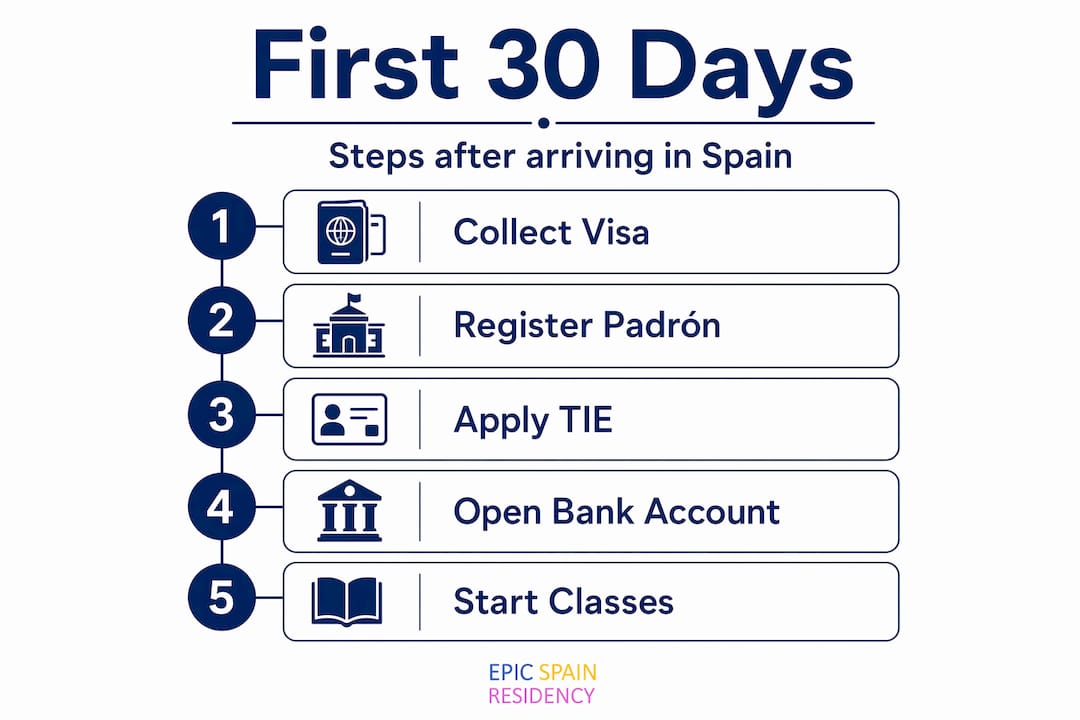
Your most time-sensitive task is registering for your TIE (Tarjeta de Identidad de Extranjero), the Foreigner Identity Card. Under current rules, TIE applications must be submitted within 30 days of arrival for non-EU nationals. This card is your primary identification in Spain and the document you need to open a bank account, sign a lease, and access healthcare through the public system.
Beyond the TIE, here are the other key steps:
- Padrón registration. Register at your local town hall (Ayuntamiento) as soon as you have a fixed address. This links you to local services including healthcare and is required for certain administrative processes.
- Work rights. From 2026, student visa holders can work up to 30 hours per week alongside their studies. Work authorization is now automatically included with the visa, so you do not need a separate permit.
- Healthcare access. Once registered with Padrón and holding your TIE, you can register with a local health center for public healthcare coverage.
- Annual renewal. Your initial visa is typically issued for one year. Renewals are handled inside Spain and require updated enrollment proof, financial documentation, and your insurance renewal.
Pro Tip: Padrón registration is often overlooked by students who focus entirely on the TIE. Do both simultaneously if you can. Skipping Padrón delays everything downstream, from healthcare registration to certain banking requirements.
If you are thinking long-term, a student visa is also the beginning of a residency pathway. Years spent in Spain on a student visa count toward certain long-term residency thresholds, and after several years of continuous legal residence you may qualify for permanent residency or eventually Spanish citizenship.
What I've learned helping students navigate this from Singapore
In my experience working with non-EU applicants, the students who struggle most with the Spain student visa process are not the ones with complicated financial situations. They are the ones who underestimate how document-heavy and procedurally specific Spanish consulate requirements are.
The apostille step catches people off-guard more than anything else. Singapore's Police Certificate system is efficient, but getting the document apostilled and professionally translated into Spanish takes time. I have seen students delay their entire application timeline by two to three weeks because they assumed this was a same-day task.
The financial proof is another consistent weak point. Submitting a savings account that shows one lump sum transferred a week before the appointment raises flags. Spanish consular officers want to see stable, consistent balances over several months. If you are relying on a parental sponsor, the sponsorship package needs to be airtight: notarized letter, recent bank statements, proof of relationship, and clear indication that funds are available for the full program duration.
What I find most encouraging about the 2026 picture is the expansion of student work rights. Being able to work up to 30 hours per week changes the financial math for many students significantly. Combine that with the depth of English-taught degree programs available in Spain, and this is genuinely one of the more accessible European study destinations for Singaporeans who plan well.
My honest advice: start earlier than you think you need to, get professional eyes on your financial documents before submission, and do not assume that arriving in Spain first will simplify anything. Since May 2025, it only complicates it.
— Epic-residency
How Epic-residency helps Singapore students move to Spain
Getting the paperwork right the first time saves months of back-and-forth with the consulate. Epic-residency specializes in helping non-EU students and families through Spain's immigration process from start to approval.
Whether you need help structuring your financial proof, preparing a clean document package, or understanding your options for education in Spain, Epic-residency has hands-on experience with exactly the kind of application Singaporean students submit. The team also covers rental support in Spain for students who need help securing housing before arrival, which directly helps meet the consulate's financial threshold. If your situation involves a partner or long-term plans beyond your studies, Epic-residency can map out what comes next. Reach out for a consultation tailored to your timeline and circumstances.
FAQ
Do Singapore passport holders need a visa to study in Spain?
Yes, for any program longer than 90 days. Singapore passport holders can enter Spain visa-free for short stays, but a national Type D student visa is required for degree programs and any study exceeding that threshold.
How long does the Spain student visa application take from Singapore?
Processing typically takes 4 to 8 weeks, but can stretch to three months during peak periods. Experts recommend applying to the Spanish Consulate in Singapore at least 3 to 4 months before your intended start date.
Can I convert a tourist visa to a student visa once I am in Spain?
No. Since May 2025, visa conversion inside Spain is no longer permitted. Your student visa application must be submitted from Singapore through the Spanish Consulate before you travel.
What is the minimum financial requirement for the Spain student visa?
You must demonstrate at least €600 per month for the duration of your studies, which equates to €7,200 for a standard academic year. Accepted proof includes bank statements, scholarship letters, or verified sponsorship documents.
Can I work in Spain on a student visa?
Yes. From 2026, student visa holders are authorized to work up to 30 hours per week alongside full-time studies, with work authorization now automatically included in the visa approval.