

Moving to Spain sounds straightforward until you hit the financial documentation wall. For applicants from Asia, spain residency proof funds requirements are one of the most misunderstood parts of the process. Which income types count? How much do you need? What does a consulate in Tokyo, Manila, or Singapore actually want to see? This guide answers all of it, with 2026 figures, document checklists, and specific advice for navigating the process from an Asian country.
Table of Contents
- Key takeaways
- Spain residency proof of funds: visa types for Asia applicants
- What counts as proof of funds for Spain
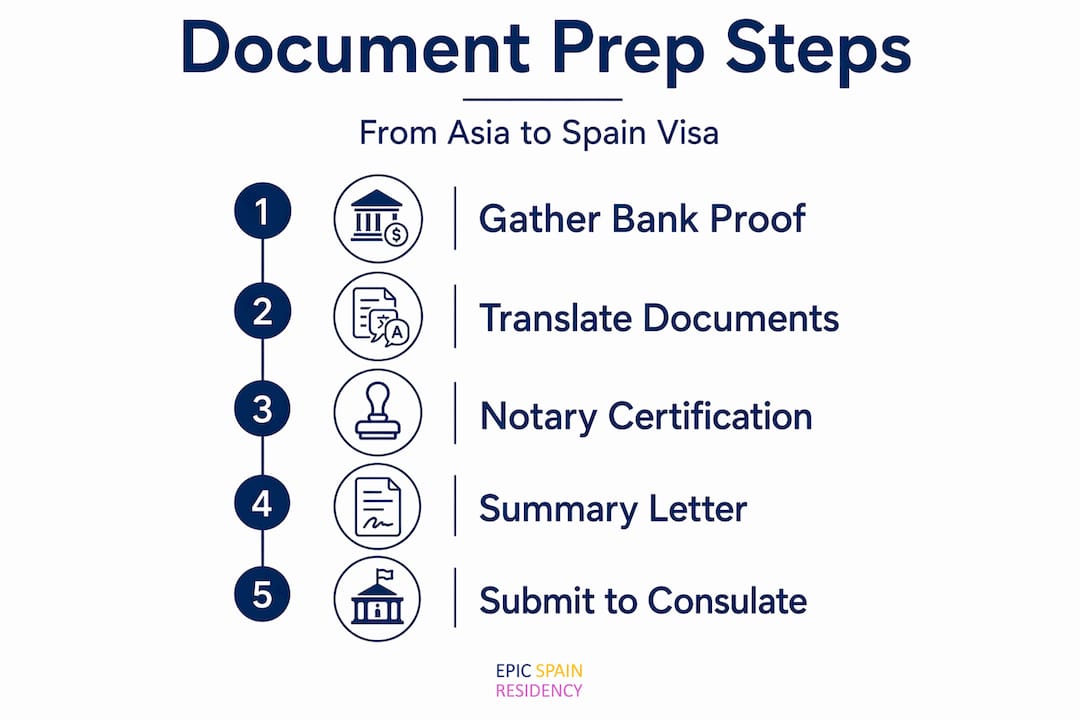
- Step-by-step: preparing your documents from Asia
- Common challenges and how to handle them
- What happens after you submit
- My honest take on this process
- How Epic-residency can help you move to Spain
- FAQ
Key takeaways
| Point | Details |
|---|---|
| Know your minimum threshold | The Non-Lucrative Visa requires €2,400/month for the main applicant, based on 2026 IPREM figures. |
| Regular income beats lump sums | Consulates favor verifiable, recurring income over large one-off deposits sitting in a savings account. |
| Golden Visa is gone | Spain ended its Golden Visa program in April 2025, making passive income proof the primary residency route. |
| Translation is not optional | Documents from Asian financial institutions require certified Spanish translation and, in most cases, an apostille. |
| Prepare for two checkpoints | Your financial proof must satisfy both the consulate at application and border control on arrival in Spain. |
Spain residency proof of funds: visa types for Asia applicants
Not every Spanish residency visa involves the same financial proof. The two most relevant options for Asia expats residency in Spain right now are the Non-Lucrative Visa (NLV) and the Digital Nomad Visa (DNV). Understanding which one fits your situation determines exactly what financial evidence you need to prepare.
Non-Lucrative Visa
The NLV is the go-to route for retirees, people with passive income, and anyone who does not plan to work in Spain. It requires you to prove you have enough income to support yourself without working. The 2026 IPREM is €600/month, and the NLV demands 400% of that figure, which equals €2,400 per month or €28,800 annually for the main applicant. Each dependent you bring adds another €600 per month to the requirement.
Digital Nomad Visa
The DNV suits remote workers and freelancers who earn income from clients or employers outside Spain. The income threshold is generally higher than the NLV, with most consulates looking for at least 200% of the Spanish minimum wage. You prove funds through employment contracts, client agreements, and recent payslips or invoices. The digital nomad visa is increasingly popular among tech professionals and consultants from countries like India, South Korea, and the Philippines.
What happened to the Golden Visa
Worth knowing if you were counting on an investment route: Spain ended its Golden Visa program in April 2025. No new applications are accepted. Legacy holders can still renew, but new applicants from Asia must rely entirely on income or savings proof rather than property or capital investment. This makes the NLV and DNV the dominant pathways, and it raises the stakes for getting your financial documentation right.
| Visa Type | Income Proof Required | Work Allowed in Spain |
|---|---|---|
| Non-Lucrative Visa | €2,400/month (main applicant, 2026) | No |
| Digital Nomad Visa | ~200% Spanish minimum wage | Yes (remote only) |
| Student Visa | 100% IPREM for student | Limited |
What counts as proof of funds for Spain
This is where most applications from Asia run into trouble. Knowing the number is one thing. Knowing what documents actually prove it to a Spanish consulate is another.

Accepted income types include pensions, investment dividends, rental income, savings, trust distributions, and royalties. What consulates want to see is that the money arrives regularly and can be verified. A pension statement from a Japanese or Korean government fund, a brokerage statement showing quarterly dividend payments, or a rental income declaration supported by a lease agreement all work well. A large lump sum that appeared in your account three months ago is far less convincing.
Here is what to prepare for the NLV specifically:
- Bank statements covering 6 to 12 months, showing recurring deposits that match your income sources
- Income certificates from your pension provider, brokerage, or employer
- Property rental agreements and corresponding income records if rental income is part of your case
- Investment account statements showing dividends or interest payments over time
- A cover letter summarizing all income sources, amounts, and linking each to its supporting document
The cover letter is not a formality. A clear summary letter tying deposits to income certificates genuinely improves how a consular officer reads your file. Think of it as a table of contents for your financial life.
Pro Tip: If your income comes from multiple sources, do not just submit a pile of statements. Write a one-page summary that shows the total monthly figure and maps each income stream to its document. Consular officers process hundreds of applications. Make their job easy and your application moves faster.
Savings can supplement income, but they do not replace it. Some consulates accept a higher savings balance as a substitute for monthly income, but this varies by consulate and is not guaranteed. If you are relying on savings, plan for at least 12 months of the required threshold held consistently in your account.
Step-by-step: preparing your documents from Asia
The Spain residency application funds process requires more preparation time for Asian applicants than most guides acknowledge. Translation, notarization, and apostille requirements add weeks to your timeline. Start at least three months before your intended submission date.
- Gather your bank statements. Pull statements from all accounts you plan to reference, covering the past 6 to 12 months. Highlight or annotate recurring deposits so the pattern is obvious at a glance.
- Obtain income verification letters. Contact your pension provider, brokerage, employer, or property manager for an official letter confirming the income amount, frequency, and your name as the recipient. These letters need to be on official letterhead.
- Get documents translated. Any document not in Spanish requires a certified Spanish translation. In most Asian countries, this means using a sworn translator recognized by the Spanish consulate in your jurisdiction. Check your local consulate's website for their specific requirements.
- Apostille where required. Documents issued by government bodies, banks, or official institutions in countries that are party to the Hague Convention need an apostille. Countries like Japan, South Korea, India, and the Philippines are all members. China is not, which means documents from mainland China require a different legalization process through the Chinese Ministry of Foreign Affairs and then the Spanish embassy.
- Write your cover letter. One page. List each income source, the monthly amount, and the document that proves it. Total everything at the bottom to show you meet or exceed the threshold.
- Prepare your accommodation proof. A signed rental agreement or property deed for your intended Spanish address is required alongside your financial documents.
Asian applicants should anticipate additional translation and notarization requirements and build that time into their planning. A document that takes one day to obtain in the UK can take two to three weeks to properly certify from Seoul or Mumbai.
Pro Tip: Ask your bank for a stamped, official balance certificate in addition to standard statements. Some Spanish consulates in Asia specifically request this format, and having it ready avoids a round-trip request that can delay your application by weeks.
Common challenges and how to handle them
The visa checkpoint versus the border checkpoint
These are two separate requirements, and confusing them is one of the most common mistakes applicants make. Your residency visa proof of funds satisfies the consulate at the point of application. But border control officers have their own requirements when you actually arrive in Spain.
For entry, officers generally look for around €113 per day per adult, proof of accommodation, and a return or onward ticket. Since April 2026, enforcement has tightened, with refusals reported at Málaga airport. Carry a printed bank statement showing your current balance, your rental agreement, and your travel itinerary every time you enter Spain, even after your visa is approved.
Preparing documentation that satisfies both the consulate and border control at the same time is the smartest approach. Unifying your documentation for both checkpoints reduces delays and avoids surprises on arrival.
Common documentation mistakes
- Submitting statements that cover less than 3 months, which gives the consulate no pattern to assess
- Missing translations on documents issued in languages other than Spanish or English
- Using informal bank app screenshots without official stamps or headers
- Failing to link income deposits to their source, leaving the consular officer to guess
- Submitting a third-party financial responsibility letter without notarization and supporting bank statements
On that last point: if a family member is sponsoring your stay, their letter must be notarized and accompanied by their own recent bank statements covering the required amounts.
Cryptocurrency income
Cryptocurrency is not accepted by Spanish consulates as proof of stable income for residency applications. If crypto represents a significant portion of your wealth, you need to convert it to fiat currency and hold it in a conventional bank account long enough to show a consistent balance history. Consult a legal expert before applying if this applies to you.
What happens after you submit
Once your financial documentation is accepted and your application is approved, the Spanish consulate issues a visa that allows you to enter Spain and register as a resident. Processing times vary by consulate and season, but most NLV applications take between 4 and 8 weeks from submission to decision. Well-organized documentation reduces the chance of additional evidence requests, which can add another 4 to 6 weeks to the timeline.
After arrival, you register at your local town hall (empadronamiento) and collect your TIE residency card. The initial NLV is valid for one year. Renewal requires proving you still meet the financial thresholds, so keep your income documentation current throughout your stay.
Tax is a real consideration once you become a Spanish resident. After 183 days in Spain in a calendar year, you are treated as a tax resident and must declare worldwide income. If you are receiving pension or investment income from Asia, understanding how Spain's tax treaties with your home country apply is worth discussing with a tax advisor. The tax implications of moving to Spain are often underestimated by first-time applicants.
My honest take on this process
I've worked with dozens of applicants from Hong Kong, Singapore, the Philippines, and India, and the pattern I see most often is the same. People underestimate how much the presentation of their finances matters, not just the numbers themselves.
A client from Hong Kong once had more than enough income. Solid dividends, a pension, and rental income from two properties. But she submitted three separate bundles of statements with no cover letter, no translations on two of the documents, and no clear link between the deposits in her bank account and the income certificates she provided. The consulate sent a request for additional evidence. That cost her six weeks and a lot of stress.
The financial proof process rewards people who think like a consular officer. That officer has your file for maybe 20 minutes. They need to see the number, see where it comes from, and see the proof. If any of those three things is unclear or missing, the file goes into the "needs more information" pile.
Cultural differences in banking also matter more than people expect. Many Asian banks issue statements in formats that Spanish consulates are not familiar with. Formats, languages, and even the way account numbers are displayed can raise questions. Getting a certified translation and an official bank letter in a standard format removes that friction entirely.
Plan ahead. Give yourself more time than you think you need. And if your financial situation is complex, get professional help before you submit, not after.
— Living
How Epic-residency can help you move to Spain
Getting the financial documentation right is the part of the Spain residency application that catches the most people off guard, especially when you are preparing it from Asia. Epic-residency specializes in exactly this. The team helps you understand the Non-Lucrative Visa requirements specific to your income type, prepares your document checklist, reviews your financial proof before submission, and coordinates translation and apostille requirements for your country of origin.
If you are a remote worker, the Digital Nomad Visa service covers income proof, client contracts, and the full application process. For couples and families, the partner visa pathway includes financial requirement support for both applicants. Epic-residency works with clients across Asia and understands the specific consular requirements in Hong Kong, Singapore, the Philippines, India, and beyond. Book a consultation to get a clear picture of what your application needs before you start gathering documents.
FAQ
How much money do I need for Spain residency in 2026?
The Non-Lucrative Visa requires €2,400 per month for the main applicant, based on 400% of the 2026 IPREM of €600. Each dependent adds €600 per month to the requirement.
What documents prove funds for a Spain residency application?
Accepted documents include bank statements covering 6 to 12 months, official income certificates, pension statements, dividend records, and rental income agreements. A cover letter linking all income sources to their supporting documents strengthens the application significantly.
Can I use savings instead of regular income for Spain residency?
Savings can support an application but consulates strongly prefer regular, recurring income. If you rely on savings, maintain a consistent balance covering at least 12 months of the required threshold and be prepared for additional scrutiny.
Does cryptocurrency count as proof of funds for Spain?
Cryptocurrency is not accepted as proof of stable income for Spanish residency applications. Applicants with crypto holdings should convert to fiat and hold funds in a conventional bank account before applying.
Do Asian applicants need to translate their financial documents?
Yes. All documents not in Spanish require certified translation by a sworn translator recognized by the relevant Spanish consulate. Many Asian countries also require an apostille on official documents, and mainland China requires a separate legalization process.