

Getting a Spain visa rejected is more common than most applicants realize, and it almost never happens randomly. Spain visa denial common reasons are clearly defined by EU regulations, and 12 official legal grounds exist under EU Visa Code Article 32 that consulates draw from every time they issue a refusal. The problem is that most applicants walk into the process without knowing which of these grounds they are most likely to trigger. This article breaks down the top reasons Spain refuses visa applications, explains the specific mistakes behind each one, and gives you practical guidance to avoid them.
Table of Contents
- Key takeaways
- Spain visa denial common reasons: documentation errors
- Insufficient financial proof
- Weak ties to your home country
- Unclear travel purpose and weak cover letters
- Non-compliant insurance and procedural mistakes
- What I have learned from watching applications succeed and fail
- How Epic-residency helps you avoid a Spain visa refusal
- FAQ
Key takeaways
| Point | Details |
|---|---|
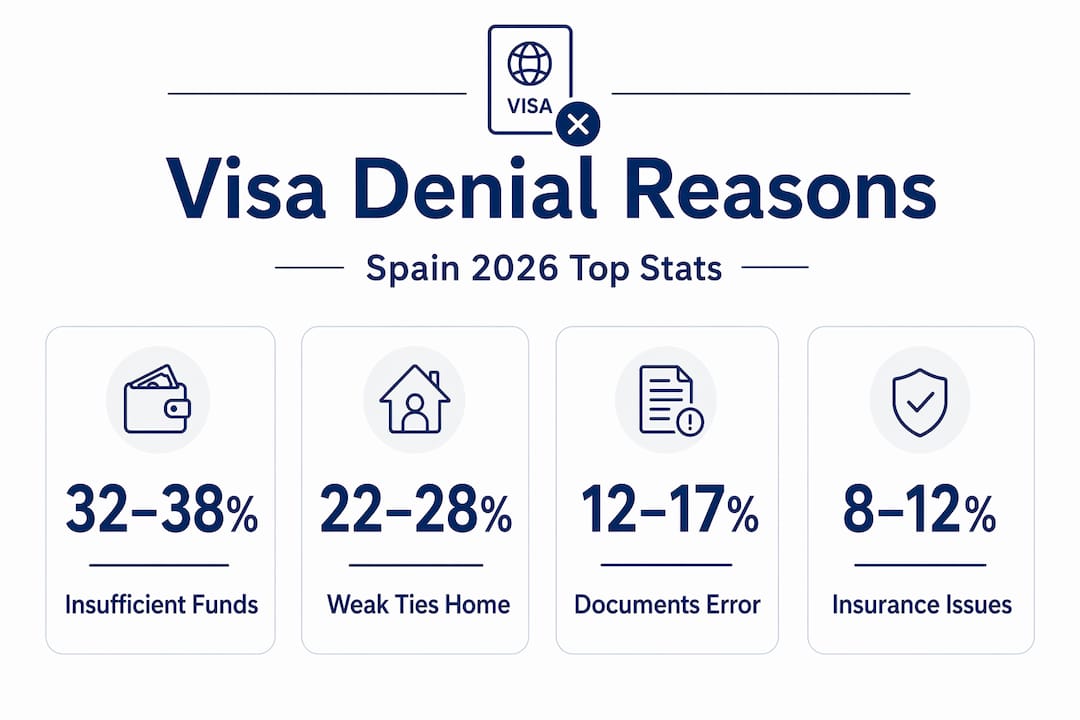
| Financial proof is the top trigger | Insufficient funds cause 32–38% of Spain visa denials, so six months of clean, consistent bank statements matter more than a last-minute deposit. |
| Documentation must be airtight | Mismatched dates, missing translations, or unsigned forms lead to outright refusal since consulates do not request corrections. |
| Home country ties are scrutinized | Stable employment, property ownership, or dependent family members are the strongest evidence of intent to return. |
| Insurance details are non-negotiable | Travel medical insurance must carry zero deductible and at least €30,000 coverage valid across all Schengen countries. |
| Cover letters must be specific | Generic or templated cover letters fail the genuine intent test and trigger refusals under Article 21(1). |
Spain visa denial common reasons: documentation errors
Documentation problems account for 18–25% of visa rejections, making them the second most common cause of Spain visa refusals. What makes this particularly frustrating is that many of these errors are completely avoidable. Consulates run strict internal checklists, and missing or inconsistent documents generally result in an outright refusal rather than a request to provide the missing item.
Here is where applicants most often go wrong:
- Missing or unsigned forms. A single unsigned page on your application form is enough to trigger a refusal. Consulates will not call you to fix it.
- Untranslated documents. Any document not in Spanish or English must be accompanied by a certified translation. Submitting a bank statement or employment letter in another language without translation is a common Spain visa application pitfall.
- Mismatched data across documents. If your flight booking shows you arriving on June 10 but your hotel reservation starts June 12, that inconsistency raises a red flag. Consulates strictly cross-check employment dates, addresses, and financial records across every document in your file.
- Unofficial document formats. Bank letters must be on official letterhead with a stamp and signature. Printed online statements are often rejected unless they are accompanied by a bank-certified cover letter.
- Undisclosed immigration history. Past overstays or visa refusals are tracked through the Schengen Information System. Failing to disclose them makes the outcome significantly worse.
Pro Tip: Before submitting, create a master checklist that maps every document to the specific requirement it satisfies. Then have someone else review the file for inconsistencies. A second set of eyes catches date mismatches and formatting gaps that you will miss after reviewing the same papers repeatedly.
Insufficient financial proof
Insufficient financial means is the single leading cause of Spain visa denials, responsible for 32–38% of all rejections. The unofficial benchmark for 2026 sits at approximately €122.10 per day of intended stay. For a 30-day trip, that means you need to demonstrate access to roughly €3,663 in liquid funds. For longer stays under the Non-Lucrative Visa, the thresholds are considerably higher.
The amount in your account is only part of the picture. How that money got there matters just as much.

| Evidence type | What consulates look for | Common mistake |
|---|---|---|
| Bank statements | 6 months of consistent income and balance | Submitting only 1–3 months of statements |
| Large deposits | Gradual, explainable accumulation | Sudden lump-sum deposits before applying |
| Income source | Regular salary, pension, or business income | Irregular or undocumented cash income |
| Supporting letters | Employer or accountant confirmation | Missing or generic employer letters |
Automated systems cross-reference financial data and flag accounts where large sums appeared shortly before the application date. This practice, often called "deposit sprinkling," is one of the most frequent reasons for visa denial. Consulates evaluate transaction patterns over six months, so a €10,000 deposit made two weeks before your appointment will not help. It will hurt.
For self-employed applicants or freelancers, the bar is higher. You need to show not just a balance but a clear, consistent income pattern. Tax returns, invoices, and accountant letters all strengthen your case. If your income fluctuates, a written explanation of your business model and revenue cycle goes a long way.
Pro Tip: If you are applying for a long-stay visa like the Non-Lucrative Visa or the Digital Nomad Visa, start preparing your financial documentation at least six months before your intended application date. Clean, consistent records are far more persuasive than a high balance with no history.
Weak ties to your home country
Weak ties to the home country cause 22–28% of visa rejections. This is the factor that surprises applicants the most, because many do not realize that consulates are actively trying to assess whether you intend to return home after your visit or stay.
This concern is especially relevant for applicants from countries with high emigration rates, younger applicants without established careers, and anyone applying for a longer-stay visa. The consulate is not questioning your character. It is doing exactly what EU law requires: verifying that you have sufficient socio-economic anchors to make overstaying unlikely.
Strong ties that work in your favor include:
- Property ownership in your home country, either owned outright or under a mortgage in your name
- Stable, long-term employment with a letter from your employer confirming your position, salary, and approved leave dates
- Dependent family members such as children or elderly parents who rely on your presence
- Ongoing business ownership or active contracts that require your return
- Enrolled education at a home institution, particularly for student visa applicants
Weak tie scenarios that frequently lead to refusal include being unemployed with no explanation, having recently resigned from a job, owning no property and having no dependents, or applying for a long trip with no clear reason to return. If your situation genuinely looks like one of these, you need to compensate with stronger documentation in other areas and a well-written cover letter that addresses the concern directly.
For partner visa applicants, the dynamic shifts somewhat. The partner visa pathway requires demonstrating ties to Spain through your relationship rather than ties back home, which changes the evidentiary focus entirely.
Unclear travel purpose and weak cover letters
Insufficiently detailed cover letters and generic itineraries fail the genuine intent test and lead to visa denial under Article 21(1) of the EU Visa Code. This is the provision that requires applicants to justify the purpose and conditions of their stay. A vague letter that says "I plan to visit Spain and explore the culture" does not meet that standard.
Here is how to build a cover letter and itinerary that actually work:
- State your purpose with specifics. If you are visiting for tourism, name the cities, the dates, and the specific activities or events you plan to attend. If you are visiting family or a partner, include their contact details and relationship to you.
- Align every document to your stated purpose. Your flight bookings, hotel reservations, and travel insurance dates must all match the trip described in your cover letter. Consulates detect inconsistencies immediately.
- Avoid generic "tour Europe" framing. If Spain is your primary destination, make that explicit. Applications that treat Spain as one stop on a vague multi-country trip often raise doubts about whether Spain is genuinely the intended destination.
- Write the letter yourself. Consulates in 2026 are increasingly able to identify templated or AI-generated cover letters. A letter that reads like a form document signals low engagement with the application and raises questions about authenticity.
- Match your letter to your visa category. A Digital Nomad Visa application requires a very different cover letter than a tourist visa. The former needs to explain your remote work setup, income sources, and why Spain is your chosen base. The latter needs to focus on your itinerary and return plans.
The cover letter is your only opportunity to speak directly to the consulate officer reviewing your file. Treat it as a professional document, not an afterthought.
Non-compliant insurance and procedural mistakes
Travel medical insurance is one of the most overlooked Spain visa application pitfalls, and it causes automatic refusals when it does not meet Schengen requirements. Policies are electronically verified by consulates in 2026, so submitting a non-compliant policy is immediately flagged.
The requirements are specific:
- Minimum coverage of €30,000 for medical emergencies and repatriation
- Zero deductible. This is the most commonly missed requirement. Many standard travel insurance policies include a deductible, which disqualifies them entirely.
- Territorial validity across all Schengen countries, not just Spain
- Coverage dates that match your travel dates exactly, including the day of arrival and departure
For long-stay visas, health insurance with zero co-pay is required, and many applicants fail this requirement because they purchase standard international health plans that include co-payments.
Beyond insurance, procedural errors round out the common reasons for denied visas in Spain. Applying under the wrong visa category is more common than you might expect. Someone who plans to work remotely applying for a tourist visa, for example, creates an immediate inconsistency between their stated purpose and their actual plans. Missing or rescheduling a biometric appointment without proper notice can also result in an application being closed. With appointment waits up to six months at high-volume consulates like Los Angeles and London, losing your slot has real consequences.
What I have learned from watching applications succeed and fail
In my experience working with applicants across every Spain visa category, the single biggest predictor of success is not income level or nationality. It is preparation quality. I have seen high-net-worth individuals get denied because their bank statements showed a suspicious deposit pattern, and I have seen modest-income applicants sail through because their documentation was clean, consistent, and thoroughly explained.
The misconception I encounter most often is that consulates are looking for reasons to approve you. They are not. They are looking for reasons to be confident. Those are different things. Confidence comes from a file where every document corroborates every other document, where the cover letter explains what the bank statements show, and where nothing raises a question that the file does not already answer.
Honest disclosure matters more than people think. Applicants who try to hide a past refusal or overstay almost always make their situation worse. The Schengen Information System is thorough, and a discrepancy between what you declare and what the system shows is treated as a credibility issue, not a paperwork error.
Start early. Six months of clean financial history, a properly structured insurance policy, and a cover letter written specifically for your situation are not things you can assemble in a week. The applications that succeed are the ones where the preparation started long before the appointment date.
— Epic-residency
How Epic-residency helps you avoid a Spain visa refusal
Avoiding Spain visa refusal issues is significantly easier when you have expert guidance from the start. Epic-residency specializes in exactly the kinds of Spain visa applications where documentation complexity and financial proof requirements are highest.
Whether you are applying for a Non-Lucrative Visa, a Digital Nomad Visa, or exploring a partner residency pathway, the team at Epic-residency reviews your full file before submission, identifies gaps in documentation, and helps you build a cover letter and financial narrative that holds up to consular scrutiny. From insurance compliance to itinerary planning, every detail is checked against current 2026 requirements. If you want to give your application the strongest possible foundation, explore Epic-residency's Spain visa services and book a consultation today.
FAQ
What is the most common reason for Spain visa denial?
Insufficient financial proof is the leading cause of Spain visa denials, accounting for 32–38% of rejections. Consulates evaluate six months of transaction history, not just your current balance.
Will the consulate ask me to fix missing documents?
No. For short-stay Schengen visas, consulates do not typically request missing documents. An incomplete file is usually refused outright, which is why submitting a complete, consistent application the first time is critical.
How much money do I need to show for a Spain visa?
The unofficial benchmark for 2026 is approximately €122.10 per day of intended stay. For longer residency visas like the Non-Lucrative Visa, the financial thresholds are considerably higher and must be demonstrated through consistent income, not just a bank balance.
Can a past visa refusal affect my new Spain visa application?
Yes. Past refusals and overstays are tracked through the Schengen Information System. Failing to disclose them worsens your outcome. Honest disclosure paired with a strong new application is always the better approach.
What travel insurance do I need for a Spain visa?
Your policy must cover at least €30,000, carry zero deductible, be valid across all Schengen countries, and match your travel dates exactly. Policies with any deductible or co-payment do not meet Schengen requirements and will trigger an automatic refusal.