

Moving to Spain from Southeast Asia is genuinely achievable. But the spain visa application southeast asia process trips up even well-prepared applicants because the requirements shift depending on your nationality, your purpose, and which consulate handles your case. Get the documents wrong, book your appointment too late, or misread your visa category, and you are looking at delays of months. This guide cuts through the confusion and walks you through every stage: visa types, required documents, the step-by-step process, common rejection triggers, and what happens after you land.
Table of Contents
- Key Takeaways
- Spain visa options for Southeast Asian nationals
- Required documents for your Spain visa application
- The step-by-step application process
- Common rejection reasons and how to avoid them
- What to expect after your visa is approved
- My honest take on applying from Southeast Asia
- How Epic-residency can help you move to Spain
- FAQ
Key Takeaways
| Point | Details |
|---|---|
| Choose the right visa type | Your purpose (work, study, residency) determines your visa category, and each has distinct income and document requirements. |
| Book appointments early | Appointment slots fill fast at BLS centers; aim to book 45 to 60 days before your intended travel date. |
| Apostille everything | Criminal records, financial documents, and official certificates must be legalized and accompanied by sworn translations. |
| Prove strong home ties | Tax returns, employment letters, and bank statements showing continuous balances reduce the risk of refusal on flight risk grounds. |
| Prepare for ETIAS | Even visa-free travelers from Singapore will need ETIAS authorization starting in late 2026, costing €7 per application. |
Spain visa options for Southeast Asian nationals
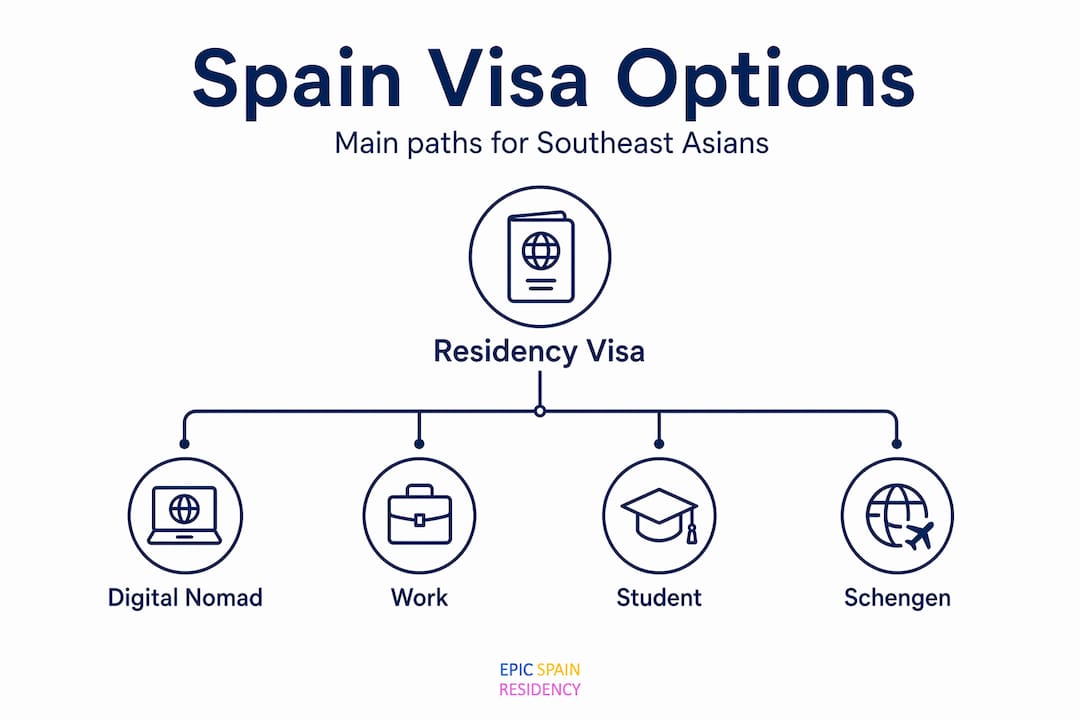
Spain offers a wider range of visa categories than most people realize. Your first decision is matching your purpose to the correct visa type, because applying under the wrong category wastes time and money.
Short-stay Schengen visas
If you are visiting Spain for tourism, a short business trip, or a family visit, the standard Schengen visa covers stays up to 90 days within any 180-day period. The standard adult fee is €90 with a processing time of around 15 days, though you should submit your application 4 to 6 weeks in advance, or 6 to 8 weeks during the summer peak. Singapore passport holders currently enter Spain visa-free for short stays, but that changes with ETIAS.
Student visas
Spain issues both short-term student visas (under 180 days) and long-term student visas for full academic programs. Long-term student visas require an admission letter from a recognized Spanish institution, proof of financial means to cover your stay, and health insurance. These visas also allow limited part-time work in some circumstances.
Work and digital nomad visas
Spain's Digital Nomad Visa (DNV) has become popular among Southeast Asian professionals working remotely. The DNV requires income of roughly double Spain's minimum wage and a letter from your employer confirming you can work remotely from Spain. You can learn more about the specifics on Epic-residency's digital nomad visa page. Traditional work visas require a Spanish employer to sponsor you and obtain a work permit on your behalf before you apply.

Long-term residency visas
The Non-Lucrative Visa (NLV) suits retirees and financially independent individuals who can prove sufficient passive income or savings without working in Spain. The Partner Visa (Pareja de Hecho) covers non-EU nationals in registered partnerships with Spanish residents or citizens. Both require substantial documentation and are processed through the Spanish consulate with jurisdiction over your country of residence.
One major change worth noting: Spain abolished its Golden Visa program for real estate investment as of April 3, 2025. No new applications are accepted under that scheme. If you were considering that route, you need to pivot to one of the established categories above.
| Visa Type | Purpose | Key Requirement |
|---|---|---|
| Schengen (short-stay) | Tourism, business, family visits | Proof of funds, return ticket, accommodation |
| Student visa | Academic programs | Admission letter, financial proof, health insurance |
| Digital Nomad Visa | Remote work from Spain | Double minimum wage income, employer letter |
| Non-Lucrative Visa | Long-term residency without working | Passive income or savings threshold |
| Partner Visa | Family reunification with Spanish resident | Registered partnership, sponsor documents |
Required documents for your Spain visa application
Getting your documents right is where most Southeast Asian applicants either win or lose their case. The list below covers the core requirements, but your specific visa category adds its own layer on top.
Universal requirements across all visa types:
- Valid passport with at least 6 months of validity beyond your intended stay and at least two blank pages
- Recent passport-size photographs meeting Schengen specifications (35x45mm, white background, taken within the last 6 months)
- Completed and signed visa application form
- Travel health insurance with minimum €30,000 coverage valid across the Schengen zone
- Proof of accommodation in Spain (hotel bookings, rental contract, or host letter)
- Proof of sufficient financial means (bank statements covering the last 3 to 6 months)
- Round-trip flight reservation
For long-term visas, you also need:
- Criminal background checks from every country you have lived in during the last 5 years, each with an Apostille stamp and a sworn Spanish translation
- Employment letter or proof of passive income depending on visa type
- Medical certificate confirming you carry no contagious diseases
- For student visas: university admission letter and proof of tuition payment
Pro Tip: Never submit bank statements that show sudden large deposits just before your application. Consular officers look for consistent balances over time. A statement showing a stable pattern over 6 months is far more persuasive than one showing a spike in the final month.
The Apostille requirement catches many applicants off guard. Documents issued in the Philippines, Indonesia, Vietnam, Thailand, and Malaysia must go through each country's designated apostille authority before they are legally recognized in Spain. Amateur translations are one of the leading causes of visa refusals from Southeast Asian applicants. Use a certified sworn translator, not a bilingual friend.
For applicants going through the spain visa application singapore consulate, note that the Spanish Embassy in Singapore handles long-term national visas directly, while short-stay Schengen applications are often processed through BLS International centers. Always verify current procedures on the embassy's official website before booking.
The step-by-step application process
Once your documents are in order, the actual submission process follows a clear sequence. Do not skip steps or assume flexibility in the system.
- Determine your consulate jurisdiction. You must apply at the Spanish consulate or BLS center with jurisdiction over your country of legal residence. If you live in Singapore, that is the Spanish Embassy in Singapore. If you live in the Philippines, it is the Spanish Embassy in Manila.
- Book your appointment. Appointment slots at BLS centers fill quickly. Book 45 to 60 days in advance, especially during summer. The spain consulate singapore appointment system operates online, so check availability regularly and move fast when slots open.
- Prepare and organize your full document package. Use a checklist specific to your visa type. Organize originals, copies, and translations in the order requested by the consulate.
- Attend your appointment and submit biometrics. You will provide fingerprints and a photograph at the BLS center or consulate. Bring every document in your package, including originals for verification.
- Pay the application fee. The standard Schengen fee is €90 for adults. Long-term national visa fees vary. Payment is typically accepted in local currency at the submission center.
- Attend a consulate interview if required. Long-term visa applicants, particularly for the NLV and DNV, may be called for a spain visa interview consulate asia appointment. Prepare to explain your financial situation, your plans in Spain, and your ties to your home country.
- Track your application and collect your visa. Processing typically takes 15 days for Schengen visas and up to 3 months for long-term national visas. Collect your passport from the BLS center or arrange courier delivery where available.
Pro Tip: For long-term visa interviews, bring printed copies of every document you submitted, plus any additional proof of ties to your home country. Officers appreciate applicants who are organized and can answer questions without fumbling through a bag.
Common rejection reasons and how to avoid them
Rejection is more common than applicants expect, and the reasons are usually preventable. Understanding what consular officers look for gives you a real advantage.
The single biggest trigger is a mismatch between your declared itinerary and your supporting documents. Spanish consular officers scrutinize itineraries strictly, and if your travel plan shows Spain as a brief stop while the bulk of your trip is in France or Germany, you should be applying at a different consulate. Your itinerary must clearly show Spain as your primary destination.
Financial proof issues are the second most common cause of rejection. Consistent financial documentation matters more than the total amount. Gaps in your bank history, unexplained transfers, or statements that only cover one month raise red flags.
Failing to demonstrate strong ties to your home country is a specific challenge for Southeast Asian applicants. Officers assess whether you have genuine reasons to return. Tax returns, employment letters, and ongoing bank statements all help make that case. Property ownership, family responsibilities, and business interests are also useful.
"The most avoidable rejections come from applicants who treat document preparation as a formality rather than the core of their case. Every piece of paper tells a story. Make sure yours is consistent, complete, and credible."
Other common pitfalls include expired documents at the time of submission, missing apostilles on background checks, and late appointment bookings that push submission dates too close to travel. Build at least a two-week buffer between your submission date and your intended departure.
What to expect after your visa is approved
Approval is not the finish line. Knowing the rules that govern your stay protects you from serious consequences.
For Schengen short-stay visa holders, the 90/180-day rolling rule is strictly enforced. You can spend a maximum of 90 days in the Schengen zone within any rolling 180-day window. Overstaying carries fines, entry bans, and complications for future visa applications.
For long-term visa holders, your first priority after arrival is registering for the Foreigner Identity Card (TIE) at your local immigration office. You must do this within 30 days of arrival. The TIE is your legal proof of residency in Spain and you will need it for everything from opening a bank account to signing a rental contract.
Key points to keep in mind after approval:
- Work permissions vary. NLV holders cannot work in Spain. DNV holders can only work remotely for non-Spanish employers. Student visa holders have limited work rights.
- Renewals require planning. Start your renewal process at least 60 days before your current visa or residency permit expires.
- ETIAS affects visa-free travelers. Singapore passport holders currently enter Spain visa-free, but starting in late 2026, ETIAS authorization will be mandatory. The ETIAS fee is €7 and the application is done online before travel.
- Overstaying has lasting consequences. A single overstay can result in a multi-year ban from the Schengen zone.
Spain is considered one of the more accessible Schengen destinations for non-EU applicants when applications are prepared correctly. The system rewards preparation, not luck.
My honest take on applying from Southeast Asia
I have worked with enough Southeast Asian applicants to know where the process breaks down, and it almost never comes down to eligibility. It comes down to preparation gaps that compound at the worst possible moment.
The appointment booking problem is real and underestimated. I have seen applicants spend months assembling perfect documents only to miss their travel window because they waited too long to book. The system does not reward patience. It rewards people who act early, check availability daily, and grab slots the moment they appear.
The Golden Visa abolition is a significant shift. Residency rules in Spain are evolving rapidly, and I always advise clients to pursue visa categories grounded in established immigration law rather than programs that depend on political goodwill. The NLV, DNV, and Partner Visa are stable, well-defined pathways. Build your plan around those.
What I have found consistently is that transparent, accurate documentation beats a technically impressive application with inconsistencies. Officers are trained to spot discrepancies. A straightforward application from someone with modest means and honest paperwork outperforms a polished application that does not quite add up. If your case is complex, get expert help before you submit, not after you receive a rejection.
— Living
How Epic-residency can help you move to Spain
Epic-residency specializes in exactly the situations Southeast Asian applicants face: unfamiliar consulate systems, document authentication requirements, and visa categories that carry real consequences if you get them wrong. The team handles the full Spain visa process, from document preparation and apostille guidance to consulate submission support and post-arrival registration.
Whether you are pursuing the Non-Lucrative Visa for long-term residency, the Digital Nomad Visa for remote work, or the Partner Visa for family reunification, Epic-residency builds your application around what actually gets approved. The team also supports clients with rental searches and school enrollment after arrival. Browse the client success stories to see how other Southeast Asian applicants have made the move. When you are ready to start, reach out to Epic-residency for a consultation tailored to your situation.
FAQ
What visa do Southeast Asian nationals need to live in Spain long term?
Southeast Asian nationals who want to live in Spain long term need a national visa, not a Schengen visa. The most common options are the Non-Lucrative Visa, the Digital Nomad Visa, and the Partner Visa, depending on your circumstances.
How far in advance should I book my Spain visa appointment?
Book your appointment at least 45 to 60 days before your intended travel date. BLS center slots fill quickly, particularly during summer, and late bookings are one of the most common reasons applicants miss their travel window.
What documents need to be apostilled for a Spain visa application?
Criminal background checks from every country you have lived in during the last 5 years must carry an Apostille stamp and a sworn Spanish translation. Other official documents such as birth certificates and marriage certificates may also require apostilles depending on your visa type.
Will Singapore passport holders need a visa to visit Spain after 2026?
Singapore passport holders currently enter Spain visa-free for stays up to 90 days. Starting in late 2026, they will need to obtain ETIAS authorization online before travel. The ETIAS fee is €7 and does not change the visa-free status itself.
Can I work in Spain on a Non-Lucrative Visa?
No. The Non-Lucrative Visa prohibits any form of employment or professional activity in Spain. It is designed for financially independent individuals or retirees who can support themselves without working in the country.