

Moving to Spain sounds straightforward until you hit the health insurance wall. Many applicants assume any policy will do. They buy a travel plan, a bank-offered product, or whatever their insurer back home recommends, and their visa application comes back denied. Spain private health insurance requirements are strict, specific, and non-negotiable at the consulate level. This article breaks down exactly what your policy must cover, how requirements shift by visa type, how to verify that your insurer is legitimate, and what happens to your healthcare coverage once you establish residency.
Table of Contents
- Key Takeaways
- Spain private health insurance requirements: the core rules
- How requirements differ by visa type
- How to secure a compliant policy
- Moving from private to public healthcare
- What I've learned from watching applicants get this wrong
- How Epic-residency can help you get this right
- FAQ
Key Takeaways
| Point | Details |
|---|---|
| DGSFP registration is mandatory | Your insurer must appear on Spain's official DGSFP register or the consulate will reject the application. |
| No copays, no waiting periods | Consulates require policies with zero copayments and zero waiting periods across all covered services. |
| Travel insurance is never accepted | Travel insurance is explicitly rejected for all long-stay Spanish residency visas. |
| Requirements vary by visa type | Student, non-lucrative, and digital nomad visas each carry specific coverage minimums and documentation rules. |
| Public healthcare comes later | Private coverage stays active until Social Security enrollment or a Convenio Especial arrangement is in place. |
Spain private health insurance requirements: the core rules
Spain's approach to health insurance for residency is different from most countries. The policy is not just a safety net. It functions as a legal compliance document. If the wording is off, if a clause limits coverage, or if the insurer is not properly registered, the application fails regardless of how much coverage the policy technically provides.
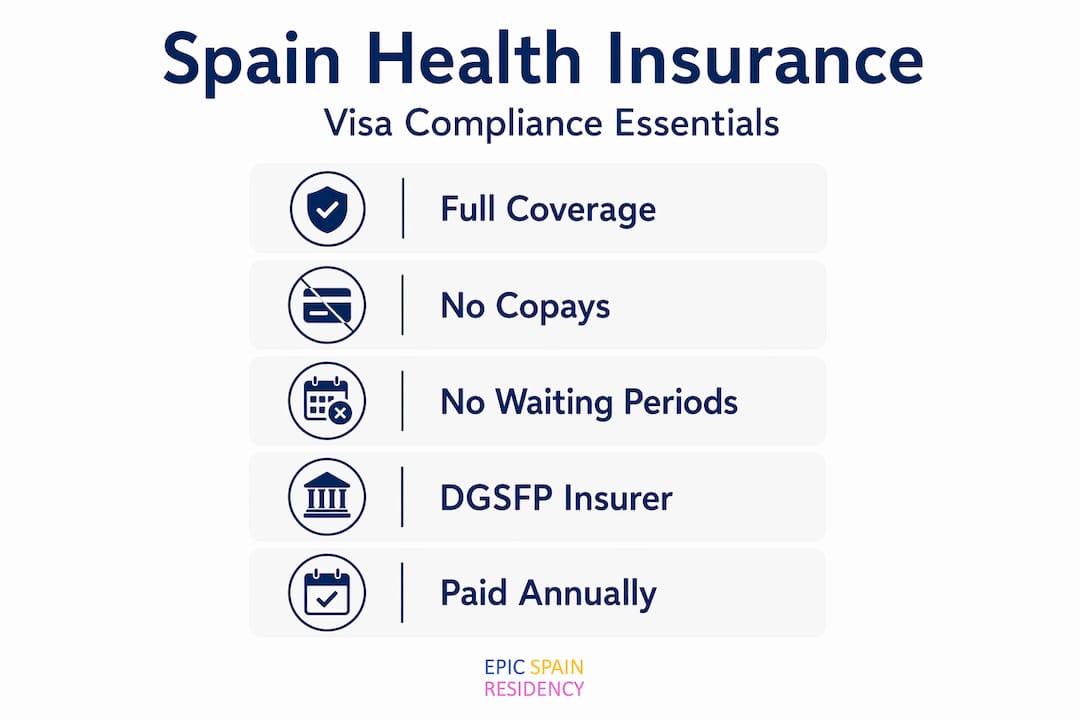
Here is what every compliant policy must include:
- DGSFP authorization: The insurer must be registered with Spain's DGSFP, the Directorate General of Insurance and Pension Funds. This is not optional. Consulates check the register directly.
- Full medical basket: Coverage must match Spain's public system in scope, meaning general medicine, specialist care, hospitalizations, diagnostics, and emergency services are all included.
- Zero copayments and no waiting periods: These two clauses appear on every Spanish consulate's checklist. Any policy with a copay structure or an initial waiting period before coverage activates will be rejected.
- Repatriation coverage: The policy must include medical repatriation as standard. This is a firm requirement for most visa categories.
- Nationwide Spain coverage: The policy must be valid across all of Spain, not limited to a specific region.
- Minimum 12-month validity: Policies must cover at least 12 months or the full duration of the requested visa, whichever is longer.
- Official certificate in Spanish: Consulates scrutinize certificate wording for phrases like "sin copagos" and "sin carencias." The certificate must be in Spanish or accompanied by a sworn translation.
Pro Tip: Do not rely on the insurer's sales team to confirm compliance. Request the actual policy wording and the official certificate before you pay. Verify "sin copagos" and "sin carencias" appear explicitly in the document.
The phrase "sin copagos, sin carencias" is the shorthand consulates use internally. If those words or their direct equivalents are absent from your certificate, the application is at risk.
How requirements differ by visa type
Spain offers several residency pathways, and each one carries its own specific nuances around private health insurance. Understanding exactly where the differences lie will save you from buying the wrong product.
| Visa Type | Coverage Minimum | Key Requirement | Public System Access |
|---|---|---|---|
| Non-Lucrative Visa | Full medical basket | DGSFP insurer, no copays, no waiting periods | Not available during visa period |
| Student Visa | Min. €30,000 coverage | No copays, no waiting periods, repatriation included | Not available |
| Digital Nomad Visa | Full medical basket | Can use private or public, but must show DGSFP-authorized coverage | Available if contributing to Social Security |
| Work Visa | Full coverage initially | Private insurance until Social Security registration | Activates after Social Security enrollment |
A few points worth unpacking beyond the table:
The Non-Lucrative Visa is the most commonly mishandled case. Holders cannot access Spain's public healthcare system during their visa period. Private insurance is the only option, full stop. This is a deliberate policy position. Spain does not want non-working residents drawing on public resources without contributing to the system.

For students, the €30,000 minimum is a floor, not a ceiling. Most visa-compliant student policies exceed this, but you need to confirm the figure appears explicitly in your certificate.
Digital Nomad Visa applicants have slightly more flexibility. If you are paying into Spain's Social Security system as a self-employed worker or through a registered employer, that contribution can substitute for private coverage. However, many applicants start their visa on private insurance before Social Security registration is complete. For UK nationals specifically, post-Brexit rules mean the old S1 or EHIC route no longer applies for long-stay residency, making the UK private health insurance Spain requirement a genuinely new problem for many people who previously assumed their NHS status would carry weight. It does not.
Family members need separate policies or must be explicitly listed as covered dependents on a primary policyholder's certificate. A single-person policy does not automatically extend to a spouse or children.
How to secure a compliant policy
Finding a policy that actually meets all the consulate standards takes more effort than a Google search. Here is a practical sequence that works.
- Verify the insurer on the DGSFP register. Go directly to the official DGSFP register online and search the insurer's legal name before you proceed. Some policies from technically registered insurers still fail consular checks because individual products within the portfolio do not meet all criteria.
- Request the visa-specific product. Many major Spanish insurers offer a standard health plan and a separate visa-compliant plan. Ask explicitly for a policy designed for visa or residency applications. These plans are sometimes labeled "seguro para visados."
- Confirm the certificate includes all required language. The document must state the insurer's DGSFP registration number, coverage start and end dates, absence of copayments, absence of waiting periods, and repatriation coverage. Specialized insurers issue compliance certificates designed specifically for immigration paperwork.
- Pay the full annual premium upfront. Many consulates require proof of payment for the full policy year, not just the first month. Monthly payment plans are often not accepted.
- Avoid travel insurance, bank policies, and EHIC. These are the three most common mistakes. Travel insurance is explicitly rejected at every Spanish consulate for long-stay applications. The EHIC covers emergencies only. Bank-packaged health products rarely include the necessary certificate format.
- Use a broker who specializes in visa-compliant policies. A specialist will know exactly which product tiers qualify and can provide the correct documentation format. Common visa denials often trace back to choosing the wrong product rather than the wrong insurer.
Pro Tip: Visa-compliant private health insurance typically costs between €45 and €150 per month depending on your age and coverage level. Budget for the full annual amount upfront and treat it as a non-negotiable visa cost, not an optional add-on.
The wording check is the step most people skip. You can have a policy from a fully DGSFP-registered insurer, pay in full, and still get rejected because a single clause buried in the contract describes a copay for specialist referrals. Policy wording mismatches are one of the leading causes of visa application rejections, so treat the certificate as carefully as you would treat a legal contract.
Moving from private to public healthcare
Private insurance does not have to be permanent. Once you establish residency and meet certain contribution thresholds, pathways to Spain's public healthcare system open up.
The most direct route is Social Security enrollment. If you are working in Spain and paying contributions, your employer registers you in the system and you gain public healthcare access almost immediately. For non-lucrative visa holders who are not working, the situation is different.
Here is how the transition options stack up:
- Convenio Especial: After one year of legal residence, non-working residents can access public healthcare via Convenio Especial by paying a monthly fee. The cost is €60 per month for those under 65 and €157 per month for those 65 and older.
- Continued private insurance: Many long-term residents choose to keep private insurance even after becoming eligible for public coverage. Private plans offer shorter wait times, English-speaking specialists in major cities, and greater flexibility overall.
- Renewals and citizenship: Your insurance documentation matters beyond the first visa application. Residency renewals require proof of continued healthcare coverage. Citizenship applications look at your entire residency record, and any gap in coverage can raise questions about the consistency of your stay.
| Coverage Type | Monthly Cost | Access Speed | Coverage Quality |
|---|---|---|---|
| Visa-compliant private insurance | €45–€150 | Immediate | Full, with no copays |
| Convenio Especial | €60–€157 | After 1 year of residency | Full public system |
| Social Security (employed) | Via payroll contributions | Upon employment | Full public system |
The practical takeaway here is that your private insurance period serves two purposes. It satisfies the legal requirement during your visa period, and it keeps you covered seamlessly while you establish the residency history needed to access public options. Do not cancel it early in anticipation of public coverage. The activation process takes time, and a gap in coverage can affect your renewal.
What I've learned from watching applicants get this wrong
I've reviewed enough Spain visa applications to say with confidence that health insurance documentation causes more preventable rejections than almost any other requirement. The frustrating part is that most of these cases involve people who genuinely tried to do it right.
The pattern I see most often: someone buys a policy from a well-known international insurer, receives a polished English-language certificate, and assumes it qualifies. It does not. The insurer may not appear on the DGSFP register, or the certificate lacks the specific Spanish-language phrasing the consulate needs, or there is a barely-visible copay clause on specialist visits. Any one of these issues is enough for a rejection.
What I always tell people: approach the health insurance requirement the same way you approach a legal contract. Read every word of the certificate. Verify the insurer registration number before you pay anything. And never assume a big brand name equals automatic compliance. No copay and no waiting period clauses are non-negotiable, and the burden is on you to prove they are present in your documentation.
Timing also matters more than people realize. Buy the policy only when you are close to submitting your visa application. A 12-month policy you purchase three months early will expire before your visa situation is fully resolved, and you will have to renew, restart the process, and potentially pay again.
— Epic-residency
How Epic-residency can help you get this right
Getting Spain private health insurance requirements right is one piece of a larger puzzle. You need the correct insurer, the correct documentation format, the correct certificate language, and you need it all to align with the specific visa category you are applying for.

Epic-residency works with non-EU individuals and families navigating every stage of this process. For people applying for the Non-Lucrative Visa, the team provides direct guidance on selecting a compliant insurer, verifying DGSFP registration, and reviewing certificate wording before submission. For remote workers applying through the Digital Nomad Visa, Epic-residency covers both the insurance requirement and the broader application process, including income documentation and Social Security planning.
The boutique structure means every client gets real attention from people who know the consulate standards in detail. If you want a consultation that walks through your specific situation and identifies exactly which policy type you need, the Epic-residency team is the right starting point. Visit epic-residency.com to book a consultation or explore the full range of Spain residency and visa services.
For additional legal context on what Spain's non-lucrative residency pathway requires, the Spain Non-Lucrative Visa 2026 legal guide from Property Lawyers provides a solid overview of current standards.
FAQ
What makes a health insurance policy compliant for Spain visas?
A compliant policy must come from a DGSFP-registered insurer and include full medical coverage with no copayments, no waiting periods, and repatriation coverage. The official certificate must confirm all criteria in Spanish.
Is travel insurance accepted for a Spain residency visa?
No. Travel insurance is explicitly rejected by Spanish consulates for all long-stay and residency visa applications, regardless of the coverage amount.
How much does visa-compliant private health insurance cost in Spain?
Costs typically range from €45 to €150 per month depending on age and plan tier. Most consulates require upfront payment for the full annual premium at the time of application.
Can I switch to public healthcare after my visa is approved?
Yes, but it takes time. Non-working residents can access public healthcare through the Convenio Especial after one year of residency, paying €60 per month under age 65. Workers enrolled in Social Security gain access sooner through payroll contributions.
Do family members need separate health insurance policies?
Yes. Each family member must be individually covered, either through their own policy or as explicitly named dependents on the primary certificate. A single-holder policy does not automatically extend to a spouse or children for visa compliance purposes.