

If you've been researching the Spain investment visa explained across real estate forums or expat groups, you may have already encountered a flood of outdated information. Here's what most articles won't tell you upfront: Spain's Golden Visa program was closed to new applicants effective April 3, 2025. That changes everything for families and individuals who were counting on buying property in Spain as their path to residency. This article cuts through the confusion, explains what was lost, and shows you exactly which doors are still open.
Table of Contents
- Key takeaways
- What the Spain investment visa actually was
- The repeal: what changed in 2025
- Alternative residency pathways in 2026
- Practical steps for pursuing Spanish residency now
- My honest take on what investors should do now
- How Epic-residency can help you
- FAQ
Key takeaways
| Point | Details |
|---|---|
| Golden Visa is gone | Spain's investment residency program was abolished in April 2025, closing all investment routes to new applicants. |
| Existing holders retain rights | Real estate Golden Visa holders can still renew their permits as long as they maintain the qualifying property investment. |
| Three viable alternatives remain | The Non-Lucrative Visa, Digital Nomad Visa, and Entrepreneur Visa are the strongest options now available to wealthy applicants. |
| Physical presence now required | Current residency pathways require more than 183 days in Spain per year, unlike the old Golden Visa. |
| Expert guidance is non-negotiable | Rapid policy changes in 2025 and 2026 make professional immigration advice more critical than ever. |
What the Spain investment visa actually was
Spain introduced its Golden Visa program in 2013 under Ley 14/2013, designed to attract foreign capital and stimulate a recovering economy. For over a decade, it became one of the most popular Spain residency by investment routes in Europe, particularly among buyers from China, the United States, Russia, and Latin America.
The qualifying investment options
The program offered five distinct routes to residency:
- Real estate purchase of at least €500,000 in Spanish property
- Government bonds worth a minimum of €2,000,000
- Shares or equity funds in Spanish companies totaling at least €1,000,000
- Bank deposits in Spanish financial institutions of at least €1,000,000
- Business projects deemed to create employment or contribute to scientific innovation
Each route granted a two-year initial visa, renewable in three-year increments. Crucially, the program included the applicant's spouse, dependent children, and dependent parents, making it a genuine family relocation tool.
Why investors loved it
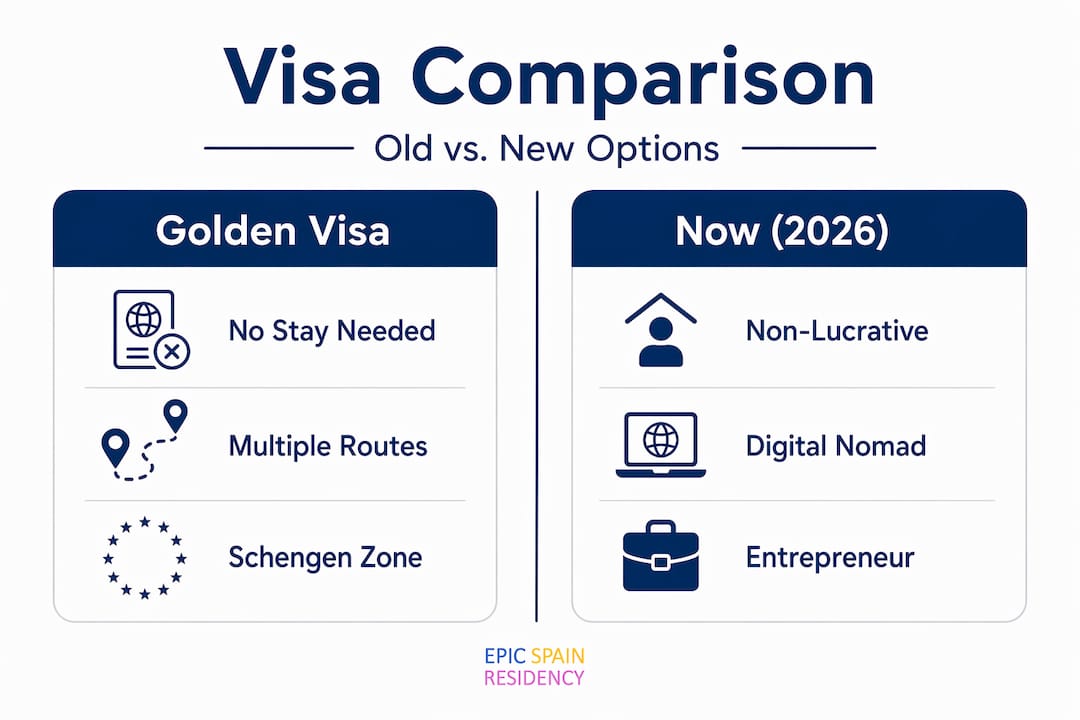
The Golden Visa required almost no physical presence to maintain. You did not need to live in Spain full time to keep your residency valid, which suited investors who split their time between countries. After five years of legal residency, holders could apply for permanent residency. After ten years, citizenship became possible.
Schengen Zone access was another major draw. Golden Visa holders could move freely across 27 European countries, which made the program especially attractive for high-net-worth individuals seeking geographic flexibility without relocating entirely.
The repeal: what changed in 2025
Organic Law 1/2025 and its effect
Organic Law 1/2025 formally repealed Articles 63 through 67 of Law 14/2013, eliminating every investment route simultaneously. There was no grace period for new applications. The April 3, 2025 cutoff was definitive. The government's stated rationale centered on housing affordability. Officials argued that foreign capital was inflating property prices in major cities like Madrid, Barcelona, and Valencia, pricing out local residents and young Spaniards.
"The closure of Spain's Golden Visa reflects a broader European shift away from passive investment schemes and toward immigration channels that serve labor and demographic needs." — Spain Residency Policy Change Risks
The five investment paths closed simultaneously: property, bonds, shares, funds, and business investments. No partial exceptions were made for applicants mid-process. This created significant disruption for families who had already signed purchase agreements or moved funds in anticipation of applying.
What this means for existing holders
The situation for current Golden Visa holders splits into two categories with very different outlooks.

Real estate investors are in the stronger position. Permit renewals continue under the original rules as long as the qualifying property investment is maintained at €500,000 or above. Selling a property does not automatically cancel eligibility, but the sale must be replaced with another qualifying property without a gap in ownership to preserve renewal rights.
Financial route holders face considerably more uncertainty. Renewal applications for bond, share, and fund investors are being contested in some cases, and legal interpretation remains unsettled. If you hold a non-real estate Golden Visa, specialist legal advice is not optional at this point.
Alternative residency pathways in 2026
Losing the Golden Visa does not mean losing access to Spanish residency. Three pathways stand out as realistic options for investors and high-net-worth individuals today.
Comparing current options
| Visa type | Income or capital required | Physical presence | Work rights |
|---|---|---|---|
| Non-Lucrative Visa | ~€28,800/year passive income | 183+ days/year | No work in Spain |
| Digital Nomad Visa | ~€3,024/month gross income | 183+ days/year | Remote work only |
| Entrepreneur Visa | ~€31,752 in savings + ENISA certification | 183+ days/year | Full business operations |
Non-Lucrative Visa
The Non-Lucrative Visa is the most straightforward route for retirees, passive income earners, and those with substantial savings. Applicants must prove roughly €28,800 annually in passive income, with additional thresholds for each family member added to the application. You cannot work for a Spanish employer, but you can live in Spain on rental income, dividends, or pension distributions.
The trade-off compared to the old Golden Visa is physical presence. You must spend more than 183 days per year in Spain to maintain the residency, which affects your tax status and ties you more firmly to the country. For families genuinely planning to relocate, this is not a burden. For investors who wanted flexibility above all, it represents a real constraint.
Digital Nomad Visa
Spain's Digital Nomad Visa targets location-independent professionals employed by companies outside Spain. The gross income threshold sits at around €3,024 per month, and no more than 20% of your total income can come from Spanish clients. This visa suits tech professionals, consultants, and freelancers whose earnings come primarily from international sources.
Pro Tip: The Digital Nomad Visa can also unlock Spain's Beckham Law tax regime, which taxes Spanish-sourced income at a flat 24% rate for qualifying new residents. That combination makes the visa particularly attractive for high earners.
Entrepreneur Visa
For those looking to launch or scale a business in Spain, the Entrepreneur Visa under the Spain Startup Act offers a structured path. The financial solvency requirement of approximately €31,752 in savings is only part of the picture. Applicants must also obtain ENISA certification confirming their project has genuine innovation value and economic significance for Spain. Without that certification, the application falls under slower provincial permit processes with stricter review criteria.
This is the closest current equivalent to what the spain startup visa explained literature describes: a route for entrepreneurs who want to build in Spain rather than simply park capital there.
Practical steps for pursuing Spanish residency now
Getting your residency application right in this environment requires more preparation than it did under the old Golden Visa framework. Here is a realistic sequence:
- Clarify your financial profile. Calculate your provable passive income, savings, or business funding, and determine which visa category you realistically qualify for before spending money on notarized documents.
- Secure Spanish health insurance first. Every residency visa requires private health insurance with no deductibles and coverage equivalent to Spain's public system. Obtain this before beginning the consulate appointment process.
- Compile financial solvency documentation. Official bank statements, proof of income sources, and investment portfolios must be recent, translated into Spanish by a certified translator, and apostilled if issued outside Spain.
- Consult an immigration specialist before applying. Given the policy volatility in 2025 and 2026, working with a Spain-specific immigration lawyer or consultancy is the single highest-return step you can take.
- Apply at the correct consulate. Your application must go through the Spanish consulate in your country of legal residence, not the country of your nationality in some cases. Getting this wrong delays the process by months.
A few risks to watch carefully:
- Renewal uncertainty for financial route Golden Visa holders remains unresolved in Spanish administrative courts.
- Stricter presence requirements under current visas mean that a second-home lifestyle is no longer compatible with maintaining legal residency.
- New Spanish immigration reforms in 2025 and 2026 favor channels tied to labor and economic activity. Passive wealth alone carries less weight than it once did.
Pro Tip: Keep all residency documentation organized in a digital folder with expiration dates flagged. Renewal timelines in Spain can run long, and missing a window because of document gaps has derailed otherwise solid applications.
My honest take on what investors should do now
I've worked with enough families in this situation to say something plainly: the Golden Visa's closure was not a surprise to anyone watching Spanish housing politics over the past three years. What surprises me is how many investors are still hoping for a policy reversal, or worse, waiting for another passive-investment route to emerge. That waiting is not a strategy.
What I've seen work consistently is a pivot toward genuine engagement with Spain. The Entrepreneur Visa, the Digital Nomad Visa, and even the Non-Lucrative Visa all require you to be in Spain and to participate in its economy or society in some way. That is a feature, not a bug. The families who build real roots here, regardless of which visa brought them, end up with more stable residency and a clearer path to citizenship than those who structured everything around minimum presence.
The harder truth is that policy reversal risks are real for any investment-linked visa program anywhere in Europe. Building your residency around a passive financial position always carries the risk that the government decides the trade-off no longer serves them. The more future-proof move is to tie your Spain residency to your actual life here.
That said, navigating the current system without good legal advice is genuinely difficult. Consulate requirements vary, administrative courts are still interpreting the 2025 law, and the documentation bar is high. Get a specialist involved early.
— Epic-residency
How Epic-residency can help you
The Spain investment visa application process has fundamentally changed, and the families who adapt fastest are the ones who get expert guidance now rather than after a rejected application. Epic-residency is a boutique Spain immigration consultancy that specializes in exactly this transition period. From Non-Lucrative Visa applications for passive income earners to full Entrepreneur Visa support for founders, the team handles documentation, consulate strategy, and renewal planning in one place. If you are relocating as a couple or family, Epic-residency also supports partner visa pathways so no one in your household falls through the cracks. Book a consultation to get a clear-eyed assessment of your specific situation.
FAQ
Is the Spain Golden Visa still available in 2026?
No. The Spain Golden Visa was abolished for new applicants on April 3, 2025, under Organic Law 1/2025. All five investment routes, including real estate, were closed simultaneously.
Can existing Golden Visa holders still renew their permits?
Real estate Golden Visa holders can renew under the original rules as long as they maintain the €500,000 property investment. Holders of financial route visas (bonds, shares, funds) face legal uncertainty and should seek specialist advice.
What is the best alternative to the Spain Golden Visa?
The Non-Lucrative Visa suits passive income earners, the Digital Nomad Visa works for remote workers earning around €3,024 per month, and the Entrepreneur Visa serves founders with an ENISA-certified business project.
How much income do I need for the Non-Lucrative Visa?
Applicants must prove approximately €28,800 in annual passive income for the primary applicant, with additional amounts required per dependent family member included in the application.
Does Spain still offer any residency by investment routes?
As of 2026, there are no direct residency by investment routes in Spain. The current system rewards earned income, business creation, and physical presence over passive capital placement.