

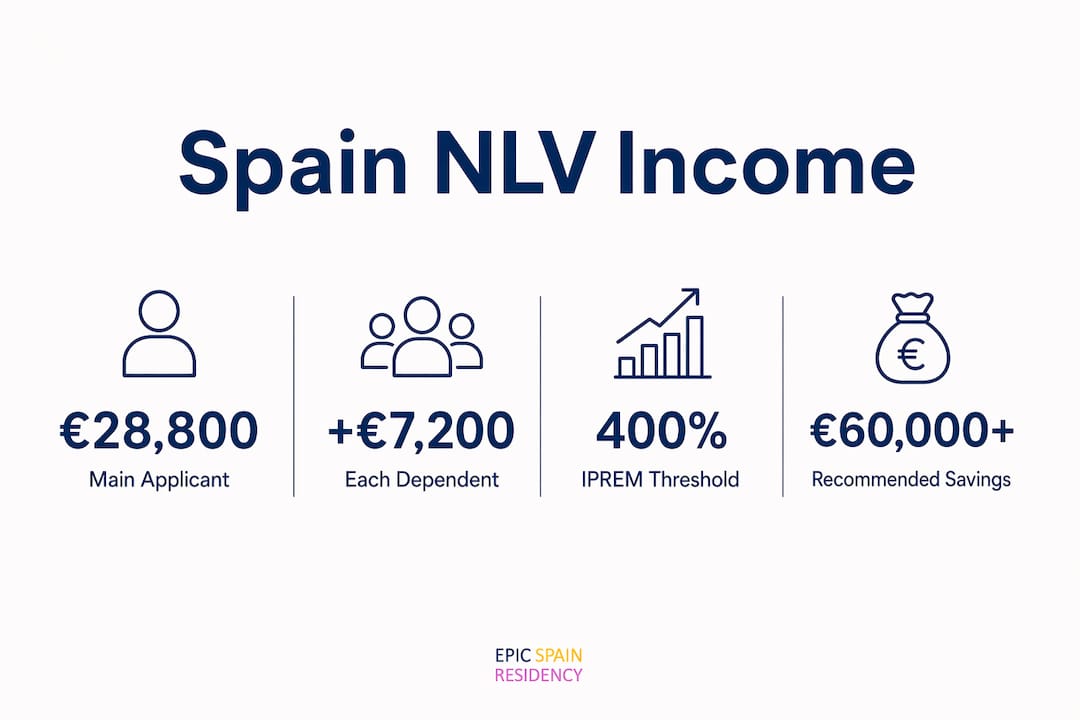
Spain's Non-Lucrative Visa (NLV) requires the main applicant to prove €28,800 in annual income for 2026, plus €7,200 for each dependent. The NLV is designed for non-EU nationals who want to live in Spain without working there. Meeting the spain income requirements NLV demands is not just about hitting the legal minimum. Consulates expect proof of stable, passive income or substantial savings, and the gap between the minimum and what actually gets approved is wider than most applicants expect.
What are the Spain income requirements for the NLV?
The NLV financial threshold is calculated using the IPREM, which stands for the Public Income Index of Multiple Effects. The IPREM is set at €600 per month for 2026, unchanged from prior years. That stability means the income bar has not shifted recently, but it also means consulates have had time to sharpen their expectations around documentation quality.
The formula is straightforward. The main applicant must show 400% of the annual IPREM, which equals €28,800 per year. Each dependent adds 100% of the annual IPREM, or €7,200. A single applicant needs €28,800. A couple needs €36,000. A couple with one child needs €43,200.

| Family unit | Annual income required |
|---|---|
| Single applicant | €28,800 |
| Couple (2 adults) | €36,000 |
| Couple + 1 child | €43,200 |
| Couple + 2 children | €50,400 |
| Single parent + 1 child | €36,000 |
These figures are the legal floor. They are not a guarantee of approval. Consulates retain discretion, and many expect applicants to show considerably more.
What types of income qualify for the NLV financial requirement?
Acceptable passive income includes pensions, dividends, rental income, investment portfolio returns, annuities, and royalties from intellectual property. Each of these qualifies because it arrives without active employment. The key test is whether the income is passive and demonstrable on paper.
Acceptable income sources include:
- Pensions: State, occupational, or private pensions from any country. UK pension holders can find detailed qualification guidance through pension income resources specific to Spanish residency.
- Dividends: Regular distributions from shares or investment funds.
- Rental income: Documented rental agreements and bank deposits showing consistent monthly receipts.
- Annuities: Fixed periodic payments from insurance or investment products.
- Royalties: Ongoing payments from intellectual property, such as published works or patents.
- Bank savings: Lump sum savings used as a substitute for recurring income, provided the balance is stable and accessible.
Work under the NLV is strictly forbidden, including remote paid work for foreign employers. Spanish consulates explicitly reject income generated by active employment, regardless of where the employer is based. This catches many applicants off guard, particularly those planning to continue working remotely for a Hong Kong or Singapore company. That income does not qualify. If remote work is your primary income source, the Digital Nomad Visa is the correct route. Epic-residency handles both pathways and can clarify which visa fits your situation.
Consulates prefer ongoing passive income over a one-off savings balance. Recurring monthly cash flows, documented across several months of bank statements, carry more weight than a single large deposit made shortly before the application.
Pro Tip: Keep your qualifying funds in a single, clearly labeled account for at least six months before applying. Consulates read bank statements looking for stability, not last-minute transfers.
How much savings should you realistically show?
The legal minimum and the practical approval threshold are two different numbers. Stable savings of €60,000 to €100,000 held consistently over 6–12 months are commonly recommended to reduce refusal risk for a single applicant. That range sits well above the €28,800 legal minimum, and for good reason.
"Many consulates accept savings equivalent to 5 years of the annual required income, roughly €144,000 for a single applicant, to cover the initial visa and two renewal cycles." — Spain NLV financial requirements
The logic behind the five-year figure is practical. The initial NLV is granted for one year. It can be renewed twice in two-year increments, covering a total of five years. Showing funds that cover the full five-year period signals to the consulate that you will not become a financial burden on Spain at any point during that window.
The contrast between minimum and recommended is stark. An applicant showing exactly €28,800 in annual income meets the legal bar but gives the consulate no margin. An applicant showing €80,000 in stable savings plus €2,400 per month in rental income presents a much stronger case. The second profile gets approved far more consistently.
Pro Tip: If your income is in a foreign currency, such as Hong Kong dollars or Singapore dollars, convert and document it clearly. Currency fluctuations can push your demonstrated income below the threshold if not accounted for in advance.
How do income requirements adjust for dependents and family applications?
Each additional family member adds €7,200 per year to the total income requirement. The calculation is linear. A couple with two children needs €50,400 annually. A single parent with two children needs €43,200. The math scales predictably, but the documentation burden grows with each dependent.
| Family unit | Annual minimum | Recommended savings buffer |
|---|---|---|
| Single applicant | €28,800 | €60,000–€100,000 |
| Couple | €36,000 | €75,000–€120,000 |
| Couple + 1 child | €43,200 | €90,000–€144,000 |
| Couple + 2 children | €50,400 | €105,000–€168,000 |
Dependents on the application must be legally recognized family members, typically a spouse or minor children. Extended family members, such as parents or siblings, face a more complex process and may need to apply separately or through a different visa category. For non-married partners, the partner visa route through Epic-residency may be more appropriate than adding a partner as a dependent on an NLV application.
Families applying together should consolidate their income documentation carefully. Each income source needs to be clearly attributed to the main applicant, since the NLV is issued to the primary holder and dependents are listed under that application. A clear financial summary document, translated into Spanish, helps consulate officers process the file without ambiguity.
What are the tax residency implications of long-term stays?
Spending over 183 days in Spain in any calendar year makes you a Spanish tax resident. That status triggers worldwide income tax obligations. Every income source you hold globally, including pensions, dividends, rental income from properties abroad, and investment returns, becomes reportable to the Spanish tax authority.
The tax implications of NLV residency include:
- Worldwide income tax: Spain taxes residents on all global income, not just Spanish-sourced income.
- Wealth tax: High-net-worth residents may face annual wealth tax on assets above certain thresholds, which vary by region.
- Modelo 720: Residents must declare foreign assets exceeding €50,000 through this annual filing.
- Double taxation treaties: Spain has treaties with many countries, including the UK, the US, and Singapore, which can reduce double taxation but require careful planning to apply correctly.
Pre-arrival tax planning is not optional for NLV holders planning long stays. Restructuring income sources, timing asset disposals, or adjusting pension drawdown schedules before moving can significantly reduce your Spanish tax bill. The 183-day tax residency rule applies regardless of your visa type, so NLV holders are not exempt. Consulting a qualified Spanish tax advisor before your first full year of residency is the most cost-effective step you can take.
Key Takeaways
Spain's NLV requires €28,800 per year for the main applicant plus €7,200 per dependent, but showing stable savings of €60,000 to €100,000 over 6–12 months is the practical standard for approval.
| Point | Details |
|---|---|
| Legal income minimum | €28,800/year for the main applicant, calculated at 400% of the IPREM (€600/month). |
| Dependent additions | Each dependent adds €7,200/year to the total required income. |
| Recommended savings buffer | €60,000–€100,000 in stable savings over 6–12 months reduces refusal risk significantly. |
| Qualifying income types | Pensions, dividends, rental income, annuities, and royalties qualify. Remote work income does not. |
| Tax residency trigger | Staying over 183 days makes you a Spanish tax resident with worldwide income tax obligations. |
What I've learned from watching NLV applications succeed and fail
The applicants who struggle most with the NLV are not the ones with too little money. They are the ones who have enough money but document it poorly. I have seen applications with €150,000 in savings get delayed or questioned because the funds were spread across five accounts, moved around in the months before applying, or held in a currency that was never converted and explained.
The second most common mistake is misunderstanding the remote work rule. Applicants from Hong Kong, Singapore, and the US frequently assume that working for a foreign company from Spain is fine under the NLV because the employer is not Spanish. It is not fine. The visa explicitly prohibits any paid work, regardless of where the employer is registered. If you earn income by working, the NLV is the wrong visa. The Digital Nomad Visa exists precisely for that situation, and it has its own income requirements worth understanding separately.
Tax planning is the area where I see the most expensive mistakes. People move to Spain, spend eight months there in year one, and then receive a Spanish tax bill covering their entire global income for that year. They had no idea it was coming. A one-hour conversation with a cross-border tax advisor before the move would have cost a fraction of what they paid in unexpected tax. The income sources guide for Spanish long-term visas is a good starting point for understanding what you need to document and declare.
My honest advice: treat the legal minimum as a floor you want to be well above, not a target you are trying to hit. Consulates are not looking for reasons to approve you. They are looking for reasons to be confident. Give them confidence.
— Living
How Epic-residency supports your NLV application
Preparing a strong NLV application means more than meeting the numbers. It means presenting your finances in a way that consulates find clear, credible, and complete.
Epic-residency is a boutique Spain-focused immigration consultancy that works with non-EU individuals and families on NLV applications from start to finish. The team reviews your income sources, identifies documentation gaps, prepares your financial summary, and manages the full submission process. Applicants who work with Epic-residency arrive at their consulate appointment with a file that is organized, translated, and built to reduce refusal risk. For Hong Kong and Singapore nationals navigating passive income documentation, Epic-residency's Spain residency guidance covers the specific requirements in detail.
FAQ
What is the minimum income for the Spain NLV in 2026?
The minimum is €28,800 per year for the main applicant, based on 400% of the IPREM, which is set at €600 per month for 2026. Each dependent adds €7,200 per year to that total.
Does remote work income count toward the NLV financial requirement?
No. Remote work income, including salary from a foreign employer, is not accepted under the NLV. Only passive income sources such as pensions, dividends, and rental income qualify.
How much savings should I show for a Spain NLV application?
Showing €60,000 to €100,000 in stable savings over 6–12 months is the practical recommendation for a single applicant. Some consulates look for savings covering five years of the required income, which equals roughly €144,000.
Does the NLV make me a tax resident in Spain?
Spending more than 183 days in Spain in a calendar year triggers Spanish tax residency. That means you owe tax on your worldwide income, not just income earned in Spain.
Can a couple apply together for the Spain NLV?
Yes. The primary applicant applies and lists the partner as a dependent. The total income requirement for a couple is €36,000 per year. Both partners must be included in the financial documentation.