
Spain residency for Hong Kong nationals is a legal status granted through structured visa pathways that allow stays beyond 90 days without EU citizenship. The four primary routes are the Non-Lucrative Visa (NLV), the Digital Nomad Visa (DNV), the Golden Visa, and the Partner Visa (Pareja de Hecho). Each carries distinct eligibility criteria, work rights, and renewal timelines. Understanding these differences upfront saves you from costly application errors and sets a clear path toward permanent residency and, eventually, Spanish citizenship.
What visa options are available for Hong Kong nationals seeking Spain residency?
Spain offers four main visa pathways for non-EU nationals, and each one suits a different lifestyle and income profile. Knowing which category fits your situation before you apply is the single most important decision in this process.
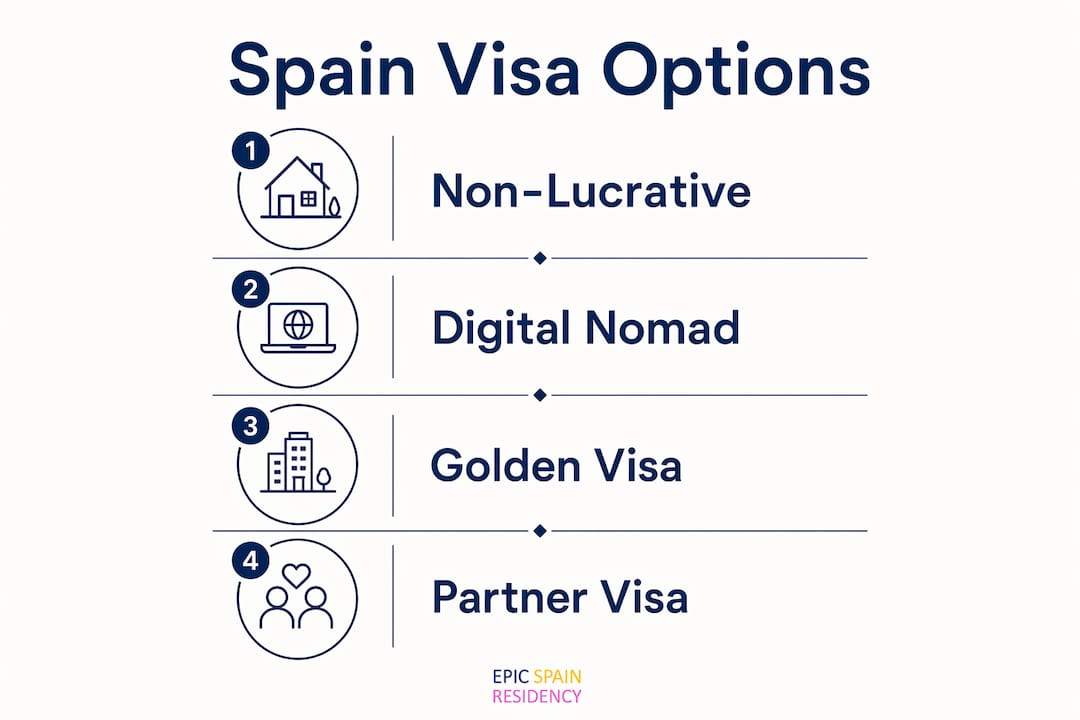
The Non-Lucrative Visa is designed for retirees and passive income earners. You must prove sufficient financial means without working in Spain. The income threshold for 2026 sits at roughly 400% of Spain's IPREM indicator per month, which translates to approximately €2,400 per month for a single applicant. This visa is popular among Hong Kong retirees and those living off investments, rental income, or pensions.
The Digital Nomad Visa targets remote workers employed by companies outside Spain. Income requirements sit at around €2,646 per month, and holders may access the Beckham Law tax scheme, which applies a flat 24% income tax rate instead of Spain's progressive scale reaching 47%. This is a significant financial advantage for high earners relocating from Hong Kong.
The Golden Visa requires a minimum €500,000 investment in Spanish real estate and grants immediate residency with full work rights. The Golden Visa pathway can be renewed every two years, and after five years, permanent residency becomes available. This route attracts Hong Kong investors and business owners who want maximum flexibility from day one.

The Partner Visa (Pareja de Hecho) provides residency for non-EU nationals in a recognized domestic partnership with a Spanish resident or citizen. Applicants must establish the partnership formally with supporting documentation, and the Pareja de Hecho route is one of the most accessible pathways for those with Spanish partners.
| Visa Type | Work Rights | Min. Financial Requirement | Initial Validity |
|---|---|---|---|
| Non-Lucrative Visa | No work allowed | ~€2,400/month | 1 year |
| Digital Nomad Visa | Remote work for foreign employers | ~€2,646/month | 1 year |
| Golden Visa | Full work and self-employment | €500,000 investment | 2 years |
| Partner Visa | Full work rights | Varies by case | 1 year |
Pro Tip: Choosing the right visa depends not only on your income level but also on your work intentions and long-term family plans. A retiree with a pension suits the NLV; a freelancer with foreign clients suits the DNV. Matching your lifestyle to the visa category avoids expensive corrections later.
How do work rights and restrictions differ across Spain residency visas?
Work authorization is the most misunderstood aspect of Spain residency for Hong Kong residents, and getting it wrong carries serious consequences. Each visa type draws a hard line on what you can and cannot do professionally while living in Spain.
- Non-Lucrative Visa: NLV holders are prohibited from any form of employment or self-employment in Spain. This includes working remotely for Spanish clients, freelancing for Spanish companies, and any activity that generates income from Spanish sources. Violation leads to immediate residency cancellation with no grace period.
- Digital Nomad Visa: Holders may work remotely for foreign companies and clients. Up to 20% of total income may come from Spanish sources without breaching visa conditions. Self-employment is permitted under this visa, making it the preferred option for Hong Kong freelancers and consultants with an international client base.
- Golden Visa: Grants unrestricted employment and self-employment rights in Spain from day one. Holders can work for Spanish companies, run local businesses, or operate as self-employed professionals without any additional work permit.
- Partner Visa: Work rights are generally full once residency is granted. Partners of Spanish residents or citizens can take local employment or operate as self-employed, placing this visa on par with the Golden Visa for professional flexibility.
The risk of violating work restrictions extends beyond the immediate visa. A cancelled residency can affect future applications and may trigger tax investigations if undeclared income is discovered. Legal experts recommend strict adherence to visa terms throughout the entire residency period.
Pro Tip: If you hold an NLV and your income situation changes, such as picking up remote consulting work, contact a qualified immigration lawyer before accepting any contracts. Switching to a DNV proactively is far less damaging than a forced cancellation.
What is the application and renewal process for Hong Kong applicants?
The application process follows a clear sequence, but documentation timing is where most Hong Kong applicants run into trouble. Many underestimate the importance of precise documentation timing and authenticated translations, which leads to delays or outright denials.
- Apply at the Spanish consulate in Hong Kong. You must apply in your legal country of residence, not where you happen to be traveling. The Spanish consulate in Hong Kong processes all initial visa applications for Hong Kong nationals.
- Prepare your documents. Core requirements include proof of income or investment, proof of accommodation in Spain, comprehensive health insurance with no co-payments, a clean criminal background check, and a medical certificate. All documents must be recent and apostilled, typically issued within three months of your application date.
- Receive your visa and travel to Spain. Initial visas are valid for one year. This gives you time to establish legal residence before your first renewal.
- Register and obtain your NIE and TIE. After arrival, you must complete empadronamiento registration at your local town hall, obtain your NIE (Número de Identificación de Extranjero), and apply for your TIE (Tarjeta de Identidad de Extranjero) within the required deadline. These steps are non-negotiable for legal residence and future renewals.
- Renew your residency. After the first year, renewals are granted in two-year blocks. Miss a renewal deadline and you risk a gap in your legal residence record.
| Residency Milestone | Timeline |
|---|---|
| Initial visa validity | 1 year |
| First renewal | 2 years |
| Second renewal | 2 years |
| Permanent residency eligibility | After 5 continuous years |
| Citizenship eligibility | After 10 continuous years |
The 5-year path to permanent residency follows a 1+2+2 structure. Continuous legal residence is the key requirement. Any significant gap, such as spending more than six months outside Spain in a single year, can reset the clock. For Hong Kong nationals planning the Spain citizenship timeline, this means treating every renewal as a critical milestone, not a formality.
Pro Tip: Keep a personal record of every entry and exit from Spain. Immigration authorities track physical presence carefully, and gaps in your residence record are the most common reason permanent residency applications are delayed.
How do Spain and UK residency options compare for Hong Kong nationals?
The Spain vs UK residency debate is one of the most common conversations among Hong Kong nationals considering relocation. Both countries offer structured pathways, but the timelines, work rights, and tax environments differ significantly.
The UK BN(O) visa route offers indefinite leave to remain after five years of residence and citizenship eligibility after six years. Full work rights apply from day one, regardless of employment type. This is a faster settlement timeline than Spain, where citizenship requires ten years of continuous residence.
Spain, by contrast, offers no direct BN(O) equivalent. Hong Kong nationals must qualify under one of the standard visa categories. The trade-off is flexibility. Spain's visa options cover a wider range of income profiles and lifestyles, from passive income retirees to active investors, without requiring a specific national status document like the BN(O) passport.
| Factor | Spain | UK (BN(O) Route) |
|---|---|---|
| Work rights from day one | Varies by visa type | Full, unrestricted |
| Permanent residency | 5 years | 5 years |
| Citizenship | 10 years | 6 years |
| Language requirement | Spanish (B1 for citizenship) | English (B1 for settlement) |
| Cost of living | Lower than UK average | Higher, especially London |
Tax implications also differ sharply. Spain's progressive income tax reaches 47% for high earners, though DNV holders can access the Beckham Law flat rate of 24% for up to six years. The UK applies income tax up to 45% with no equivalent flat-rate scheme for new residents. For Hong Kong professionals earning above HKD 1 million annually, the Beckham Law option makes Spain materially more attractive from a tax perspective.
Cultural and family factors matter too. Spain offers a lower cost of living than the UK, particularly outside Madrid and Barcelona. For families prioritizing schooling, healthcare access, and quality of life at a lower price point, Spain consistently ranks ahead of the UK in expat satisfaction surveys.
Key takeaways
Spain residency for Hong Kong nationals requires matching your income source, work intentions, and long-term goals to the correct visa category before applying.
| Point | Details |
|---|---|
| Four main visa routes | NLV, DNV, Golden Visa, and Partner Visa each suit different income and work profiles. |
| Work rights vary sharply | NLV prohibits all work; DNV allows remote foreign work; Golden Visa permits full employment. |
| Application starts in Hong Kong | Apply at the Spanish consulate in Hong Kong with apostilled documents dated within three months. |
| Residency follows a 1+2+2 structure | Permanent residency is available after five continuous years; citizenship after ten. |
| Spain vs UK trade-off | UK offers faster citizenship via BN(O); Spain offers more visa flexibility and lower living costs. |
What I've learned advising Hong Kong nationals on Spain residency
The most expensive mistake I see Hong Kong applicants make is choosing the Non-Lucrative Visa because it sounds simple, then discovering mid-residency that they want to take on consulting work. The NLV is genuinely excellent for retirees and passive income earners. For anyone with even a remote chance of generating professional income, it is the wrong starting point.
Document preparation is where applications fail most often. Hong Kong nationals frequently submit background checks or financial statements that are just days outside the three-month validity window. Spanish consulates do not grant exceptions. One missed date means restarting the entire document collection process, sometimes losing a consulate appointment slot that took months to secure.
The forward-planning piece is also undervalued. If your goal is Spanish citizenship after ten years, every single year of residence counts. That means treating your empadronamiento registration, your NIE, your TIE, and every renewal as legal milestones, not bureaucratic chores. I have seen applicants lose years of residence credit because they spent too long outside Spain without understanding the physical presence rules.
My honest advice: get professional legal support from the start. The cost of a qualified immigration consultant is a fraction of the cost of a rejected application, a cancelled visa, or a delayed citizenship timeline. Spain's residency system rewards preparation and penalizes guesswork.
— Living
How Epic-residency supports Hong Kong nationals with Spain residency
Epic-residency specializes in Spain residency applications for Hong Kong nationals, covering the full range of visa types from the Non-Lucrative Visa to the Digital Nomad Visa and Partner Visa. The team handles eligibility assessments, document preparation, certified translations, and consulate appointment coordination so nothing falls through the cracks.
Post-arrival support covers NIE registration, empadronamiento, and TIE card applications. Epic-residency also manages renewal applications and advises on work restriction compliance to protect your residency status long term. For Hong Kong nationals who want their Spain residency handled correctly the first time, Epic-residency is the specialist to call.
FAQ
What is the minimum income for a Spain Non-Lucrative Visa in 2026?
The Non-Lucrative Visa requires approximately €2,400 per month for a single applicant in 2026, based on 400% of Spain's IPREM indicator. Additional dependents increase this threshold.
Can Hong Kong nationals work remotely in Spain on a Non-Lucrative Visa?
No. NLV holders are prohibited from all forms of work, including remote work for foreign employers. Working under an NLV risks immediate visa cancellation. The Digital Nomad Visa is the correct route for remote workers.
How long does it take to get permanent residency in Spain?
Permanent residency in Spain requires five years of continuous legal residence, following a 1+2+2 renewal structure. Gaps in physical presence of more than six months per year can interrupt this timeline.
How does Spain residency compare to the UK BN(O) route for Hong Kong nationals?
The UK BN(O) route offers indefinite leave to remain after five years and citizenship after six, with full work rights from day one. Spain requires ten years for citizenship but offers more visa flexibility and a lower cost of living, particularly for retirees and passive income earners.
Do Hong Kong nationals need to speak Spanish to apply for residency?
Spanish language proficiency is not required for initial residency applications. However, a B1 level in Spanish is required when applying for citizenship after ten years of residence.