

Empadronamiento is the mandatory municipal registration that records your habitual residence in Spain and is the legal foundation for accessing public services, residency permits, and civic rights as a non-EU resident. Without it, you cannot get a public healthcare card, enroll children in school, or renew your residency status. Spain empadronamiento importance explained simply: this single registration at your local town hall, known as the ayuntamiento, determines your legal standing in Spanish public life from day one. The process is straightforward, but the consequences of skipping or delaying it are serious and long-lasting.
What is the empadronamiento process in Spain?
Empadronamiento is the act of registering on the padrón municipal, the official census of residents maintained by each Spanish municipality. Every person who lives in Spain, regardless of nationality or immigration status, is legally required to register. The padrón is not a visa or a residency permit. It is a separate, parallel record that proves you actually live at a specific address in a specific town.

How to register step by step
Registration happens in person at your local ayuntamiento. Most municipalities require an appointment, which you can book online or by phone. The process typically takes 15–20 minutes, and you often walk out with proof of registration the same day.
You need to bring three things:
- Your original passport or national ID card. A photocopy alone is not accepted.
- Proof of your address. A signed rental contract is the most common document. Property owners bring their title deed. Both must be current and show the address where you actually live.
- The municipal registration form. The clerk usually provides this at the office, but some ayuntamientos offer it as a download.
One field that surprises many newcomers is the profession field. Retirees list "jubilado" as their profession. The clerk typically fills this in based on what you tell them, so do not leave it blank or guess.
Pro Tip: Book your appointment as soon as you have a signed rental contract. Some municipalities have waiting times of two to four weeks, and your residency application clock does not start until you are registered.
Certificado vs. volante: which document do you need?
Spain issues two types of registration proof. A volante de empadronamiento is issued on the spot and works for everyday administrative tasks like opening a bank account or registering a vehicle. A formal certificado de empadronamiento carries the municipal secretary's official stamp and is required for immigration procedures. Some immigration offices require a certificado dated within 90 days, so always check which document your specific application needs before your appointment.
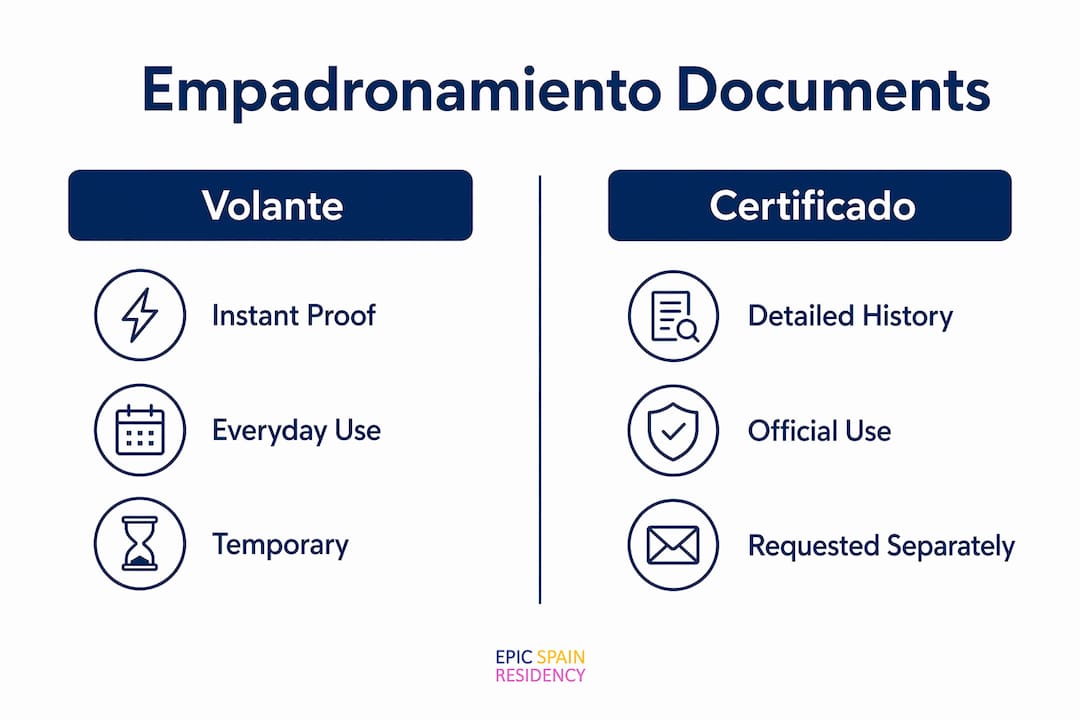
Why empadronamiento matters for legal compliance and public services
Registration on the padrón is legally mandated for all residents in Spain, not just EU citizens. Non-compliance puts you in administrative limbo. You cannot access services, and your residency record has no official starting point.
The practical consequences of being unregistered are immediate:
- Public healthcare: Your SIP card, the health card that gives you access to Spain's public health system, requires active padrón registration. Without it, you pay out of pocket for every medical visit.
- School enrollment: Spanish public schools use padrón records to assign children to local schools. No registration means no enrollment in your catchment area.
- Residency card (TIE) applications and renewals: The Tarjeta de Identidad de Extranjero requires a current padrón certificate. An expired or missing registration stalls your application.
- Local benefits and social services: Municipal programs, from language classes to housing assistance, use padrón data to determine eligibility.
- Voting rights: Long-term non-EU residents from certain countries can vote in local elections, but only if they are registered on the padrón.
Municipalities allocate budgets for schools, health centers, and social services based on padrón population data. When you register, you are not just complying with the law. You are directly contributing to the funding of the services you will use. Staying off the padrón does not make you invisible to the system. It makes you ineligible for it.
Experts confirm that the padrón is the foundational key to Spanish public life. Residents who delay registration often face weeks or months of blocked access to healthcare and other services while they wait for their appointment and paperwork to process.
How empadronamiento supports future immigration processes
A continuous padrón history is one of the most valuable assets a non-EU resident can build in Spain. The reason is simple: Spanish immigration law requires documented proof of continuous residence for several major legal milestones.
| Immigration Milestone | Minimum Continuous Residence | Key Document Required |
|---|---|---|
| Arraigo Social (social roots residency) | 3 years | Certificado histórico de empadronamiento |
| Long-term EU residency permit | 5 years | Certificado histórico de empadronamiento |
| Spanish nationality by residency | 10 years | Certificado histórico de empadronamiento |
The certificado histórico de empadronamiento is a document that lists every address where you have been registered in Spain, with exact dates. This historic certificate is the primary evidence immigration authorities use to verify continuous residence. No other document replaces it.
The danger of gaps in your registration is severe. Failure to maintain continuous registration can break your official residence record. If you are removed from the padrón, whether because you forgot to update your address or because your landlord reported you as having left, re-registering restarts your residence timeline. A person who needed one more year to qualify for permanent residency could find themselves starting over from zero.
Pro Tip: Every time you move within Spain, update your padrón registration within two weeks. Bring your new rental contract to the ayuntamiento and request a new certificado. Keep copies of every registration document you ever receive, organized by date.
Experienced expats who have gone through residency renewal and naturalization processes consistently identify an unbroken padrón history as the single most important administrative asset they maintained throughout their time in Spain.
Common challenges in the empadronamiento process for non-EU residents
The registration process is simple in theory. In practice, several obstacles catch newcomers off guard.
- Landlord reluctance: Some landlords refuse to allow tenants to register at their property, fearing tax scrutiny or legal complications. This is illegal. Spanish law gives tenants the right to register at their rental address regardless of landlord preference. If your landlord refuses, you can report the situation to your local social services office.
- No formal rental contract: Residents in informal living situations, such as staying with family or in shared housing without a lease, can still register. Social services can issue an ICR, an informe de conocimiento de residencia, which serves as address verification for registration purposes. This report is typically valid for 90 days.
- Confusing empadronamiento with residency permits: These are two separate legal processes. Your padrón registration does not grant you a residency permit, and having a residency permit does not automatically register you on the padrón. You must complete both independently.
- Failing to update after moving: Many residents register once and forget to update when they change address. This creates a mismatch between your official record and your actual location, which can cause problems during visa legal requirements checks and renewals.
- Municipal variation: Procedures, appointment systems, and required documents vary between municipalities. A process that works in Madrid may differ in Valencia or a small rural town. Always check your specific ayuntamiento's website before your appointment.
Pro Tip: If your landlord refuses to let you register, ask your local ayuntamiento for their specific procedure for contested registrations. Many municipalities have a formal process that bypasses landlord consent entirely.
Key Takeaways
Empadronamiento is the mandatory municipal registration that every non-EU resident in Spain must complete to access public services, maintain legal residency, and build the continuous residence history required for long-term immigration milestones.
| Point | Details |
|---|---|
| Register immediately on arrival | Book your ayuntamiento appointment as soon as you have a signed rental contract. |
| Know which document you need | Use a volante for daily tasks and a certificado for all immigration procedures. |
| Never let your registration lapse | Gaps in your padrón history restart your residence timeline for permanent residency and citizenship. |
| Update every time you move | Failing to update your address creates legal mismatches that delay renewals and applications. |
| Registration and residency permits are separate | Completing one does not complete the other. Both are legally required. |
The document most people underestimate
Most newcomers treat empadronamiento as a box to check. I have seen that mindset cost people years. A client who moved between two Spanish cities and forgot to update their padrón registration discovered the gap only when applying for long-term residency. The interruption meant their five-year clock reset. They had to wait another five years. That is not a bureaucratic inconvenience. That is a life plan delayed.
The padrón is not just a census record. It is a legal diary of your life in Spain. Every entry, every address, every date is a piece of evidence that immigration authorities will scrutinize when you apply for permanent residency or citizenship. An error-free, unbroken record is worth more than any single visa document you will ever file.
My strongest advice: treat your padrón the way you treat your passport. Protect it, update it, and never assume it is someone else's responsibility to maintain. The ayuntamiento will not send you a reminder when your registration needs updating. That responsibility is yours alone.
The residents who integrate most successfully into Spanish life are not the ones with the best lawyers or the most money. They are the ones who registered on day one, updated every time they moved, and kept every piece of paper the ayuntamiento ever gave them.
— Living
How Epic-residency helps non-EU residents get residency right
Getting empadronamiento right is the first step. Choosing the correct visa pathway is what comes next. Epic-residency specializes in guiding non-EU individuals and families through Spain's residency system, from initial registration compliance to full visa applications. Whether you are applying for a Non-Lucrative Visa to retire or live on passive income, or a Digital Nomad Visa to work remotely from Spain, Epic-residency's team ensures your padrón documentation meets every requirement. The consultancy handles the details that derail self-managed applications, so your residency timeline stays on track from the start.
FAQ
What documents do I need for empadronamiento in Spain?
You need your original passport or national ID, a valid rental contract or proof of property ownership, and a completed municipal registration form. These three documents cover the standard requirements at most ayuntamientos across Spain.
How long does empadronamiento registration take?
The appointment at the town hall typically takes 15–20 minutes, and many municipalities issue proof of registration the same day. Waiting times for appointments vary by municipality and can range from a few days to several weeks.
Is empadronamiento the same as a Spanish residency permit?
No. Empadronamiento is municipal census registration, while a residency permit is a separate immigration authorization. You must complete both independently, as one does not substitute for the other.
What happens if I move to a new address in Spain?
You must update your padrón registration at your new ayuntamiento as soon as possible. Failing to update creates a gap or mismatch in your official record, which can affect residency renewals and future immigration applications.
Can I register on the padrón without a formal rental contract?
Yes. Residents without a formal lease can request an ICR, an official social services residency report, which serves as address verification for registration purposes and is typically valid for 90 days.