

Article 31 of Spain's Organic Law 4/2000, known as the Foreigner Law, is the legal foundation for temporary residence permits that allow non-EU foreigners to live in Spain for more than 90 days and up to five years. For non-EU individuals and families planning a move to Spain, understanding spain foreigner law article 31 is not optional. It defines which visa categories exist, what documents you need, and how you stay legal long term. The 2026 extraordinary regularization has added new urgency to this topic, making it one of the most consequential pieces of Spain immigration regulations in a generation.
What does Spain foreigner law article 31 actually cover?
Article 31 authorizes temporary residence for non-EU nationals for periods exceeding 90 days but not exceeding five years. That single provision creates the legal space for a wide range of permit types, from passive income holders to workers to family members joining a resident sponsor. The law does not treat all applicants the same. Each modality carries its own eligibility criteria, documentation standards, and renewal conditions.
The core eligibility requirements apply across all modalities. Applicants must demonstrate sufficient financial means, present a clean criminal record from every country of residence in the past five years, and provide proof of legal entry or current lawful status in Spain. These are not box-checking exercises. Spanish immigration authorities exercise significant administrative discretion when assessing whether your documents reflect an underlying reality, not just a paper trail.

What are the key modalities under Article 31 for non-EU foreigners?
Article 31 covers several distinct permit types. Each one targets a different life situation, and choosing the wrong category is one of the most common and costly mistakes applicants make.
The main modalities include:
- Non-lucrative residence: For individuals with passive income, pensions, or savings sufficient to support themselves without working in Spain. This is the most popular route for retirees and financially independent expats.
- Work-related permits: Covers employed and self-employed categories. Requires a job offer or registered business activity in Spain.
- Family reunification: Allows legal residents to bring qualifying family members to Spain. Recent updates have expanded eligibility criteria under this route.
- Arraigo (social, labor, or family integration): Designed for individuals already living in Spain who can demonstrate deep ties to the country. Arraigo categories were expanded under recent decrees to reflect the reality of long-term undocumented residents.
- Humanitarian circumstances: A discretionary category for individuals facing exceptional hardship or protection needs.
Each modality requires nominative, specifically dated documents. A bank statement made out to "the account holder" with no date will not pass. A letter of support without a date stamp will not pass. This level of specificity trips up a large share of first-time applicants.
Pro Tip: Request all supporting documents in your own name and confirm they carry a date within the last three months. Generic or undated documentation is routinely rejected by immigration authorities, regardless of how strong the rest of your file is.
For families, the family reunification route requires proof of ongoing financial support and legal residency of the sponsoring family member. The bar is higher than many applicants expect.
How does the Article 31 permit renewal process work?
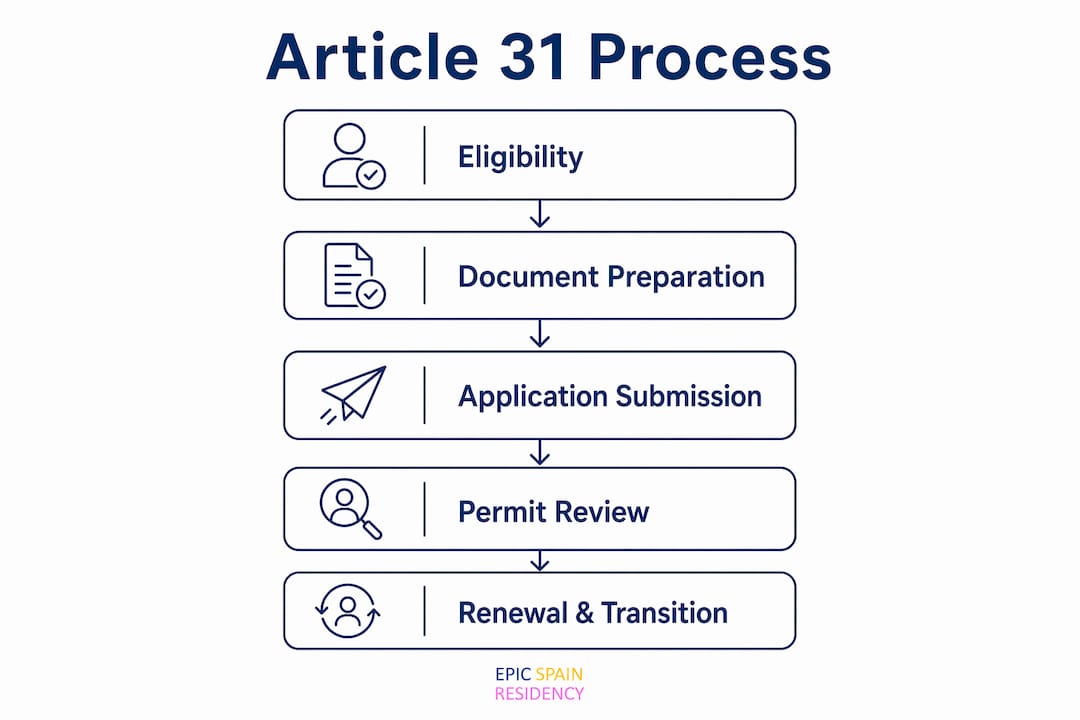
Initial permits granted under Article 31 are valid for up to two years on first issue, with the possibility of renewal up to the five-year maximum. After five years of continuous legal residence, you become eligible to apply for long-term residency, which carries a stronger set of rights and is harder to lose.
Renewal is not automatic. Spanish authorities evaluate three main factors:
- Criminal record compliance: Any conviction during the permit period can block renewal. Authorities check both Spanish and international records.
- Tax and social security compliance: If you have been working or running a business, your tax filings and social security contributions must be current. Gaps here are treated as red flags.
- Social integration: This is the factor most applicants underestimate. Renewals evaluate integration through autonomous community reports, language course certificates, and evidence of community participation. Proactive participation in regional training programs significantly strengthens a renewal application.
Applicants must also notify authorities of any changes in nationality, civil status, or address during the permit period. Failing to update these records is a compliance violation that can complicate renewal even when everything else is in order.
The transition from temporary to long-term residency after five continuous years of legal stay is one of the most significant milestones in Spain's immigration system. Long-term residents gain access to a broader set of rights, including greater employment freedom and stronger protection against expulsion.
What is the 2026 extraordinary regularization linked to Article 31?
Spain's Council of Ministers approved an extraordinary regularization in april 2026 that represents the largest single expansion of legal status for undocumented migrants in the country's recent history. The policy operates within the Article 31 framework and grants one-year renewable residence and work permits to qualifying individuals.
Eligibility requirements for the 2026 regularization are specific:
- Residency before january 1, 2026: Applicants must prove they were physically present in Spain before this date.
- Five months of continuous stay: The residency must be uninterrupted and documentable.
- Clean criminal record: Both Spanish and international criminal records are checked.
- No active deportation order: Applicants with pending removal proceedings are excluded.
The Spanish government estimates roughly 500,000 individuals will benefit from this measure. Independent think-tanks suggest the actual number of undocumented residents in Spain may be as high as 840,000, meaning a significant portion of the undocumented population still falls outside the program's reach. That gap matters for families who arrived after the cutoff date or who cannot document continuous residency.
Documentation is the single biggest obstacle. All submitted documents must be nominative and specifically dated. Utility bills, rental contracts, school enrollment records, and employer letters all qualify, but only if they name the applicant directly and carry a clear date. Minister Elma Saiz described the 2026 regularization as a historic milestone for migrant integration, but the documentary bar is real and unforgiving.
Pro Tip: Build a chronological evidence file covering every month of your stay. Gaps in the timeline are the most common reason applications stall. A single undocumented month can undermine an otherwise strong file.
What documents do non-EU families need for Article 31 compliance?
Families face a more complex documentation challenge than single applicants because every family member requires their own complete file. The sponsor's permit must be valid and in good standing before any dependent application can proceed.
The core documentation checklist for most Article 31 modalities includes:
- Valid passport with at least one year of remaining validity
- Criminal record certificate from Spain and every country of residence in the past five years
- Proof of financial means (bank statements, pension letters, or income certificates, all nominative and dated)
- Proof of address in Spain (rental contract or property deed in the applicant's name)
- Medical insurance with full coverage in Spain, without copayments
For family reunification specifically, the sponsor must also provide proof of adequate housing for all family members and documentation of the family relationship. The family reunification standards under Article 31 require demonstrating ongoing support, not just a one-time financial snapshot.
Regional authorities play a significant role in processing. Spain's autonomous communities handle integration reports and some permit renewals. The regional vs. national rules differ enough that an application prepared for Madrid may need adjustments before submission in Catalonia or Andalusia.
| Document type | Key requirement |
|---|---|
| Criminal record certificate | Apostilled, translated, issued within 3 months |
| Bank statements | Nominative, dated, covering 3–6 months |
| Rental contract or property deed | In applicant's name, registered where required |
| Medical insurance policy | Full Spain coverage, no copayments |
| Proof of family relationship | Apostilled birth or marriage certificate |
Pro Tip: Start gathering documents at least three months before your intended application date. Apostille processing and official translations take longer than most applicants expect, and expired documents are a leading cause of delays.
Key Takeaways
Article 31 of Spain's Foreigner Law defines the legal framework for all non-EU temporary residence, and success depends on matching the right modality to your situation, meeting strict documentation standards, and maintaining active compliance throughout the permit period.
| Point | Details |
|---|---|
| Article 31 scope | Covers temporary residence from 90 days up to five years across multiple permit modalities. |
| Documentation standard | All documents must be nominative, specifically dated, and issued within the required timeframe. |
| Renewal criteria | Authorities evaluate criminal record, tax compliance, and social integration at every renewal. |
| 2026 regularization | Roughly 500,000 undocumented residents qualify for one-year renewable permits under the new program. |
| Family applications | Each family member needs a complete individual file; the sponsor's permit must be valid and current. |
What I've learned from watching Article 31 applications succeed and fail
The most dangerous assumption non-EU applicants make is that Article 31 is a checklist. It is not. Spanish immigration officials have real discretion, and two applications with identical documents can produce different outcomes depending on how clearly the file tells a coherent story about the applicant's life in Spain.
The cases I see fail most often share one pattern: the applicant assembled documents that technically satisfy each requirement but do not connect. A bank statement from one country, a rental contract in a different name, a criminal record certificate that covers only the last two years instead of five. Each document looks fine in isolation. Together, they raise questions the applicant is not present to answer.
The cases that succeed do the opposite. They build a file that makes the official's job easy. Every document is dated, named, and logically sequenced. The financial evidence matches the lifestyle described. The integration evidence is specific, not generic. A certificate from a Spanish language school in Barcelona carries more weight than a vague letter from a neighbor.
The 2026 regularization has raised the stakes further. With hundreds of thousands of applications entering the system, officials are processing under pressure. A clean, complete, well-organized file moves faster and attracts less scrutiny. A file with gaps invites requests for additional documentation, which can add months to the process.
My honest advice: treat your application as a legal argument, not a form submission. Every document is evidence. Every gap is a question you are leaving unanswered.
— Living
How Epic-residency supports non-EU families through Article 31 applications
Non-EU families navigating Spain's residency system face a process where small documentation errors cause long delays.

Epic-residency is a boutique Spain-focused immigration consultancy that works exclusively with non-EU individuals and families. The team handles non-lucrative visa applications, work permits, family reunification cases, and the 2026 extraordinary regularization process. Every client gets a file review before submission, which catches the nominative and dating errors that most commonly trigger rejections. Epic-residency also advises on the partner visa route for couples where one partner holds legal residency in Spain. If you are ready to start your application or need a second opinion on a file already in progress, Epic-residency's team is available for a consultation.
FAQ
What is Article 31 of Spain's Foreigner Law?
Article 31 of Organic Law 4/2000 authorizes temporary residence permits for non-EU foreigners, covering stays from 90 days up to five years across multiple modalities including non-lucrative, work-related, and family reunification permits.
Who qualifies for the 2026 extraordinary regularization in Spain?
Applicants must have been continuously resident in Spain before january 1, 2026, for at least five months, hold a clean criminal record, and have no active deportation order. Qualifying individuals receive a one-year renewable residence and work permit.
How long does a temporary residence permit last under Article 31?
Initial permits are typically issued for up to two years and are renewable. After five years of continuous legal residence, applicants can apply for long-term residency status.
What documents are required for an Article 31 permit application?
Core documents include a valid passport, apostilled criminal record certificates, nominative and dated proof of financial means, a Spanish address document in the applicant's name, and a medical insurance policy with full Spain coverage and no copayments.
Can family members be included in an Article 31 application?
Family members apply through the family reunification modality, which requires the sponsoring resident to demonstrate valid legal status, adequate housing, and ongoing financial support for all dependents.