

Spanish residency permit legal categories are the official classifications that determine how non-EU nationals can legally live, and in some cases work, in Spain. The right category shapes everything: your work rights, your income requirements, how long you can stay, and your path to permanent residency. For non-EU individuals and families planning a move, choosing the wrong category is not just inconvenient. It can mean starting over. The main categories available today are the Non-Lucrative Visa, the Digital Nomad Visa, work-based permits, Family Reunification, and Student Visas. Each serves a different life situation, and understanding the differences is the first real step toward a successful relocation.
What are the main types of Spanish residency permits for non-EU nationals?
The primary legal residency pathways for non-EU nationals break into five core categories. Each targets a specific profile of applicant, and eligibility requirements differ significantly between them.
-
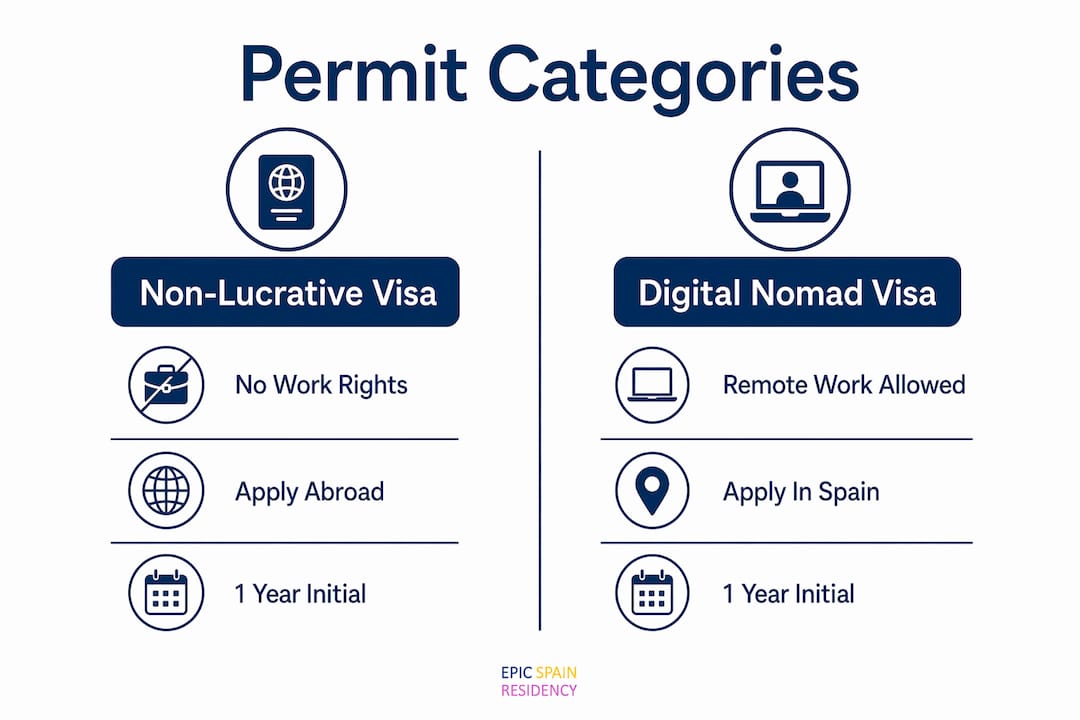
Non-Lucrative Visa (NLV). This permit is for individuals who can support themselves without working in Spain. You must demonstrate passive income of roughly €28,800 per year, typically from savings, investments, pensions, or rental income abroad. Retirees and financially independent individuals are the primary applicants. The NLV does not permit any form of employment, including remote work for foreign employers.
-
Digital Nomad Visa (DNV). Introduced under Spain's Startup Act, this permit targets remote workers and freelancers employed by companies outside Spain. The income threshold sits at approximately €3,024 per month. Unlike the NLV, the DNV explicitly permits remote work for foreign employers, making it the go-to option for location-independent professionals.
-
Work-based permits. These require either a job offer from a Spanish employer or a viable business plan for self-employment. Employers must often demonstrate that no qualified EU candidate was available for the role. Work permits count fully toward permanent residency and typically allow greater mobility after renewal.
-
Family Reunification. Eligible relatives of legal residents in Spain can apply to join their sponsor under this category. Spouses, minor children, and in some cases dependent parents qualify. The sponsor must meet minimum income and housing requirements to bring family members.
-
Student Visa. This permit covers enrollment in accredited Spanish educational institutions. Student Visa holders can stay up to 180 days with multiple renewals possible, and limited part-time work is permitted under specific conditions. Students can also transition to other residency categories after completing their studies.
Pro Tip: If you are unsure which category fits your situation, map your income sources first. Passive income points to the NLV. Active remote work points to the DNV. A Spanish job offer points to a work permit. That single question eliminates most of the confusion.
How do Spanish residency permit categories compare?

Comparing the main permit types side by side reveals the trade-offs that matter most to applicants. Work rights, application location, and duration are the three factors that most often determine which category is the right fit.
| Permit type | Work rights | Where to apply | Initial duration | Income threshold |
|---|---|---|---|---|
| Non-Lucrative Visa | No work permitted | Spanish consulate abroad | 1 year | ~€28,800/year |
| Digital Nomad Visa | Remote work for foreign employers | Consulate or inside Spain | 1 year | ~€3,024/month |
| Work permit | Full work rights in Spain | Spanish consulate abroad | 1 year | Job offer or business plan |
| Family Reunification | Mirrors sponsor's rights | Spanish consulate abroad | 1 year | Sponsor's income threshold |
| Student Visa | Limited part-time work | Spanish consulate abroad | Up to 180 days | Proof of enrollment and funds |
All initial permits run for one year. After that, renewals are issued in two-year blocks. That renewal structure matters because consistent, uninterrupted legal residence is what qualifies you for permanent residency down the road.
The NLV and DNV are the most popular routes for non-EU families relocating without a Spanish employer. The NLV suits retirees and those with investment income. The DNV suits professionals who work remotely. Work permits suit those with a concrete Spanish job offer or a business they want to operate locally.
Pro Tip: The Digital Nomad Visa is the only permit that can sometimes be applied for while already inside Spain, which gives it a flexibility advantage for applicants already in the country on a tourist entry.
What is the process for applying for Spanish residency from abroad?
The application process for most Spanish residency permit types follows a strict sequence. Non-EU citizens must apply at the Spanish consulate in their country of origin or legal residence before entering Spain. Attempting to switch from a tourist entry to a residency permit while inside Spain is generally not allowed.
The standard steps for a consular application are:
- Determine your category. Confirm which permit type matches your income, employment status, and personal situation before gathering any documents.
- Gather documentation. Core documents include a valid passport, proof of income or employment, private health insurance, a clean criminal record certificate, and proof of accommodation in Spain.
- Book a consulate appointment. Appointment availability varies by consulate and country. Some locations have wait times of several weeks. Book early.
- Submit your application. Present your full document package at the appointment. Incomplete applications are rejected without exception.
- Wait for approval. Processing times range from four to twelve weeks depending on the consulate and permit type.
- Travel to Spain and register. Once approved, you enter Spain on your visa and register with local authorities within 30 days to receive your physical residence card.
The Digital Nomad Visa is a notable exception. Under specific circumstances, it can be applied for from within Spain, which makes it more accessible for applicants already in the country. This flexibility does not apply to the NLV or standard work permits.
Pro Tip: Criminal record certificates must be apostilled and translated into Spanish by a certified translator. This step alone can take two to four weeks in many countries. Start it before you do anything else.
How does permanent residency connect to your initial permit category?
Permanent residency in Spain, formally known as Long-Term Residency or Larga Duración, is the legal status that grants an indefinite right to live and work in Spain without renewal. It is the goal most non-EU families are building toward from day one.
The requirements for permanent residency are specific and non-negotiable:
- Five continuous years of legal residence in Spain
- No more than 10 months total absence during that five-year period
- No single absence exceeding 6 consecutive months
- Continuous legal status throughout, meaning no gaps between permits
Every major permit category, including the NLV, DNV, work permits, and Family Reunification, counts toward the five-year requirement. Student Visas count under certain conditions but are treated differently in some administrative contexts. The key is maintaining unbroken legal status. A lapse in renewal, even a short one, can reset the clock.
Permanent residency removes the income threshold requirement entirely. Once you hold Long-Term Residency status, you are no longer required to prove passive income or remote employment. You have the right to work in any capacity in Spain.
After 10 years of legal residence, non-EU nationals become eligible to apply for Spanish citizenship. Citizenship applicants must also demonstrate basic Spanish language proficiency and pass a cultural knowledge test administered by the Cervantes Institute. The path from first permit to citizenship is long, but every category described here contributes to it.
Permanent residency conditions are worth understanding before you choose your first permit. Some applicants pick the cheapest or easiest entry route without realizing that gaps in coverage or the wrong permit type can complicate their long-term timeline.
Key takeaways
The most reliable path to long-term residence in Spain is choosing the right permit category from the start and maintaining unbroken legal status through every renewal until you qualify for permanent residency.
| Point | Details |
|---|---|
| Five core permit categories | NLV, DNV, work permits, Family Reunification, and Student Visas cover most non-EU applicants. |
| Work rights vary sharply | NLV prohibits all work; DNV allows remote work for foreign employers; work permits allow full Spanish employment. |
| Consular application is standard | Most permits require applying at a Spanish consulate abroad before entering Spain. |
| Five years builds permanent residency | Continuous legal residence across any qualifying permit category leads to indefinite Long-Term Residency. |
| Golden Visa is gone | The property investor visa was abolished in 2025; income-verified permits are now the primary routes. |
Why your permit choice matters more than most people realize
Most applicants focus on whether they qualify for a permit. Fewer think carefully about whether the permit they qualify for actually fits the life they want to build in Spain. That gap is where most problems start.
I have seen families choose the Non-Lucrative Visa because it seemed simpler, only to discover six months later that one spouse wanted to take on freelance work. The NLV prohibits that entirely. Switching categories mid-residency is possible but adds cost, paperwork, and delay. Getting the category right the first time is not just administrative tidiness. It protects your five-year timeline toward permanent residency.
The abolition of the Golden Visa in 2025 removed what many investors saw as the easiest route. Property ownership still helps. It demonstrates ties to Spain and strengthens NLV and DNV applications as supporting evidence. But it no longer grants residency on its own. That shift has pushed more applicants toward income-verified permits, which means consulates are busier and documentation standards are higher.
Most successful non-EU relocations rely on three categories: the NLV, the DNV, and standard work permits. If your situation fits one of those three cleanly, you are in good shape. If it does not, you need professional guidance before you apply, not after a rejection.
The single most common mistake I see is underestimating documentation. A missing apostille or an unsigned health insurance certificate can kill an application that was otherwise strong. Build your document checklist from the consulate's official requirements, not from forums or outdated blog posts.
— Living
How Epic-residency helps you choose the right permit
Choosing between Spanish residency permit legal categories is not a decision to make on incomplete information. Epic-residency is a boutique Spain-focused immigration consultancy that specializes in exactly this process for non-EU individuals and families.
Epic-residency handles Non-Lucrative Visa applications, Digital Nomad Visa filings, partner and family reunification permits, and long-term residency planning. The team works with you from category selection through document preparation, consulate submission, and post-arrival registration. If you are weighing your options or ready to start your application, Epic-residency gives you the expertise to do it right the first time. You can also explore the partner visa pathway if your move involves a non-EU partner joining you in Spain.
FAQ
What are the main Spanish residency permit legal categories for non-EU nationals?
The five main categories are the Non-Lucrative Visa, the Digital Nomad Visa, work-based permits, Family Reunification, and the Student Visa. Each targets a different applicant profile based on income source, employment status, and family situation.
Can I switch residency permit categories while already living in Spain?
Switching categories inside Spain is possible in limited cases but is generally not the standard process. Most applicants must apply at a Spanish consulate in their home country before entering Spain.
How long does it take to qualify for permanent residency in Spain?
Permanent residency requires five continuous years of legal residence with no more than 10 months total absence and no single absence exceeding 6 consecutive months.
Does the Non-Lucrative Visa allow any form of remote work?
No. NLV holders are prohibited from all forms of employment, including remote work for foreign employers. The Digital Nomad Visa is the correct category for remote workers.
Is property ownership enough to get Spanish residency in 2026?
No. The Golden Visa for property investors was abolished in 2025. Owning property in Spain supports applications as evidence of ties to the country but does not independently qualify you for any residency permit.