

Spain's visa legal requirements are defined as a set of mandatory document submissions, eligibility criteria, and procedural steps that non-EU nationals must complete before entering Spain for long-term residency. The correct visa category determines everything: your document checklist, income threshold, health insurance standard, and consulate procedure. Families and individuals planning a move to Spain in 2026 face a more digitally enforced system than ever before. This guide covers the core Spain visa legal requirements overview, from visa types and document rules to step-by-step application procedures and the compliance pitfalls that cause the most rejections.
What are the main spain visa legal requirements?
Spain's immigration framework divides visas into two fundamental categories: short-stay visas (up to 90 days) and long-stay national visas (over 90 days). If you plan to live in Spain, you need a long-stay visa. Most non-EU nationals must obtain this visa from the Spanish consulate in their home country before traveling. Switching from a tourist entry to a residence visa once inside Spain is generally not permitted.
The five visa types most relevant to families and individuals relocating to Spain are:
- Non-Lucrative Visa (NLV): For retirees and passive income holders who will not work in Spain. Requires proof of sufficient income and comprehensive private health insurance.
- Digital Nomad Visa (DNV): For remote workers employed by non-Spanish companies. Requires proof of employment or contracts and income above a defined threshold.
- Entrepreneur or Startup Visa: For founders and self-employed professionals launching a business in Spain. Requires a business plan and authorization from relevant Spanish authorities.
- Family Reunification Visa: For spouses, children, and dependents joining a legal resident in Spain.
- Golden Visa (Investor Visa): For individuals making qualifying investments in Spanish real estate or financial assets.
Each category carries distinct eligibility rules. Income requirements for the Non-Lucrative Visa are approximately €2,400 per month, with additional amounts required per dependent. These benchmarks are tied to Spain's IPREM index and updated annually. Meeting the income threshold is necessary but not sufficient. You also need clean criminal records, valid health insurance, and properly certified documents.
Pro Tip: Check the specific consulate requirements for your country of residence, not just Spain's national guidelines. Consulates in London, New York, and Miami each publish their own document checklists, and minor differences can affect your application.

What documents do you need for a spain visa application?
Document preparation is where most Spain visa applications succeed or fail. Consulates treat document compliance as a rigorous verification process, not a formality. Every item on the checklist must meet specific standards for format, certification, and translation.
The core documents required across most long-stay visa types include:
- Valid passport: Must have at least one year of remaining validity and sufficient blank pages. Some consulates require the passport to have been issued within the last 10 years.
- Completed national visa application form: Must be signed and submitted in the correct format specified by the consulate.
- Criminal record certificate: Required for all countries where you have lived in the past five years. Must be recent (typically issued within the last three to six months), legalized with an apostille, and accompanied by a sworn certified translation into Spanish.
- Health insurance policy: Must be from an insurer authorized to operate in Spain, cover the full territory of Spain, include no co-payments, and provide comprehensive medical coverage with no exclusions for pre-existing conditions in many cases.
- Proof of financial means: Bank statements, pension letters, dividend records, or rental income documentation. For the Non-Lucrative Visa, passive income evidence such as pension payments, dividends, or rental income verified through consistent bank statements is required.
- Medical certificate: Confirming you have no contagious diseases that pose a public health risk.
- Passport-sized photographs: Meeting specific dimension and background requirements.
For family applications, each dependent must submit their own complete document set. This includes passports, criminal records (for adults), birth certificates, and marriage certificates where applicable. All of these require apostille legalization and sworn translation. Coordinating family documents simultaneously with the principal applicant's file is critical. Submitting incomplete family documents is one of the most common causes of processing delays.
The health insurance requirements deserve special attention. Many applicants purchase a policy that looks adequate on paper but fails consulate review because the insurer is not authorized in Spain or the policy includes co-payments. Verify authorization status before purchasing.
Pro Tip: Treat your document preparation as a compliance project with a deadline. Build a spreadsheet listing every document, its source, the apostille requirement, the translation requirement, and the expiration date. This prevents last-minute gaps that delay your consulate appointment.
How do you apply for a spain visa step by step?
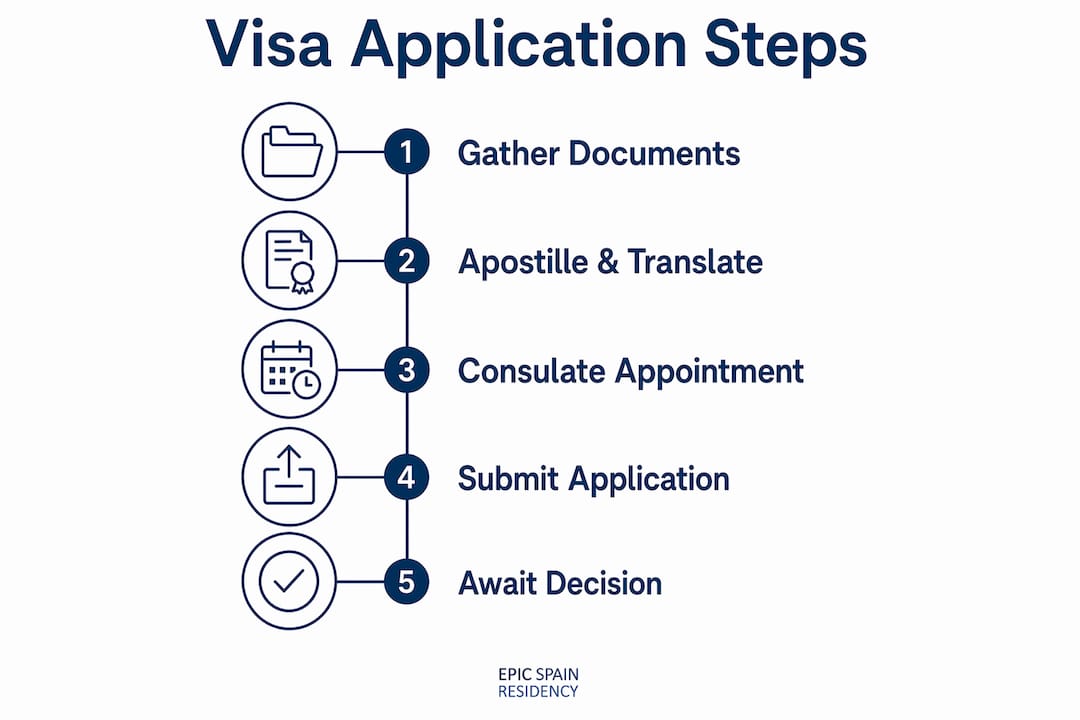
The Spain visa application process follows a defined sequence. Understanding the full visa processing timeline before you start prevents the most common scheduling errors.
Before you travel:
- Determine the correct visa type for your situation.
- Gather and certify all required documents, including apostilles and sworn translations.
- Book a consulate appointment in your country of residence. Appointment availability varies significantly by consulate. Some locations have wait times of several weeks.
- Attend the appointment in person, submit your complete document file, and pay the visa fee.
- Wait for the consulate decision. Processing times range from a few weeks to several months depending on the consulate and visa type.
After you arrive in Spain:
- Register at your local town hall (this is called empadronamiento and establishes your official address in Spain).
- Apply for your Foreigner Identity Card, known as the TIE card, at the local police station. This card is your physical proof of legal residency.
- Complete any additional registrations required for your visa type, such as social security enrollment for working visa holders.
Building a timeline that covers both pre-travel and post-arrival steps significantly reduces the risk of missing deadlines. Many applicants focus entirely on getting the visa and underestimate the post-arrival administrative workload.
Common reasons for delays include:
- Submitting documents that have expired between preparation and the appointment date
- Booking a consulate appointment before all documents are ready
- Failing to account for the time needed to obtain apostilles from foreign government agencies
- Missing the TIE application window after arriving in Spain
Pro Tip: Work backward from your planned move date. If you want to arrive in Spain in september, your consulate appointment should ideally be no later than june, accounting for processing time and post-arrival steps.
What are the most common spain visa compliance pitfalls?
Visa refusals in Spain follow predictable patterns. Incomplete or uncertified criminal records, invalid health insurance, expired passports, and incomplete translations account for the majority of avoidable denials. Knowing these pitfalls in advance gives you a clear advantage.
The most frequent compliance failures are:
- Criminal record timing errors: The certificate must be recent at the time of submission, not at the time you ordered it. If your appointment is delayed, you may need to reorder the certificate.
- Health insurance policy gaps: Policies with co-payments, geographic exclusions, or from non-authorized insurers are rejected outright. Always confirm the insurer's authorization status with the consulate before purchasing.
- Apostille and translation mismatches: A document with an apostille but no sworn translation, or a translation without a corresponding apostille, is treated as incomplete. Both elements must be present and consistent.
- Family document coordination failures: When applying with dependents, missing a single document for one family member can put the entire application on hold.
- Overstaying short-stay entries: Spain enforces a strict 90-day rule. The EES digital system records every entry and exit electronically. Overstaying is no longer a matter of judgment. It is a recorded fact with legal consequences.
Starting in 2026, the EU's Entry/Exit System makes overstaying a short-stay visa virtually impossible to conceal. Every border crossing is logged digitally. Applicants who plan to "figure it out once they arrive" face serious legal exposure.
Pro Tip: If your criminal record certificate is approaching its expiration window, order a new one before your consulate appointment rather than after. The cost of reordering is far lower than the cost of a delayed or refused application.
Key takeaways
Spain's visa legal requirements demand precise document compliance, correct visa category selection, and a well-managed timeline covering both pre-travel preparation and post-arrival registration steps.
| Point | Details |
|---|---|
| Choose the right visa type | Long-stay national visas are required for residency over 90 days and must be obtained before arrival. |
| Meet income thresholds | Non-Lucrative Visa applicants need approximately €2,400 per month in passive income, plus amounts for dependents. |
| Certify every document | Criminal records, civil certificates, and translations all require apostille legalization and sworn Spanish translation. |
| Health insurance must comply | Policies must come from Spain-authorized insurers, cover all of Spain, and include no co-payments. |
| Plan for post-arrival steps | TIE card application and town hall registration are mandatory after arriving in Spain on a long-stay visa. |
What i've learned from working with spain visa applicants
The single biggest mistake I see is treating the Spain visa application as a document collection exercise rather than a compliance project. Applicants gather the right documents in the wrong format, from the wrong sources, or at the wrong time. The consulate does not grade on effort. A criminal record certificate without an apostille is the same as no certificate at all.
Family applications add another layer of complexity that most guides underestimate. Coordinating apostilles, translations, and civil status certificates for three or four family members across multiple countries requires a project management mindset. I have seen families delay their move by six months because one dependent's birth certificate was not properly legalized.
The health insurance requirement is also more specific than most people expect. Spain does not simply require "health insurance." It requires a policy from an authorized insurer, with no co-payments, covering all of Spain, with no coverage gaps. Policies that look comprehensive on paper often fail on one of these technical points. Checking the Spain visa types relevant to your situation before purchasing insurance saves real money and time.
The EES system changes the stakes for anyone considering a "wait and see" approach to visa status. Digital border tracking means there is no gray area anymore. Start your application early, prepare your documents correctly the first time, and treat the timeline as a hard constraint, not a rough estimate.
— Living
How Epic-residency helps you meet spain's visa requirements
Epic-residency specializes in guiding non-EU individuals and families through Spain's visa and residency requirements from start to finish. Whether you are applying for a Non-Lucrative Visa, a partner residency, or a Digital Nomad Visa, Epic-residency handles the document compliance, consulate coordination, and post-arrival registration steps that applicants most often get wrong.

Epic-residency's boutique approach means your case is handled by specialists who know the specific requirements of your consulate, your visa type, and your family situation. If you are ready to move forward, explore Epic-residency's services and case studies to see how other non-EU families have successfully made Spain their long-term home.
FAQ
What is the minimum income for a spain non-lucrative visa?
Applicants must demonstrate approximately €2,400 per month in passive income, with additional amounts required for each dependent. Income benchmarks are tied to Spain's IPREM index and updated annually.
Can i switch from a tourist visa to a residency visa inside spain?
No. Non-EU nationals must obtain a long-stay national visa from the Spanish consulate in their home country before arriving. Switching visa status from inside Spain is generally not permitted.
What documents need an apostille for a spain visa application?
Criminal record certificates, civil status documents such as birth and marriage certificates, and any foreign official documents require both an apostille and a sworn certified translation into Spanish before submission to a Spanish consulate.
How long does the spain visa application process take?
Processing times vary by consulate and visa type, but applicants should plan for several weeks to several months from document submission to visa approval, plus additional time for post-arrival steps like the TIE card application.
What happens if i overstay my short-stay visa in spain?
Spain's EES digital system records every entry and exit electronically. Overstaying a 90-day short-stay visa is logged automatically and carries serious legal consequences, including bans on future entry to the Schengen Area.