

Spain is the top relocation destination for non-EU citizens seeking a Mediterranean lifestyle, accessible residency, and a lower cost of living than most of Western Europe. The country offers structured visa pathways including the Non-Lucrative Visa (NLV), the Digital Nomad Visa (DNV), and the Family Reunification Visa, each designed for different financial profiles and life situations. Whether you are a retiree living on passive income, a remote worker, or a family seeking better schooling and community, Spain has a legal route built for you. This guide covers the real reasons non-EU individuals and families choose Spain, what the process actually looks like, and what to expect once you arrive.
Why move to spain as a non-eu citizen?
The core reason non-EU citizens relocate to Spain is quality of life at a price point that Northern Europe and North America cannot match. Spain ranks 16th globally in quality of life, scoring high on healthcare, safety, climate, and lifestyle. That ranking reflects something real: over 300 sunny days per year on much of the peninsula, a public healthcare system that covers legal residents, and a food culture that keeps daily costs manageable even in mid-sized cities.
Spain also sits inside the Schengen Area, which means legal residents can travel freely across 27 European countries. For non-EU families, that mobility is a significant benefit that no single-country residency in Asia, the Americas, or Africa can replicate. Add in the path to permanent residency after five years and citizenship after ten, and the long-term value of moving to Spain from outside the EU becomes clear.

The country's work-life balance culture is another draw. Late dinners, community-centered weekends, and a pace of life that prioritizes family time over constant productivity attract people who are deliberately stepping away from high-pressure environments. That is not a cliché. It is a structural feature of Spanish society that shapes daily life in ways that matter.
What visa options exist for non-eu citizens moving to spain?
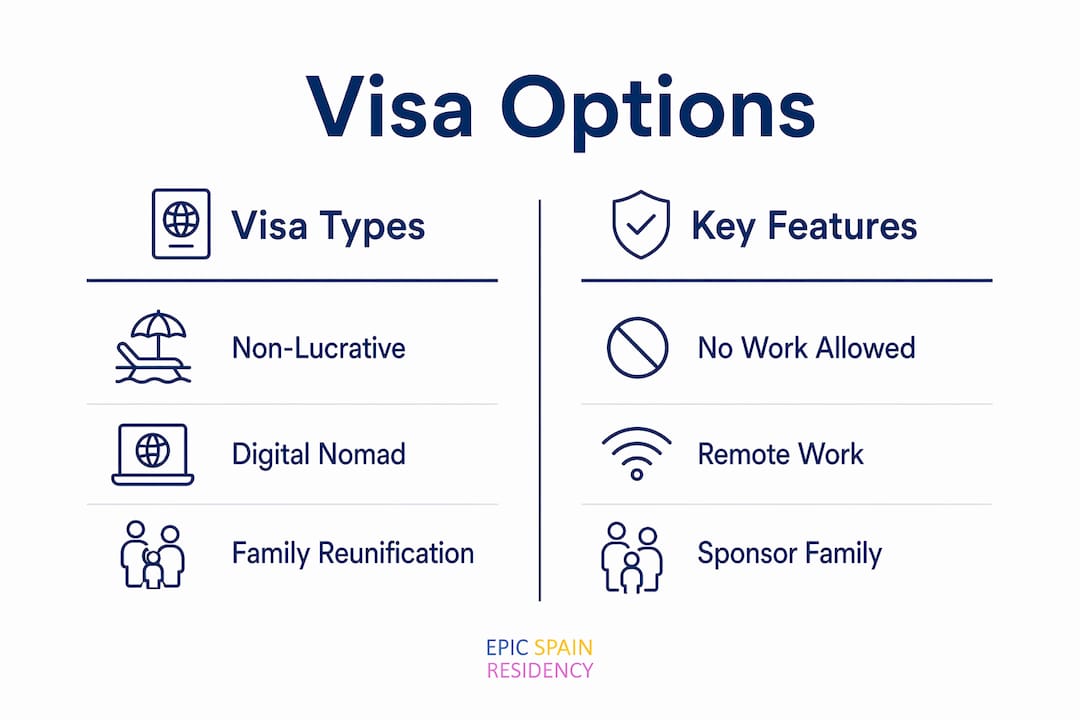
Three visa pathways cover the majority of non-EU applicants. Each targets a different lifestyle and income type.
Non-Lucrative Visa (NLV) The NLV is designed for financially independent individuals who do not intend to work in Spain. It requires minimum financial means of €28,800 per year for a single applicant and €36,000 per year for couples. Applicants must show passive income or savings, hold private health insurance from a Spanish-authorized insurer, and submit apostilled criminal records. The NLV prohibits employment or running a business in Spain, making it the preferred route for retirees and investors.
Digital Nomad Visa (DNV) The DNV targets remote workers employed by companies outside Spain. Applicants must demonstrate consistent income above a defined threshold and show that their work is conducted for non-Spanish clients. This visa allows holders to work legally while residing in Spain, which the NLV does not permit.
Family Reunification Visa Non-EU residents who already hold Spanish residency can sponsor qualifying family members through the family reunification process. This route is commonly used by couples and parents bringing children to join them after an initial residency is established.
| Visa Type | Who It Suits | Work Permitted | Key Financial Requirement |
|---|---|---|---|
| Non-Lucrative Visa | Retirees, passive income holders | No | €28,800/year (individual) |
| Digital Nomad Visa | Remote workers | Yes (non-Spanish clients) | Proof of stable remote income |
| Family Reunification | Dependents of residents | Conditional | Sponsor's income proof |
| Partner Visa (Pareja de Hecho) | Unmarried partners of residents | Conditional | Relationship documentation |
Processing times vary from two weeks to three months depending on consulate workload and how complete your documentation is. That range matters. Applicants who submit incomplete files wait at the longer end of that window, sometimes longer.
Pro Tip: Apply at least four months before your intended move date. Spanish consulates differ significantly in processing speed, and consulate-specific timelines are not always predictable. Earlier is always safer.
How does life in spain benefit non-eu residents?
The lifestyle benefits of living in Spain are concrete, not abstract. Here is what actually changes when you relocate.
Healthcare access is one of the strongest draws. Legal residents in Spain gain access to the public healthcare system after registering with a local health center. Spain's public system covers primary care, specialist visits, and hospital treatment. Private healthcare is also affordable by international standards, with monthly premiums significantly lower than comparable coverage in the United States or Australia.
Cost of living outside Madrid and Barcelona is genuinely lower than most Western European cities. Food and housing costs remain affordable especially outside the major urban centers, even as property prices in popular areas have risen. A family of four can live comfortably in Valencia or Seville on a budget that would be considered modest in London or Zurich.
Cities popular with non-EU expats include:
- Madrid: Best for professional networks, international schools, and English-language services
- Barcelona: Strong creative and tech community, Catalan culture, Mediterranean coast access
- Valencia: Lower cost than Madrid or Barcelona, excellent climate, growing expat community
- Costa del Sol (Malaga area): Large established expat population, English widely spoken, strong rental market
Non-EU expats consistently choose these cities for their combination of infrastructure, schooling options, and cultural diversity. Each city offers a different version of Spanish life, so your choice should match your priorities.
Family and community culture in Spain is another underrated benefit. Neighborhoods function as genuine communities. Children play outside. Grandparents are involved. The social fabric is tighter than in many countries where non-EU families originate, and that matters especially for families relocating with young children.
What challenges do non-eu movers face in spain?
Spain's residency process rewards preparation and punishes shortcuts. The most common obstacles are predictable and avoidable if you know what to expect.
Spanish bureaucracy is paper-heavy and procedurally rigid. Documents must be apostilled, translated by a certified translator, and submitted in the correct format. A single missing apostille can result in rejection and force you to restart the process from scratch. Treat every application as a legal procedure, not an administrative formality.
Health insurance compliance is the most frequently overlooked requirement. Full coverage without copays is the top cause of visa rejections among non-EU applicants. Standard travel insurance and home-country health policies do not qualify. You need a policy from a Spanish-authorized insurer that covers hospitalization, outpatient care, and repatriation, with no cost-sharing clauses.
Language barriers are real outside major cities. English is widely spoken in Madrid, Barcelona, Valencia, and the Costa del Sol, but Spanish proficiency is required for most official procedures and deeper community integration. Families who invest in Spanish language learning before arriving adapt significantly faster.
Visa processing delays are unpredictable. Even complete applications can sit for weeks longer than expected during peak periods. Plan your finances and housing arrangements to accommodate a flexible arrival window.
Pro Tip: Get your proof of funds documentation reviewed by a specialist before submission. The financial evidence standards are specific, and what counts as acceptable proof varies by consulate.
How can non-eu families integrate into spanish society?
Integration is a process, not an event. Families who approach it actively settle faster and report higher satisfaction with the move.
-
Learn Spanish before you arrive. Even basic conversational Spanish changes your experience dramatically. Apps like Duolingo and Babbel are useful starting points, but structured classes at a language school produce faster results. Children pick up Spanish quickly through school immersion, but parents need to invest independently.
-
Enroll children in the Spanish public school system. Spain's public schools are free for legal residents and provide the fastest route to language acquisition and social integration for children. International schools in Madrid, Barcelona, and Valencia offer English-language curricula for families who need continuity during the transition, but they come at a cost.
-
Register with your local town hall (empadronamiento). This registration is required for accessing public services including healthcare, schooling, and eventually residency renewal. It is one of the first steps after arrival and unlocks a range of residency and social benefits that legal residents are entitled to.
-
Join local expat networks and community groups. Cities like Valencia and Malaga have active expat communities organized through Facebook groups, Meetup events, and local associations. These networks provide practical support, housing leads, and social connection during the adjustment period.
-
Understand the long-term residency path. After five years of continuous legal residence, non-EU citizens can apply for permanent residency. After ten years, citizenship becomes available. Planning for these milestones from the start shapes how you structure your visa renewals and documentation.
Key takeaways
Spain offers non-EU citizens a legally accessible, lifestyle-rich relocation option that combines affordable living, quality healthcare, and a clear path to permanent residency.
| Point | Details |
|---|---|
| Visa options are structured | The NLV, DNV, and Family Reunification Visa cover most non-EU applicant profiles. |
| Financial thresholds are fixed | The NLV requires €28,800 per year for individuals; couples need €36,000 per year. |
| Health insurance is non-negotiable | Only Spanish-authorized policies without copays satisfy consulate requirements. |
| Integration requires active effort | Learning Spanish and registering locally accelerates settlement for the whole family. |
| Long-term residency is achievable | Five years of legal residence qualifies you for permanent residency; ten years for citizenship. |
What i've learned watching families move to spain
Most people who contact me about relocating to Spain underestimate one thing: how much the process rewards preparation and punishes assumptions. I have seen applicants with strong finances and genuine motivation get rejected because their health insurance policy had a single copay clause buried in the fine print. That is not bad luck. That is a documentation problem that a thorough review would have caught.
The lifestyle case for Spain is real. The climate, the food, the pace of life, the community feel in smaller cities like Valencia or Seville. These are not marketing points. They are things residents describe consistently after their first year. But the path to getting there requires treating the visa application as a legal process, not a paperwork exercise.
My honest advice: do not try to optimize for speed. Optimize for accuracy. A complete, correctly formatted application submitted four months before your target date will serve you far better than a rushed file submitted six weeks out. Spain is worth the patience. The families who arrive prepared are the ones who thrive.
— Living
How Epic-residency helps non-eu citizens move to spain
Epic-residency is a boutique Spain-focused immigration consultancy that handles the full residency application process for non-EU individuals and families. The team specializes in the Non-Lucrative Visa, the Digital Nomad Visa, and the Partner Visa, managing documentation, consulate compliance, and health insurance verification from start to finish.
Epic-residency works with clients across Asia, the Americas, and beyond, translating complex Spanish immigration requirements into clear, manageable steps. If you are ready to explore your options, the team at Epic-residency can assess your profile and identify the right visa pathway for your situation. You do not have to figure out Spain's bureaucracy alone.
FAQ
What is the minimum income for the non-lucrative visa?
The Non-Lucrative Visa requires €28,800 per year for a single applicant and €36,000 per year for couples. This must come from passive income sources such as pensions, investments, or savings.
Can non-eu citizens work in spain on a non-lucrative visa?
No. The NLV prohibits employment and running a business in Spain. Remote workers who need to work legally should apply for the Digital Nomad Visa instead.
How long does a spain visa application take to process?
Processing times range from two weeks to three months depending on the consulate and document completeness. Submitting a complete, apostilled file at least four months before your intended move date reduces the risk of delays.
Do non-eu residents get access to spanish public healthcare?
Yes. Legal residents who register with their local town hall and health center gain access to Spain's public healthcare system. Private health insurance is required for the initial visa application but does not replace public coverage once residency is established.
What is the path to permanent residency in spain?
Non-EU citizens who maintain continuous legal residence for five years can apply for permanent residency. Citizenship becomes available after ten years of legal residence, subject to language and integration requirements.