

Most people applying for a Spain visa focus almost entirely on gathering documents. They spend weeks compiling bank statements, health insurance certificates, and accommodation proof, then feel blindsided when the consulate requests an interview or asks for additional paperwork they never anticipated. Understanding the role of consulado in the Spain visa process from the start changes everything. The consulate is not a passive mailbox. It is the decision-making authority that controls your timeline, your eligibility assessment, and ultimately whether you get on that plane.
Table of Contents
- Key takeaways
- The role of consulado in the Spain visa process
- What the consulate actually does with your file
- How consulate procedures affect your timeline
- Collecting your visa after approval
- Common mistakes and how to avoid them
- My honest take on the consulate experience
- Ready to apply with confidence?
- FAQ
Key takeaways
| Point | Details |
|---|---|
| Jurisdiction determines your consulate | You must apply at the consulate covering your place of residence, not the nearest Spanish embassy. |
| Consulates hold real authority | They can request additional documents, summon you for interviews, and extend processing timelines. |
| Timelines are not fixed | Standard processing is 15 days for Schengen visas but can stretch to 45 days with consular requests. |
| Pickup is personal | Approved visas and passports must be collected in person by the applicant in most cases. |
| Refusals come with appeal rights | Written refusals include grounds and a window of one to two months to appeal or seek judicial review. |
The role of consulado in the Spain visa process
The Spanish consulate is the official government body responsible for receiving, reviewing, and deciding on visa applications submitted by foreign nationals. Its function goes far beyond stamping passports. The consulate verifies your eligibility, checks your documentation against Spain's visa requirements, and makes the final call on your application.
One of the first things to understand is consular jurisdiction. Applicants must file at the consulate that covers their specific place of residence. If you live in Los Angeles, you apply through the Spanish Consulate in Los Angeles. If you live in London, you go through the Spanish Consulate General in London. Moving to a different city and then applying at a different consulate because it seems more convenient is not allowed. The consulate assigned to your residential jurisdiction is the only one that can process your file.
This matters even more for applicants in Southeast Asia, where Spain maintains consulates in cities like Manila, Bangkok, and Kuala Lumpur. Each covers a defined geographic zone, and applying outside your zone is grounds for rejection before your application is even reviewed.
Here is what the consulate specifically manages in the visa process:
- Jurisdiction verification: Confirming that your residence falls within the consulate's geographic coverage area
- Main destination rule: For Schengen visa applications, the main destination must be Spain, or if you are spending equal time in multiple Schengen countries, the consulate of your first entry point handles the application
- Authorized submission centers: Many consulates route applications through third-party visa centers. Applications must be submitted in person by appointment at authorized centers like BLS International
- Appointment protocols: You cannot walk in. Every submission requires a pre-booked appointment, and availability varies significantly by location and time of year
What the consulate actually does with your file
Once your application is submitted, the consulate's authority kicks in at a level most applicants do not expect. The consulate services for Spain visa applicants extend well beyond document collection.

Consular offices can actively manage your file by requesting missing or supplementary documents and by calling you in for a personal interview before making a decision. This is not a rare occurrence. It happens regularly, particularly for long-stay visa categories like the Non-Lucrative Visa, the Digital Nomad Visa, and student visas.
The Spain visa interview process is not a formal interrogation, but it is a structured conversation where a consular officer assesses the credibility and completeness of your application. They may ask about your financial situation, your ties to your home country, your reasons for choosing Spain, or the specifics of your accommodation arrangements. Being unprepared for this conversation can undermine an otherwise solid application.
Here is where consular authority has the most practical impact:
- Document requests: The consulate can ask for items not listed in the standard checklist. This might include additional bank statements, a more detailed health insurance policy, or proof of property ownership in your home country
- Interview summons: You may be called in for a face-to-face meeting at the consulate itself, separate from your original submission appointment
- Eligibility assessment: Consular officers exercise discretion. Two applicants with similar profiles can receive different outcomes depending on how their files are presented
- Timeline control: Every request the consulate makes resets or extends your waiting period
Pro Tip: Prepare a document binder that goes beyond the minimum requirements. Include a cover letter explaining your application, a financial summary, and any supporting context that strengthens your case. Consular officers process hundreds of files. A well-organized, clearly explained application stands out.
How consulate procedures affect your timeline
Timeline expectations are where most applicants get tripped up. The legal standard for Schengen visa decisions is 15 calendar days from the date of application. That sounds fast. In practice, it rarely plays out that cleanly.
Here is how the timeline typically unfolds when consulate procedures are factored in:
- Appointment wait time: Before the clock even starts, you may wait weeks or months to secure a submission appointment, particularly in high-demand locations like New York, London, or Manila
- Standard processing window: Once submitted, the consulate has 15 calendar days to decide on Schengen visas. Long-stay national visas often carry longer official windows
- Extended processing: The decision period may be extended if the consulate needs to consult central authorities or request additional documentation. This can push the timeline to 30 or even 45 days
- Interview scheduling: If the consulate calls you for a personal interview, your file is paused until that interview takes place and the officer submits their assessment
- Post-interview review: After an interview, additional deliberation time is added before a final decision is issued
For applicants in Southeast Asia, the added complexity of time zone differences, local public holidays, and consulate-specific office schedules makes planning even more critical. Applicants from the U.K. post-Brexit face their own set of Spain visa requirements that differ from EU nationals, and processing volumes at consulates in London can create longer appointment backlogs than in smaller cities.
The practical takeaway: build at least 90 days of buffer between your application submission and any planned travel or relocation date. Timeline extensions from consular requests are common, and rushing this process creates unnecessary risk.
Collecting your visa after approval
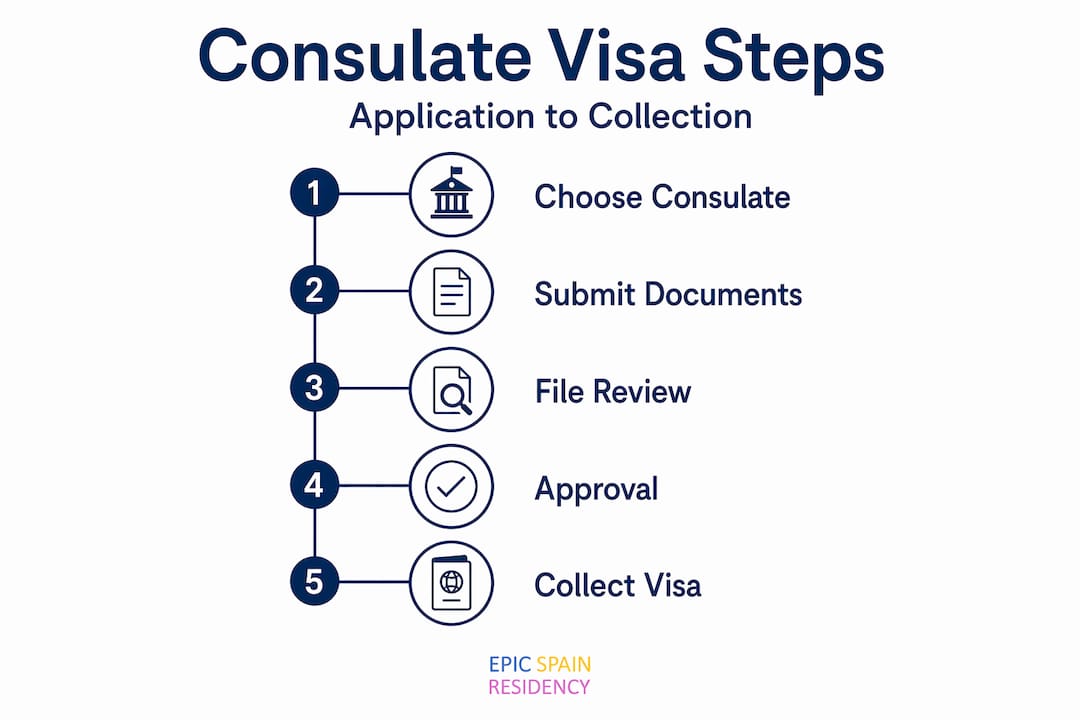
Approval is not the end of the process. What happens after the consulate approves your application catches many people off guard.
Students must pick up passports in person from BLS or the designated collection point. Representatives cannot collect on behalf of adult applicants. This rule applies broadly across visa categories, not just student visas. The practical implication is significant: you need to be physically available to collect your passport within the collection window the consulate specifies.
Key points to understand about visa collection:
- In-person requirement: The applicant must appear in person. Sending a friend, family member, or colleague is not permitted for adult applicants
- Minor exceptions: Parents or legal guardians may collect on behalf of minors, but documentation proving guardianship is required
- Collection windows: Consulates and visa centers specify a pickup period. Missing this window can create complications and may require rescheduling
- Location logistics: Post-approval collection at consulate-approved centers can be a hidden bottleneck, especially for applicants who live far from the designated pickup location
Pro Tip: When you submit your application, ask the visa center staff specifically about the collection process, the expected notification method, and the pickup window. Do not assume the process mirrors what you read online. Consulate-specific policies vary.
Common mistakes and how to avoid them
The function of Spanish consulate staff is to assess applications fairly, but they are not there to help you fix a poorly prepared file. That responsibility falls entirely on you.
The most damaging mistake applicants make is submitting incomplete documentation and assuming the consulate will ask for what is missing. That assumption is wrong. A consulate can refuse an application outright if it is materially incomplete, without giving you a chance to supplement it.
Here is how to approach the process with fewer complications:
- Submit a complete file from day one: Review the official checklist from your specific consulate, not a generic list from a third-party website. Requirements vary by consulate and visa category
- Prepare for interview requests: If you are applying for a long-stay visa, treat an interview as a real possibility, not a remote one. Know your application inside and out
- Book appointments early: In cities like London, Los Angeles, and Singapore, appointment slots fill weeks or months in advance. Waiting until your documents are ready to book your appointment is a common and costly mistake
- Understand your appeal rights: If your visa is refused, the refusal is notified in writing with stated grounds. You have one month to file for reconsideration and two months for judicial review. Use that window strategically, not emotionally
- Know your jurisdiction: Applying at the wrong consulate wastes time and money. Confirm your assigned consulate before you do anything else
For applicants pursuing long-term residency pathways like the Non-Lucrative Visa or the partner visa, the consulate interaction is more involved than for short-stay Schengen applications. The documentation requirements are heavier, the scrutiny is higher, and the stakes of getting it wrong are greater.
My honest take on the consulate experience
I have worked with applicants from the U.S., the U.K., and across Southeast Asia, and the pattern I see repeatedly is the same. People research Spain visa requirements thoroughly, prepare their documents carefully, and then walk into the consulate process assuming it will be linear and predictable. It is not.
What I have learned is that the consulate is not an obstacle. It is a filter. And the applicants who get through it smoothly are the ones who treat it that way. They do not just meet the minimum requirements. They anticipate what a consular officer might question and address it preemptively. They build timelines with real buffer. They understand that a request for an interview or additional documents is not a red flag. It is a normal part of how consulates do their job.
The uncomfortable truth is that most delays and refusals are preventable. Not because the rules are easy, but because the rules are knowable. The consulate's authority is well-defined. Its procedures are documented. What catches people off guard is not the system itself. It is the gap between what the official instructions say and what actually happens in practice.
My advice: treat the consulate interaction as the most important part of your application, not an administrative afterthought. Prepare as if an interview is guaranteed. Submit as if your file will be scrutinized by someone who has seen every trick and every shortcut. Because it will be.
— Epic-residency
Ready to apply with confidence?
Knowing how the consulate works is a real advantage. Applying with expert support is an even bigger one.
Epic-residency specializes in Spain visa applications for non-EU individuals and families across the U.S., U.K., and Southeast Asia. Whether you are pursuing the Non-Lucrative Visa, the Digital Nomad Visa, a student visa, or a partner residency pathway, the team at Epic-residency prepares your file to consulate standards from the start. That means fewer surprises, fewer delays, and a significantly higher chance of approval on the first submission. If your situation is complex or you are simply not willing to risk getting it wrong, reaching out to Epic-residency is the most practical next step you can take.
FAQ
What is the role of the consulado in the Spain visa process?
The Spanish consulate receives, reviews, and decides on visa applications. It verifies jurisdiction, assesses documentation, conducts interviews when needed, and issues the final visa decision.
Which consulate should I apply to for a Spain visa?
You must apply at the consulate that covers your place of residence. Applying at a consulate outside your jurisdiction is not permitted and will result in your application being rejected.
How long does the Spain visa process take at the consulate?
The standard legal decision period is 15 calendar days for Schengen visas, but this can extend to 45 days if the consulate requests an interview or additional documents.
Can someone else collect my visa from the consulate?
In most cases, no. Adult applicants must collect their passport and visa in person. Only parents or legal guardians may collect on behalf of minors, with appropriate documentation.
What happens if the consulate refuses my Spain visa?
Refusals are issued in writing with stated reasons. Applicants have one month to file for reconsideration and two months to pursue judicial review of the decision.
Recommended
- Partner Visa Spain | EPIC Residency | 西班牙伴侶簽證 (Pareja de Hecho) | 非歐盟伴侶居留途徑
- Non‑Lucrative Visa Spain | EPIC Residency | 西班牙非盈利簽證 | 最簡便的歐洲居留與退休移民方案
- Digital Nomad Spain | EPIC Residency | 西班牙數位遊牧簽證 | 遠距工作與歐洲居留新方案
- How Spain's Digital Nomad Visa is Boosting the Coastal Rental Market hence Attracting More International Investors