

If you hold a British National (Overseas) passport and you're planning to relocate to Spain, the Spain visa BNO passport holders guide you need is not the generic one floating around online. BNO holders occupy a specific legal position post-Brexit: not EU citizens, not standard British citizens with settled status, and not covered by any bilateral residency agreement. That gap creates real complexity. This guide covers exactly what you need to know, from short-stay rules and long-term visa options to the application process and what happens after you land.
Table of Contents
- Key Takeaways
- Spain entry rules for BNO passport holders
- Long-term visa options for BNO holders
- How to apply for a Spain visa as a BNO holder
- Settling in Spain after visa approval
- My take on Spain visas for BNO holders in 2026
- How Epic-residency helps BNO holders move to Spain
- FAQ
Key Takeaways
| Point | Details |
|---|---|
| 90-day limit applies | BNO holders can stay visa-free in Spain for up to 90 days per 180-day period only. |
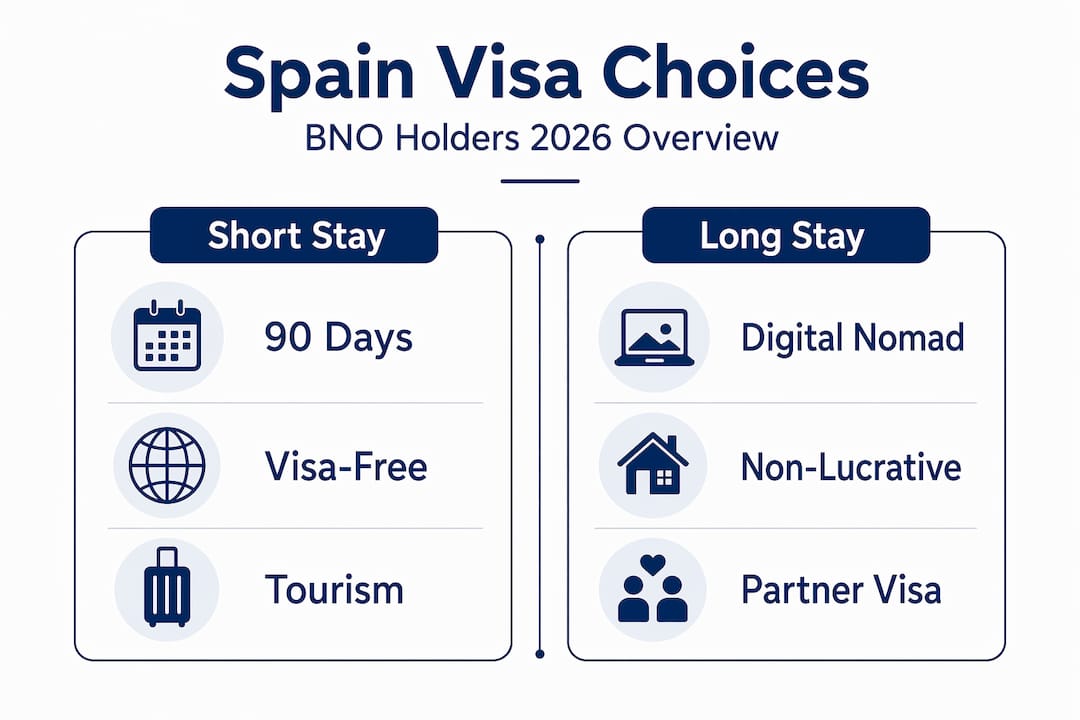
| Three main visa routes | The Digital Nomad, Non-Lucrative, and Partner visas are the most relevant long-term options for BNO holders. |
| Apply from your consulate | Applying at a Spanish consulate before arrival is safer and more predictable than applying inside Spain. |
| Document timing is critical | Apostilled criminal records and other documents expire quickly, so time your paperwork carefully. |
| Tax residency triggers fast | Spending more than 183 days in Spain makes you a tax resident, with significant financial consequences. |
Spain entry rules for BNO passport holders
Before you think about visas, you need to understand the baseline. As a BNO passport holder, you are treated as a third-country national under Schengen rules. That means 90 days visa-free in any 180-day rolling period for tourism or short business trips. Not 90 days per calendar year. The 180-day window rolls continuously, which catches a lot of people off guard.
Your passport must be valid for at least three months beyond your planned departure date from the Schengen Area. It also needs to have been issued within the last ten years. Both conditions must be met simultaneously, so check your passport before booking anything.
Here is what many BNO holders get wrong at the border:
- The 90-day clock starts on first entry, not on arrival in Spain specifically. Time spent in France, Germany, or any other Schengen country counts toward your limit.
- ETIAS is coming. The European Travel Information and Authorization System is expected to launch for third-country nationals, including BNO holders, in 2026. It is not a visa, but you will need pre-authorization before traveling.
- Overstaying has serious consequences. A single overstay can result in a multi-year entry ban and will complicate any future visa application.
Pro Tip: If you are splitting time between the UK and Spain while waiting for your visa to process, track your Schengen days on a spreadsheet. Border officers can and do check entry stamps, and being even one day over creates problems you do not want.
Long-term visa options for BNO holders
Once you decide to stay beyond 90 days, you need a visa. Spain offers several routes that work for BNO passport holders, and the right one depends entirely on your income source, lifestyle, and long-term plans.
Digital Nomad Visa
The Digital Nomad Visa (DNV) is Spain's newest and most talked-about residency route. It is designed for remote workers and freelancers who earn income from clients or employers outside Spain. The income threshold for 2026 sits at €2,762 per month, roughly twice Spain's minimum wage. You can find detailed eligibility criteria and application tips on Epic-residency's Digital Nomad Visa page.

You can work for Spanish clients, but only up to 20% of your total income may come from Spanish sources. The visa is initially granted for one year and can be renewed for up to five years total.
Non-Lucrative Visa
The Non-Lucrative Visa (NLV) is the go-to option for retirees and anyone living off passive income, savings, or pensions. You cannot work in Spain under this visa, which is a hard stop many applicants miss. The financial requirement is approximately €30,000 per year for the main applicant, plus around €8,000 for each dependent you bring with you.
Renewal requires that you have physically spent more than 183 days per year in Spain. This is a recent regulatory tightening that catches people who were treating the NLV as a flexible part-time residency. Spain now enforces this seriously. Epic-residency's Non-Lucrative Visa guide covers the renewal process in detail.
Partner Visa
If your spouse or partner is an EU citizen or already holds Spanish residency, the Partner Visa (Pareja de Hecho) can be a faster and less financially demanding route. It grants residency based on your relationship rather than your income. Documentation requirements are strict, and the relationship must be formally registered. More on this at Epic-residency's Partner Visa page.
Visa comparison at a glance
| Visa type | Best for | Income requirement | Work allowed? |
|---|---|---|---|
| Digital Nomad Visa | Remote workers, freelancers | €2,762/month | Yes (foreign clients) |
| Non-Lucrative Visa | Retirees, passive income holders | ~€30,000/year | No |
| Partner Visa | Spouses/partners of EU residents | Varies | Yes (after residency card) |
Pro Tip: Do not choose a visa based on which one is easiest to get. Choose based on what you plan to do in Spain for the next five years. Switching visa categories mid-residency is possible but slow and expensive.
How to apply for a Spain visa as a BNO holder
The application process is where most rejections happen, and most of them are preventable. Here is a step-by-step breakdown of what the process actually looks like.
-
Choose your consulate. You must apply at the Spanish consulate with jurisdiction over your place of legal residence in the UK or Hong Kong. You cannot simply pick the one with the shortest wait time.
-
Book your appointment early. Processing bottlenecks at Spanish consulates have pushed wait times up to six months in 2026. Treat this as a project with at least a three-month runway, preferably more.
-
Gather your documents. The standard checklist includes: a valid BNO passport, completed national visa application form, recent passport photos, proof of accommodation in Spain, apostilled criminal record check (from every country you have lived in for the past five years), private health insurance, and proof of financial means.
-
Get the right health insurance. This is the single most common rejection trigger. Spanish immigration requires zero-deductible, comprehensive private health insurance. Policies with co-pays are rejected. Read the policy terms carefully before purchasing.
-
Time your apostilled documents carefully. Criminal record certificates apostilled more than 90 days before your appointment are considered expired. Given consulate delays, document expiration during the wait period is a real and common problem. Order them as late as possible while still leaving yourself a buffer.
-
Submit and wait. Processing typically takes four to eight weeks after your appointment. You cannot legally enter Spain to begin your residency until the visa is stamped in your passport.
Pro Tip: If you are considering applying for the Digital Nomad Visa after arriving in Spain on a tourist entry, understand the risk clearly. Rejected applicants must leave immediately with no grace period to fix paperwork. Applying from a consulate before you arrive is almost always the safer choice.
Settling in Spain after visa approval
Getting your visa approved is the beginning, not the end. There are several legal steps you must complete within specific timeframes once you arrive.
- Register on the padrón municipal. This is the local population register at your town hall. You need it for almost everything: opening a bank account, enrolling children in school, accessing healthcare. Register within the first few weeks of arrival.
- Apply for your TIE card. The Tarjeta de Identidad de Extranjero is your physical residency card. You apply at a local immigration office (Oficina de Extranjería) within 30 days of arrival. Bring your passport, visa, padrón certificate, and photos.
- Understand your tax position. Spending more than 183 days in Spain triggers Spanish tax residency. This affects how your pension, investments, and foreign income are taxed. Many BNO holders relocating from Hong Kong are surprised by the scope of Spanish worldwide income taxation. Epic-residency has a detailed breakdown of UK tax reduction strategies that apply here.
- Arrange healthcare. Under the NLV, you rely on private insurance. Under the DNV, you may be able to access public healthcare after registering and paying into the social security system. Check your specific visa conditions.
The padrón is not optional. Without it, you are legally invisible in Spain. Every administrative process, from getting a driving license to accessing social services, runs through that registration.
My take on Spain visas for BNO holders in 2026
I've worked with enough BNO passport holders navigating Spain's immigration system to say this plainly: the biggest mistakes are not about paperwork. They are about timing and expectations.
Most people underestimate how long consulate appointments take to secure. Visa application tripling has made 2026 particularly difficult. I've seen applicants lose their rental deposits in Spain because their visa took three months longer than expected. Start the process earlier than you think you need to.
The second issue is visa choice. I've seen people pick the Non-Lucrative Visa because it sounds simple, only to discover they cannot legally do any freelance work and their savings are being depleted faster than planned. The DNV is more demanding to qualify for, but it gives you more flexibility. Match the visa to your actual life, not the path of least resistance.
Finally, tax planning from day one is not optional. Spanish tax residency is not something you can manage retroactively. Get advice before you move, not after your first Spanish tax return arrives.
— Living
How Epic-residency helps BNO holders move to Spain
Epic-residency is a boutique Spain immigration consultancy that works exclusively with non-EU individuals and families relocating to Spain. For BNO passport holders, that means hands-on support with Non-Lucrative Visa applications, Digital Nomad Visa qualification and filing, and Partner Visa documentation. The team knows exactly which health insurance policies pass Spanish consulate scrutiny, how to time documents around appointment delays, and how to structure your application to minimize rejection risk. Epic-residency also offers rental support in Spain to help you secure accommodation before your visa appointment, which is a required document in most applications. If you are serious about relocating, a consultation is the most efficient first step you can take.
FAQ
Can BNO passport holders live in Spain long term?
Yes, but you need a long-term visa. BNO holders can stay visa-free for up to 90 days per 180-day period, but relocating requires applying for a visa such as the Non-Lucrative Visa, Digital Nomad Visa, or Partner Visa before your tourist entry expires.
What income do I need for Spain's Digital Nomad Visa?
The Digital Nomad Visa requires a minimum monthly income of €2,762 in 2026, sourced primarily from clients or employers outside Spain.
How long does the Spain visa application take for BNO holders?
Processing typically takes four to eight weeks after your consulate appointment, but securing that appointment can take up to six months in 2026 due to high application volumes. Plan for a total timeline of six to nine months from start to finish.
What health insurance do I need for a Spain visa?
You need a comprehensive private health insurance policy with zero deductibles and no co-payments, valid in Spain for the full duration of your visa. Policies with any co-pay structure are rejected by Spanish immigration authorities.
Does living in Spain make me a Spanish tax resident?
Yes. Spending more than 183 days in Spain in a calendar year triggers Spanish tax residency, which means your worldwide income becomes subject to Spanish taxation. Early tax planning before your move is strongly advised.