

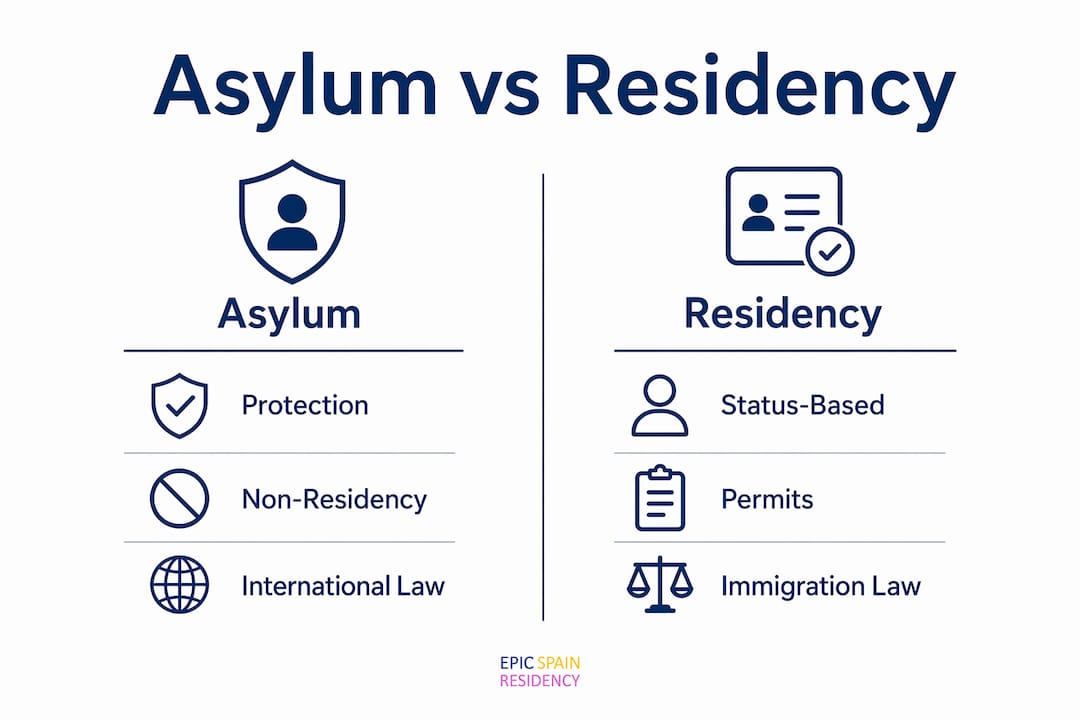
Asylum and residency in Spain are two legally separate statuses governed by entirely different bodies of law. Asylum is regulated by Ley 12/2009 and provides international protection to individuals fleeing persecution or serious harm. Residency, by contrast, is granted under immigration law and tied to categories like employment, study, family ties, or passive income. Understanding the Spain asylum vs residency legal difference is not just a technicality. It determines which documents you receive, what rights you hold, and how your path to long-term settlement unfolds. These two systems run in parallel, but they do not overlap automatically.
What is the spain asylum vs residency legal difference?
The core distinction is this: asylum is protection-based, and residency is status-based. Asylum exists to shield people from harm. Residency exists to authorize people to live and work in Spain under defined conditions.
Asylum and residency are distinct legal categories under Spanish law. Applying for asylum does not generate a residence permit. The documents issued during the asylum process, which are called the white card and red card, are procedural checkpoints, not immigration authorizations in the traditional sense. A red card tells the Spanish government you are a recognized asylum applicant. It does not tell an employer you hold a work permit under immigration law.

Residency permits, on the other hand, are issued under Spain's immigration framework and come in several types. These include the Non-Lucrative Visa, the Digital Nomad Visa, family reunification permits, and work-based authorizations. Each type grants specific rights tied to its category. The legal framework, the issuing authority, and the rights attached are all different from those connected to asylum status.
Pro Tip: If you are planning long-term settlement in Spain, identify your legal pathway before you apply for anything. Mixing asylum and residency strategies without understanding the restrictions can cause delays or disqualify you from certain permits entirely.
How does the asylum application process in spain work?
The asylum application process in Spain follows a structured sequence, and each stage produces different documentation with different legal weight.
- Registration. You declare your intention to seek asylum at a border post, a police station, or a designated asylum office. This step opens the procedure formally.
- Lodging the application. Once the application is formally submitted, Spain's Office of Asylum and Refuge (OAR) issues a white card as proof of lodging. This card confirms your application is in the system. It does not yet confirm admissibility.
- Admissibility review. OAR reviews whether your case qualifies for full examination. If admitted, the white card is replaced by a red card, which certifies your status as an asylum seeker and authorizes your legal stay in Spain during processing.
- Processing period. Processing can take up to two years in practice, well beyond the official six-month review window. Red cards must be renewed to maintain your legal stay and, after six months, your right to work.
- Decision. OAR issues a resolution granting refugee status, subsidiary protection, or rejection.
The red card is the document most people confuse with a residence permit. The red card is not a residence permit under immigration law. It is a temporary authorization tied specifically to your pending asylum case. This distinction matters enormously when you try to access banking, housing, or employment services that require standard immigration documentation.
Pro Tip: Renew your red card before it expires. A lapsed red card puts your legal stay at risk and can interrupt access to work authorization, even if your asylum case is still open.
How do refugee status and subsidiary protection differ?
Spain grants two forms of international protection under Ley 12/2009, and they are not interchangeable. Refugee status requires a well-founded fear of persecution based on race, religion, nationality, political opinion, or membership in a particular social group. These are the grounds defined by the 1951 Geneva Convention. Subsidiary protection applies when refugee criteria are not met, but the person faces a real risk of serious harm, including the death penalty, torture, or indiscriminate violence from armed conflict.
| Feature | Refugee Status (Asylum) | Subsidiary Protection |
|---|---|---|
| Legal basis | 1951 Geneva Convention, Ley 12/2009 | Ley 12/2009, EU Qualification Directive |
| Eligibility trigger | Persecution for Convention grounds | Risk of serious harm, no persecution required |
| Duration of status | 5-year renewable residence card | 1-year renewable, extendable to 5 years |
| Path to nationality | Eligible after 5 years of legal residence | Eligible after 10 years |
| Document issued | TIE card as refugee | TIE card as subsidiary protection holder |
The practical gap between these two statuses is significant. Family reunification, work authorization, and public service access are available under both, but the administrative timelines and renewal requirements differ. Refugees reach the five-year mark for nationality eligibility faster than subsidiary protection holders, who face a ten-year wait under standard rules. Choosing the right evidentiary approach when building your asylum case can therefore affect your settlement timeline by years.
What are the key differences between asylum and ordinary residency permits?
Asylum and ordinary residency permits serve different populations and produce different legal outcomes. Here is where the Spain asylum vs residency legal difference becomes most practical.
- Eligibility. Asylum requires demonstrating a protection need tied to persecution or serious harm. Residency permits require meeting criteria tied to income, employment, family relationships, or study enrollment.
- Documentation. Asylum produces a white card, then a red card, then a TIE card upon grant. Residency produces a TIE card directly, along with a foreigner identification number (NIE).
- Work rights. Asylum seekers gain work authorization only after six months of pending status. Most residency permit holders receive work rights from the start, depending on permit type.
- Duration and renewal. Residency permits under immigration law are issued for defined periods, typically one to two years initially, with renewal pathways leading to long-term residency. Asylum-related TIE cards follow different renewal cycles.
- Path to permanent residency. Both pathways can lead to permanent residency after five years of continuous legal residence. However, the documentation requirements and qualifying periods differ between protection status holders and standard permit holders.
The NIE (foreigner identification number) is often misunderstood. Both asylum seekers and residency permit holders receive an NIE, but the NIE alone does not indicate which legal status you hold. The TIE card is what specifies your actual authorization category.
Pro Tip: If you are considering Spain's Non-Lucrative Visa as an alternative to asylum, note that it requires proof of sufficient passive income and does not require employment. It is one of the most direct routes to stable legal residency for non-EU nationals who do not qualify for protection-based status.
What happens if asylum is rejected?
Asylum rejection does not automatically mean you must leave Spain. Several residency pathways remain available, but timing and sequencing are critical.
- Extraordinary regularization. Spain's 2026 regularization program allows some individuals with pending or rejected asylum claims to apply for stable residence permits. Applicants must renounce their asylum application to qualify, and eligibility requires proof of residence before January 1, 2026, along with a clean criminal record.
- National protection statuses. Spain recognizes certain national protection categories outside the asylum framework. These apply in specific humanitarian or exceptional circumstances and are governed by separate administrative rules.
- Standard residency permits. After rejection, you may apply for a work permit, family reunification, or other immigration-based authorization. However, a November 2024 reform limits eligibility for some residence permits if your asylum application is still active. You may need to formally withdraw your asylum claim before applying.
- Family reunification. If a family member holds legal residency or citizenship in Spain, you may qualify for a family reunification permit regardless of your prior asylum history.
- Non-Lucrative or Digital Nomad Visa. If you meet the financial or remote work criteria, these visa categories are entirely separate from the asylum system and can be pursued independently.
The 2024 reform is the most consequential recent change for people navigating both systems. It means you cannot simply hold an active asylum application as a backup while pursuing residency. You must choose, and you must time that choice carefully.
How do asylum and residency statuses affect long-term rights?
The rights attached to your legal status in Spain determine your daily life, not just your immigration file. The table below summarizes the key practical differences.
| Right | Asylum Seeker (Red Card) | Refugee / Subsidiary Protection | Standard Residency Permit |
|---|---|---|---|
| Right to work | After 6 months pending | Immediate upon grant | Depends on permit type |
| Family reunification | Limited during processing | Yes, upon grant | Yes, with qualifying permit |
| Access to public services | Basic humanitarian access | Full access | Full access per permit terms |
| Path to permanent residency | 5 years after grant | 5 years (refugee), 5 years (subsidiary) | 5 years continuous legal residence |
| Path to Spanish nationality | 5 years (refugee) | 10 years (subsidiary) | 10 years standard |
Refugees hold a meaningful advantage on the path to Spanish nationality. The five-year residency requirement for nationality, compared to ten years for most other categories, reflects Spain's commitment to integrating recognized refugees. Subsidiary protection holders do not share this accelerated timeline. Standard residency permit holders also face the ten-year standard unless they qualify through other routes such as marriage to a Spanish national.
Key takeaways
Asylum and residency in Spain operate under separate legal frameworks, and confusing them leads to documentation errors, missed deadlines, and lost eligibility for critical permits.
| Point | Details |
|---|---|
| Asylum is protection-based | Ley 12/2009 governs asylum; it is not a residency permit and does not automatically grant immigration status. |
| Red card is not a residence permit | The red card authorizes stay during processing only; it carries different legal weight than a TIE issued under immigration law. |
| Refugee status accelerates nationality | Recognized refugees can apply for Spanish nationality after 5 years; subsidiary protection holders wait 10 years. |
| 2024 reform affects sequencing | Active asylum applications can block eligibility for some residency permits; timing your withdrawal matters. |
| Residency permits offer broader stability | Work, family, and long-term rights are more clearly defined under standard immigration permits than during asylum processing. |
What i've learned from watching migrants navigate both systems
Most people who contact Epic-residency about asylum have already spent months in the system before realizing their red card does not function like a residence permit. That gap between expectation and legal reality is where things go wrong.
The most common mistake I see is treating the asylum application as a safety net while pursuing residency on the side. The 2024 reform closed that door. You cannot hold an active asylum claim and apply for certain residence permits simultaneously. The systems are not parallel tracks you can ride at the same time. They are separate roads, and at some point you have to pick one.
My honest view is that asylum should only be pursued when the legal grounds genuinely exist. It is not a migration strategy. It is a protection mechanism. When people use it as a fallback, they often end up in a worse position than if they had pursued a standard visa from the start. The Non-Lucrative Visa, the Digital Nomad Visa, and family-based routes are underused by people who assume they are out of reach. Many are not.
The 2026 regularization program is a real opportunity for people who have been in Spain informally. But it requires renouncing your asylum application, and that step is irreversible. Get legal advice before you make that call.
— Living
How Epic-residency helps you find the right path
If you are weighing your Spain immigration options and trying to understand whether asylum or a standard visa is the right route, Epic-residency provides the clarity you need before you file anything. The team specializes in non-EU residency pathways including the Non-Lucrative Visa, the Digital Nomad Visa, and partner-based residency. These are stable, well-defined routes that give you clear rights from day one. Epic-residency guides you through eligibility assessment, document preparation, and application sequencing so you avoid the timing errors that derail so many cases. Book a consultation to get a personalized assessment of your situation.
FAQ
What is the main legal difference between asylum and residency in spain?
Asylum is governed by Ley 12/2009 and provides international protection based on persecution or serious harm. Residency is granted under immigration law and tied to work, study, family, or income criteria.
Does applying for asylum in spain give you a residence permit?
No. The red card issued during asylum processing authorizes your stay during the procedure only. It is not a residence permit under immigration law and does not carry the same rights.
Can you apply for residency while your asylum case is pending?
A November 2024 reform limits eligibility for some residence permits while an asylum application is active. In many cases, you must formally withdraw your asylum claim before applying for a standard residency permit.
How long does asylum processing take in spain?
Processing formally targets six months, but in practice cases regularly extend up to two years. Red cards must be renewed throughout this period to maintain legal stay and work authorization.
Can a rejected asylum seeker still get legal residency in spain?
Yes. Options include Spain's 2026 extraordinary regularization program, family reunification, work permits, and passive income visas. Each route has its own eligibility criteria and timing requirements.