

Spain property purchase for foreign nationals is fully legal, unrestricted by nationality, and governed by a clear set of legal and financial steps that every buyer must complete. Whether you hold an EU passport or come from outside Europe entirely, Spanish law places no ceiling on what you can own. What it does require is an NIE (Número de Identificación de Extranjero), a working relationship with an independent lawyer, and a realistic budget that accounts for taxes and fees on top of the purchase price. This guide covers every stage of that process, from your first document application to your ongoing tax obligations as an owner.
What do foreign nationals need to buy property in Spain?
The single non-negotiable requirement for any spain property purchase foreign nationals undertake is the NIE. Spain's Golden Visa program ended in 2025 and no longer grants residency rights, so property ownership alone does not give you the right to live in Spain. You need to separate the purchase process from any residency ambitions and plan for both independently.
Foreign buyers come from every corner of the world. British nationals remain among the most active buyers on the Costa del Sol and Costa Blanca. American, German, and Scandinavian buyers concentrate heavily in the Balearic Islands and Catalonia. The Spanish real estate market does not discriminate by passport. It does, however, require paperwork, patience, and professional support.

What is an NIE and why do foreign buyers need one?
The NIE is a tax identification number issued by the Spanish authorities to all non-Spanish residents who engage in legal or financial activity in Spain. Without it, you cannot sign a purchase deed, open a Spanish bank account, pay property taxes, or register a mortgage. Every single legal transaction in the Spain property purchase process requires this number.
How to apply for an NIE:
- Apply in person at a Spanish consulate in your home country before you travel, which is the most reliable route for buyers who are not yet in Spain
- Apply at a National Police station (Comisaría de Policía) inside Spain, which requires an appointment booked through the official government portal
- Authorize a lawyer or gestor in Spain to apply on your behalf using a power of attorney, which is the most practical option if you cannot travel repeatedly
Processing times vary. Consulate applications typically take 2–6 weeks. In-country applications can be faster but appointment availability is unpredictable. Delays in obtaining the NIE cascade through every subsequent step, so apply the moment you decide to buy.
Pro Tip: Apply for your NIE before you make an offer on any property. Sellers and agents in Spain will not hold a property for you while you wait for a tax number.
What are the legal steps for buying property in Spain?
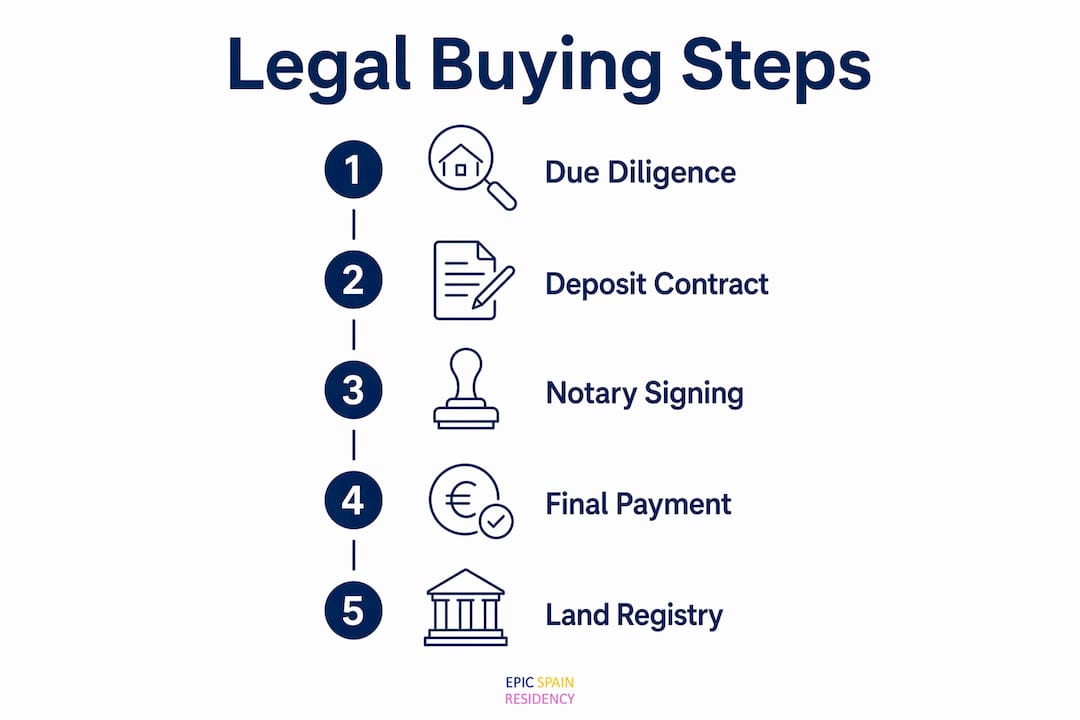
The Spain property purchase legal steps follow a defined sequence, and skipping any one of them creates financial and legal exposure that can be very difficult to unwind after completion.
Foreign buyers must appoint an independent lawyer who works exclusively for them, not for the estate agent or the seller. This is the single most important decision in the entire process. The notary public, who finalizes the deed, performs a neutral function. The notary verifies legality but does not represent your interests. Your lawyer does.
"The notary's role is to ensure the transaction is legal, not to protect the buyer. Foreign buyers who rely on the notary for due diligence are taking a serious risk." — Abaco Advisers Legal Checklist
Five due diligence checks your lawyer must complete before you sign anything:
- Land registry search (Registro de la Propiedad): Confirms the seller legally owns the property and identifies any mortgages, liens, or encumbrances registered against it.
- Cadastral check: Verifies the property's official size, boundaries, and classification match what the seller is representing.
- Urban planning verification: Confirms the property has all required building licenses and is not subject to demolition orders or planning violations.
- Debt searches: Checks for outstanding utility bills, municipal taxes (IBI), and any other charges that could transfer to you at completion.
- Community fees certificate: Under Spain's Ley de Propiedad Horizontal, buyers inherit community debts for the current year plus three prior years. A certificate confirming all fees are paid is a mandatory precontract check.
Once due diligence is complete, the buyer and seller sign a deposit contract. Spanish law uses a specific structure called arras penitenciales, governed by Article 1454 of the Spanish Civil Code. Under this arrangement, the buyer loses the deposit if they withdraw, and the seller must pay double the deposit if they withdraw. The deposit is typically 10% of the purchase price. This structure gives both parties real financial skin in the game.
How does financing work for non-resident buyers in Spain?
Spanish banks do offer mortgages to non-residents, but the terms differ from what residents receive. Non-resident mortgages are typically 60–70% loan-to-value, meaning you need a minimum 30–40% deposit from your own funds. Repayment terms run commonly 20–25 years. That deposit requirement is the biggest practical barrier for most foreign buyers.
| Buyer type | Maximum LTV | Rental income tax rate |
|---|---|---|
| EU/EEA resident | Up to 70% | 19% |
| Non-EU resident | Up to 60% | 24% |
| Spanish resident | Up to 80% | Standard income tax |
The tax difference on rental income is significant. An American or British buyer renting out a Spanish property pays 24% tax on rental income as a non-EU national. An EU citizen in the same situation pays 19%. That gap affects the yield calculation on any investment property and should factor into your decision before you buy.
Opening a Spanish bank account is practically required for the purchase process, even though it is technically optional. A Spanish bank account eliminates cross-border payment delays, simplifies tax payments, and reduces currency exchange costs over time. Banks like Santander, BBVA, and CaixaBank all offer non-resident accounts. Bring your passport, NIE, and proof of address from your home country.
Pro Tip: Lock in your currency exchange rate early using a specialist foreign exchange service. Moving large sums at spot rates can cost thousands of dollars compared to a forward contract.
What taxes and costs should you budget for in Spain?
Budget an extra 12–14% of the purchase price on top of the agreed sale price to cover all taxes and fees. That figure catches many first-time buyers off guard. On a 400,000 euro property, that means 48,000 to 56,000 euros in additional costs before you get the keys.
Breakdown of purchase costs:
- Property Transfer Tax (ITP): Applies to resale properties and varies by region, typically 6–10% of the purchase price
- VAT (IVA): Applies to new-build properties at 10%, plus 1.5% stamp duty
- Notary fees: Typically 0.5–1% of the purchase price
- Legal fees: Typically 1–1.5% for independent legal representation
- Land registry fees: A smaller fixed cost for registering the deed in your name
- Mortgage arrangement fees: If financing, add bank valuation and arrangement costs
Ongoing ownership costs are equally important to plan for. Annual filing of Form 210 is mandatory for all non-resident property owners, even if you do not rent the property out. Spain charges an imputed income tax on properties that are not your primary residence. You also pay the IBI municipal property tax annually, community fees if the property is part of a development, and potentially wealth tax if your Spanish assets exceed the regional threshold.
The community fee and Form 210 obligations begin from the first year of ownership. Many foreign buyers discover these obligations only after they have already missed a filing deadline. Set up a Spanish fiscal representative or use a gestor from day one.
How do you navigate the Spanish real estate market as a foreign buyer?
Spain's property market is not uniform. Prices in central Madrid and Barcelona bear no resemblance to rural Extremadura or inland Murcia. Foreign buyers concentrate in coastal and island markets: the Costa del Sol, Costa Blanca, the Balearic Islands, and the Canary Islands. These markets are driven by foreign investment and have seen sustained price growth even as other European markets cooled.
Practical tips for buying in Spain as a foreigner:
- Avoid off-plan purchases without legal protection: New developments look attractive but carry developer insolvency risk. Your lawyer must verify the developer holds a bank guarantee for your deposit.
- Use a power of attorney if you cannot attend completion: A notarized power of attorney lets your lawyer sign the final deed on your behalf. This is common and fully legal.
- Check short-term rental licenses before buying an investment property: Many municipalities have restricted or suspended new tourist rental licenses. Buying a property expecting rental income without a valid license is a costly mistake. The Spain Airbnb market has tightened considerably in major cities.
- Factor in document processing time: NIE applications, bank account opening, and mortgage approvals all take time. A realistic timeline from first offer to completion is 2–4 months.
- Hire a local gestor for ongoing compliance: A gestor handles your annual tax filings, community fee payments, and utility registrations for a modest annual fee. It is money well spent.
UK nationals face the additional complexity of post-Brexit rules. British buyers are now treated as non-EU nationals for mortgage and tax purposes. That means the 60% LTV cap and the 24% rental income tax rate apply. Understanding UK tax implications of Spanish property ownership is a separate planning exercise that requires specialist advice.
Key Takeaways
Buying property in Spain as a foreign national is legally straightforward but financially and procedurally demanding, requiring an NIE, independent legal counsel, and a budget that covers 12–14% in taxes and fees above the purchase price.
| Point | Details |
|---|---|
| NIE is mandatory | Apply for your NIE before making any offer. Every legal and financial step requires it. |
| Independent lawyer is non-negotiable | The notary is neutral. Only your own lawyer protects your interests during due diligence. |
| Budget 12–14% above purchase price | Taxes, notary fees, and legal costs add significantly to the headline price. |
| Non-resident mortgage caps at 60–70% LTV | You need a minimum 30–40% deposit from personal funds as a non-resident buyer. |
| Annual tax filing starts immediately | Form 210 and community fees are due from year one, even if you do not rent the property. |
What I have learned from watching foreign buyers get this wrong
The most expensive mistake I see foreign buyers make is not hiring an independent lawyer early enough. Buyers arrive in Spain, fall in love with a property, and trust the estate agent to handle the paperwork. The agent's lawyer then acts for both parties, which is a clear conflict of interest. By the time problems surface, the deposit is gone and the legal bills are mounting.
The second misconception is about the notary. Buyers assume the notary is their advocate. The notary is a public official who confirms the transaction is legal under Spanish law. That is a very different thing from confirming the transaction is good for you. A property can be legally transferred and still carry undisclosed debts, planning violations, or community disputes that your own lawyer would have caught.
The third issue is timing. Foreign buyers routinely underestimate how long document processing takes in Spain. The NIE, the bank account, the mortgage approval, and the due diligence checks all run in parallel, and any one of them can stall the whole process. Buyers who start these steps late lose properties they wanted or face pressure to sign before they are ready.
My honest advice: treat the legal and administrative setup as the first phase of the purchase, not a formality you handle after you find a property. The buyers who do this well spend their time in Spain enjoying their new home. The ones who skip steps spend it in lawyers' offices.
— Living
How Epic-residency helps foreign nationals settle in Spain
Buying property in Spain is often the first step toward building a life there. The next step is securing the right to stay.

Epic-residency specializes in helping non-EU nationals and families establish legal residency in Spain after their property purchase. The team handles Non-Lucrative Visa applications, NIE coordination, and the full residency pathway from initial application through long-term settlement. For buyers who want to live in their Spanish property rather than visit it, Epic-residency provides the immigration expertise that property lawyers do not. Speak with the team to understand which visa route fits your situation, your income, and your timeline.
FAQ
Can foreigners buy property in Spain without restrictions?
Yes. Foreign nationals face no ownership restrictions when buying property in Spain, regardless of nationality. The only mandatory requirement is obtaining an NIE before completing any legal transaction.
Does buying property in Spain give you residency rights?
No. Spain's Golden Visa program, which previously linked property investment to residency, ended in 2025. Property ownership now provides no automatic residency rights, and buyers must apply for a separate visa or residency permit.
How much does it cost to buy property in Spain as a foreigner?
Budget 12–14% above the purchase price to cover property transfer tax, notary fees, legal fees, and land registry costs. On a 300,000 euro property, that adds 36,000 to 42,000 euros in closing costs.
What mortgage can a non-resident get in Spain?
Spanish banks offer non-residents mortgages at 60–70% loan-to-value with repayment terms of 20–25 years. You must fund the remaining 30–40% from personal savings, plus all purchase taxes and fees.
What ongoing taxes apply to foreign property owners in Spain?
Non-resident owners must file Form 210 annually, pay the IBI municipal property tax, and cover community fees. Rental income is taxed at 19% for EU nationals and 24% for non-EU nationals.