

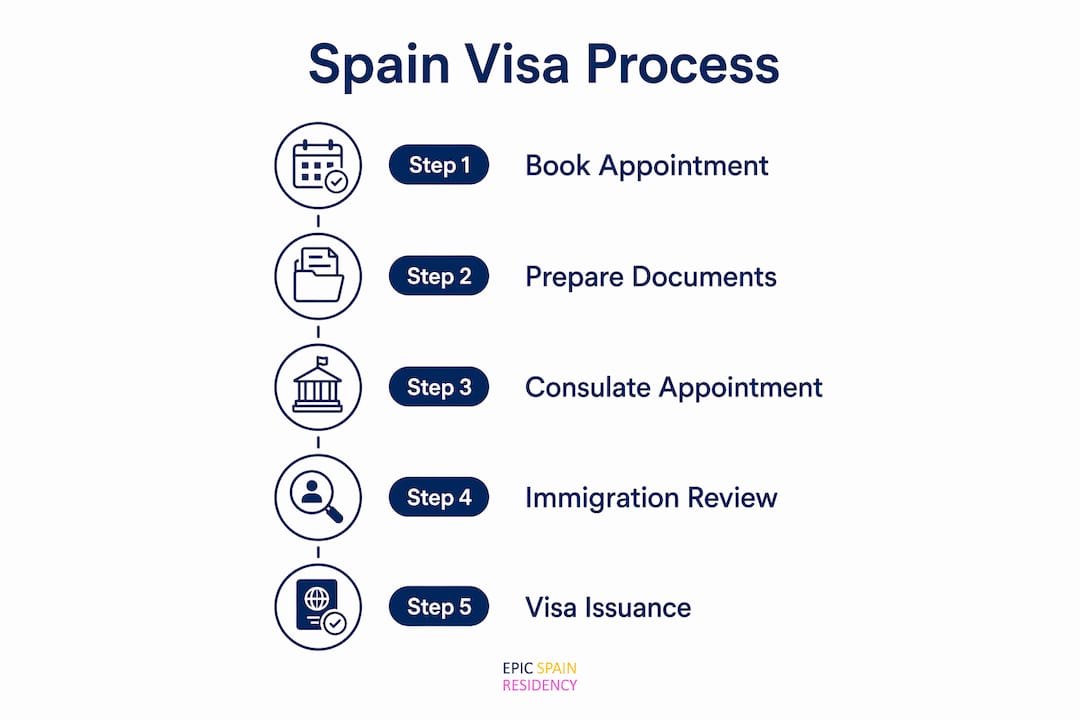
Spain consular processing is the structured procedure by which non-EU nationals apply for a Spanish visa through their home country's Spanish consulate before entering Spain to pursue residency. The process involves two distinct phases that many applicants conflate: the consulate stage abroad and the residency registration stage inside Spain. The Spanish Ministry of Interior and Provincial Aliens Affairs Offices both play roles, but at different points in the sequence. Getting clear on which authority handles what saves you from costly mistakes before you ever board a plane.
What is Spain consular processing, step by step?
Spain consular processing starts the moment you book your appointment at the Spanish consulate in your home country. The consulate does not help you prepare your application. Its job is to verify that your documents meet the requirements set by Spanish immigration law. That distinction matters more than most applicants realize.
Booking your appointment and gathering documents
Consulate appointment slots fill quickly, especially in major cities. Book as early as possible, often weeks or months in advance depending on your location. The document checklist for most long-stay visas includes a completed national visa application form, a valid passport, passport photos, proof of financial means, private health insurance, a clean criminal background check with apostille, a medical certificate, and proof of accommodation in Spain. All documents issued in a language other than Spanish require a certified translation.
The apostille requirement catches many applicants off guard. An apostille is an official authentication stamp recognized under the Hague Convention. Your background check and other official documents need one before the consulate will accept them.
- Completed national visa application form (signed)
- Valid passport with at least one year of remaining validity
- Recent passport photos meeting Spanish consulate specifications
- Proof of sufficient financial means (bank statements, pension letters, or income proof)
- Private health insurance covering Spain with no copayments
- Criminal background check with apostille, issued within 3–6 months
- Medical certificate confirming no contagious diseases
- Certified Spanish translations of all foreign-language documents
- Proof of accommodation in Spain (rental contract or property deed)
Pro Tip: Have a lawyer review your full document package before your appointment. Legal review significantly reduces the risk of errors that cause delays or outright denials at the consulate stage.
What happens at the consulate appointment
Most consulate appointments last only 15–30 minutes. Officials verify your documents rather than advise you on your application. They will collect your biometric data, including fingerprints and a photograph, and may ask basic questions about your plans in Spain. Your written documents and your verbal answers must align. Misalignment between the two is a significant red flag that can result in visa denial.

Visa fees typically range between €80 and €150 per applicant, depending on your nationality, the visa type, and the specific consulate. Payment methods vary by location. Most consulates require payment by bank draft or money order rather than cash or credit card. Confirm the accepted payment method with your consulate before your appointment date.
After the appointment, the consulate forwards your application to Spanish immigration authorities for review. You do not interact directly with those authorities. The consulate acts as the gatekeeper and communication channel throughout this stage.
How long does Spain visa processing take?
Processing times for Spanish national visas officially allow up to 3 months from the date of application. That is the legal maximum, not the typical experience. Real-world processing times generally fall in the 8–12 week range for well-prepared applications.
| Scenario | Estimated timeline |
|---|---|
| Best case (complete, error-free file) | 4–6 weeks |
| Average case | 8–12 weeks |
| Delayed case (document issues or backlog) | 3–4 months |
| Worst case (missing documents or resubmission) | Beyond 4 months |
Several variables push timelines toward the longer end. Consulate workload fluctuates by season, with summer months and holiday periods creating backlogs. Applications submitted in september or january tend to move faster than those submitted in june or december.
Incomplete or outdated documents are the most common cause of delays. Background checks and medical certificates expire 3–6 months after issue, which creates a timing challenge. If your background check expires while the consulate is still reviewing your application, you may need to resubmit. Plan your document gathering so that all time-sensitive items remain valid through the full expected processing window.
Pro Tip: Apply at least 3 months before your intended move date. Check the Spain visa timeline for 2026 to build a realistic schedule around your specific visa type.
What happens after your Spain visa is approved?
Visa approval triggers a specific set of actions you must complete in the right order. The consulate will notify you when your visa is ready for collection. Most consulates offer in-person pickup, and some offer courier delivery for an additional fee. Confirm the pickup or delivery options with your consulate when you submit your application.
As of 2026, the Spanish National Visa is valid for one year from the date of issuance. This replaced the previous 90-day validity window. The change gives applicants significantly more flexibility to plan their move without rushing to enter Spain within a narrow timeframe.
Key facts about your approved visa:
- The visa is a national long-stay visa (Type D), not a residency permit.
- You must enter Spain within the visa's validity period.
- The visa allows you to live in Spain while you complete the residency registration process.
- The visa does not replace the TIE residency card, which you must obtain after arrival.
- Entering Spain on a tourist visa or visa waiver and then attempting to convert to residency is not the correct procedure for most visa categories.
The role of the consulate ends at visa issuance. Once you enter Spain, a completely different set of authorities takes over.
What do you need to do after arriving in Spain?
Arriving in Spain with your visa is not the finish line. The visa grants you entry. Legal residency requires a separate step: obtaining the Foreigner Identity Card, known as the TIE card.
Scheduling your TIE appointment
You must schedule your TIE appointment within 30 days of arriving in Spain. Missing this window creates legal complications that are difficult and expensive to resolve. The TIE is your physical proof of legal residency and the document you will use for most official transactions in Spain.
The appointment takes place at the Provincial Aliens Affairs Office or, in some cities, at a designated police station. The Provincial Aliens Affairs Office handles many residency and registration steps inside Spain, making it a central point of contact for your first months in the country. The consulate has no involvement in this stage.
Steps to complete after arrival
- Register your address at the local town hall (empadronamiento). This registration is required for the TIE application and for accessing public services.
- Open a Spanish bank account. Most landlords and utility providers require a local account.
- Obtain a Spanish tax identification number (NIE) if you have not already done so through the consulate.
- Attend your TIE appointment with your passport, visa, empadronamiento certificate, completed application form, and the required fee payment receipt.
- Collect your TIE card when notified. Processing typically takes several weeks after your appointment.
Pro Tip: Book your TIE appointment the same week you arrive, not the same day. Appointment slots at the Provincial Aliens Affairs Office fill fast in major cities like Madrid, Barcelona, and Valencia. Waiting even a few days to search for a slot can push your appointment past the 30-day deadline.
A common misunderstanding is that the visa and the TIE are interchangeable. They are not. The visa is issued abroad and grants entry. The TIE is issued in Spain and grants legal residency. You need both, in that order, to be fully compliant with Spanish immigration law.
Key Takeaways
Spain consular processing requires completing the visa stage abroad and the residency registration stage inside Spain, and conflating the two is the most common and costly mistake applicants make.
| Point | Details |
|---|---|
| Two-phase process | The consulate handles visa issuance; Spanish local authorities handle residency registration after arrival. |
| Document timing matters | Background checks and medical certificates expire in 3–6 months, so coordinate your document gathering carefully. |
| Processing takes 8–12 weeks | Plan your move date at least 3 months after submitting your application to avoid pressure. |
| Visa validity is now one year | As of 2026, national visas are valid for 365 days from issuance, giving you more flexibility to plan travel. |
| TIE appointment within 30 days | Schedule your residency card appointment within 30 days of arrival to stay legally compliant. |
The part most guides skip over
The consular appointment is the most visible part of this process, but it is not the most consequential. The real risk zone is the 30-day window after you land in Spain. Most applicants spend months preparing for the consulate and then arrive in Spain without a clear plan for the TIE appointment, empadronamiento, or NIE. Those post-arrival steps are where legal status actually gets established.
I have seen well-prepared applicants with perfect document files stumble badly after arrival simply because they did not know the TIE appointment had to happen so quickly. The consulate gives you no briefing on what comes next. That information gap is not accidental. The consulate's job ends at visa issuance. What happens inside Spain is entirely your responsibility.
The other thing worth saying plainly: the 15–30 minute consulate appointment is not the place to discover a problem with your file. By the time you sit down with a consular officer, your documents either work or they do not. Professional review before submission is not a luxury for complicated cases. It is standard practice for anyone who cannot afford to restart a 3-month process from scratch.
— Living
How Epic-residency supports your Spain visa process
Preparing a complete, compliant visa file while managing the logistics of an international move is a significant undertaking. Epic-residency specializes in exactly this process for non-EU individuals and families relocating to Spain.
Epic-residency handles the full scope of Spain residency applications, from the Non-Lucrative Visa and Digital Nomad Visa to partner residency and student pathways. The team reviews your documents before submission, prepares you for the consulate appointment, and guides you through the post-arrival TIE and registration steps. If you want a clear process with professional oversight at every stage, Epic-residency is the place to start.
FAQ
What is Spain consular processing?
Spain consular processing is the procedure by which non-EU nationals apply for a Spanish visa at their home country's Spanish consulate before traveling to Spain. It covers document submission, biometric collection, and visa issuance.
How long does Spain visa processing take at the consulate?
Processing officially takes up to 3 months. Real-world timelines average 8–12 weeks for complete, well-prepared applications, with best-case scenarios as short as 4–6 weeks.
Is a Spanish visa the same as a residency permit?
No. The visa grants entry into Spain. The TIE residency card, obtained after arrival at local Spanish authorities, is the actual residency permit. You need both documents to be legally resident in Spain.
What documents do I need for a Spain consulate appointment?
Core documents include a completed visa application form, valid passport, proof of financial means, private health insurance, a criminal background check with apostille, a medical certificate, and certified Spanish translations of all foreign-language documents.
What happens if I miss the TIE appointment deadline after arriving in Spain?
Failing to schedule your TIE appointment within 30 days of arrival creates legal complications with Spanish immigration authorities. Resolving the issue typically requires legal assistance and can delay your residency status significantly.