

Spain immigration consultancy is defined as professional guidance that aligns visa applications, legal requirements, and tax obligations into a single coordinated strategy for non-EU individuals relocating to Spain. This role goes far beyond collecting documents. A qualified consultant or immigration lawyer diagnoses your visa pathway, prepares your application package, and coordinates with tax and Social Security frameworks to prevent compliance failures after you arrive. For families and individuals considering the move, understanding this role is the first step toward a successful, rejection-free application.
What the Spain immigration consultancy role actually covers
The Spain immigration consultancy role covers four core functions: pathway diagnosis, documentation preparation, legal coordination, and post-arrival compliance planning. Most applicants assume the job is filing forms. It is not.
The first task any qualified consultant performs is case diagnosis. They assess your income sources, employment type, nationality, and family situation to identify which visa fits your profile. Spain offers the Non-Lucrative Visa (NLV), the Digital Nomad Visa (DNV), the Partner Visa (Pareja de Hecho), student visas, and self-employed pathways, and each carries distinct eligibility criteria. Choosing the wrong one wastes months and money.

Documentation preparation is where route diagnosis and tax-immigration coordination become critical. A consultant builds your application package to match the specific consulate's expectations, not just the general legal standard. Consulates in New York, London, and Miami interpret the same rules differently, and an experienced consultant knows those variations.
Client support continues through the application window, including responding to official requests for additional documents, preparing you for any required interviews, and tracking your application status. For renewals, the same consultant should coordinate timing with your tax filings to avoid gaps in legal status.
- Pathway identification: Matching your financial and employment profile to the correct visa category
- Document assembly: Preparing apostilled, translated, and consulate-specific documentation packages
- Tax and Social Security coordination: Aligning your visa type with autónomo registration or employment contracts
- Application tracking: Monitoring status, responding to queries, and managing renewal timelines
- Family applications: Handling dependent and partner applications alongside the primary applicant
Pro Tip: Before your first consultation, prepare a one-page summary of your income sources, employment contracts, and family situation. Consultations typically run 30 to 60 minutes with a flat fee plus 21% VAT, and arriving prepared means you cover far more ground.
How immigration consultancy and immigration law differ in Spain
The distinction between an immigration consultant and an immigration lawyer (abogado) is not a technicality. It determines what kind of help you can legally receive and what recourse you have if something goes wrong.
| Professional | Legal powers | Best suited for |
|---|---|---|
| Immigration consultant | Advises, prepares documents, coordinates filings | Standard visa applications, renewals, pathway planning |
| Abogado (immigration lawyer) | Represents clients in appeals, legal proceedings, and court | Visa refusals, complex cases, family disputes, judicial appeals |
| Gestoría | Handles routine administrative filings | Tax registration, autónomo setup, basic paperwork |
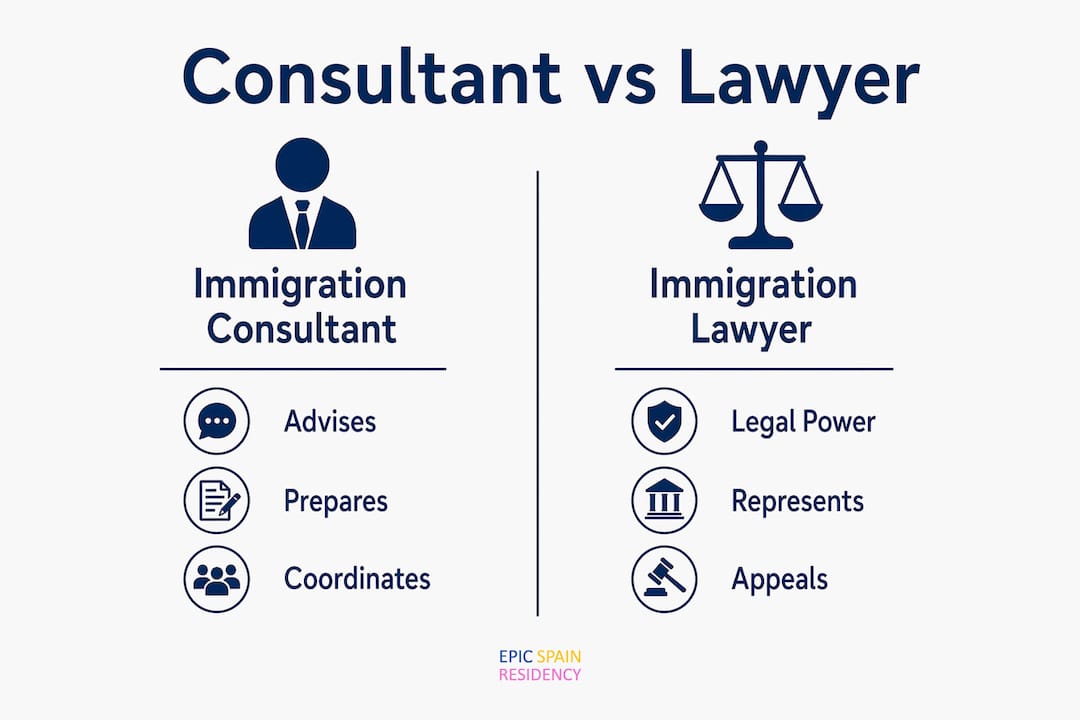
An immigration consultant operates without a law license. They can advise you, build your application, and coordinate with other professionals, but gestorías and consultants cannot represent clients in legal proceedings or file judicial appeals. That requires a licensed abogado with a colegiado number, which is the official bar registration number you can verify through Spain's Consejo General de la Abogacía.
Administrative appeals must be filed within one month of a refusal decision, and judicial appeals within two months. Missing those windows closes your legal options permanently. This is why a consultant who spots a refusal risk early and escalates to a lawyer saves you far more than their fee.
Gestorías occupy a third category. They are licensed administrative agents who handle routine filings: tax registration, Social Security enrollment, and autónomo paperwork. They are efficient and affordable for standard tasks, but gestores lack authority for judicial appeals and cannot provide strategic legal defense. For a straightforward NLV renewal, a gestoría may be sufficient. For a Digital Nomad Visa with complex employment structures, you need a consultant or lawyer with specialist knowledge.
Always verify credentials before hiring. Ask for a colegiado number if you are hiring a lawyer. For consultants, check client reviews, ask for case examples, and confirm they have handled your specific visa type before.
Why tax and Social Security planning must align with your visa
The most expensive mistake non-EU applicants make is treating their visa application as separate from their tax and financial identity in Spain. Immigration status, tax residency, and autónomo registration are deeply linked, and inconsistency between them can invalidate your legal status and trigger compliance investigations.
Here is a concrete example. You apply for a Non-Lucrative Visa, which prohibits work in Spain. You then register as autónomo (self-employed) after arrival because you want to invoice Spanish clients. That registration directly contradicts your visa conditions. The result is a compliance failure that can cost you your residency permit. A coordinated consultant catches this before it happens.
The Digital Nomad Visa creates its own layer of complexity. It permits remote work for non-Spanish clients and employers, but DNV applicants require employment proof, Social Security certificates, and complex compliance checks that leave very little margin for error. The visa also opens access to Spain's special tax regime, commonly called the Beckham Law, which caps income tax at 24% for qualifying applicants. However, you must apply for this regime within six months of registering as a tax resident. Miss that window and you lose the benefit permanently.
- NLV applicants must demonstrate passive income without triggering work-related tax registrations
- DNV applicants must align employment contracts with Social Security exemptions and Beckham Law eligibility
- Partner Visa applicants must coordinate their residency timeline with the primary applicant's tax filings
- Self-employed applicants must register as autónomo in a way that matches their permit's authorized economic activities
Pro Tip: Ask any consultant you interview whether they coordinate directly with a tax advisor or handle tax planning in-house. Fragments in consultancy services create unexpected financial risks after arrival. You want one team that sees the full picture.
When to hire a consultant and how to choose the right one
Professional support is not optional for every visa, but it is strongly recommended for any application with financial complexity, prior refusals, or family dependents involved. Here is a practical framework for deciding.
- Assess your visa complexity. A student visa for a single applicant with straightforward enrollment documents is manageable without professional help. A Digital Nomad Visa for a freelancer with multiple income streams and a spouse is not.
- Check for prior refusals. If you have been refused a Spanish visa before, legal planning reduces the chance of refusal and a lawyer should review your case before you reapply.
- Evaluate your tax situation. If you own property, have business income, or plan to work in any capacity after arrival, integrated consultancy covering both immigration and tax is worth the investment.
- Verify credentials. For lawyers, confirm their colegiado number. For consultants, ask for references from clients who completed the same visa type. Check whether they have handled consulate-specific requirements at your local Spanish consulate.
- Assess communication quality. Your consultant must be fluent in both English and Spanish. Errors in translation or misunderstandings with official bodies are a leading cause of delays.
Red flags include consultants who guarantee approval, quote unusually low fees without explaining scope, or cannot name the specific consulate requirements for your visa. A strong consultancy assesses eligibility and anticipates objections rather than simply filing papers and hoping for the best. You can review common visa denial reasons to understand what a good consultant should be protecting you against.
Common challenges consultants resolve in Spain's visa process
Spain's immigration system is not static. Consulate requirements shift, processing times vary by location, and procedural updates arrive without much public notice. Experienced consultants track these changes as part of their core service.
The most frequent challenge is documentation complexity. Each consulate interprets requirements slightly differently, and specialist consultants prevent errors by building application packages that meet the specific standards of your consulate rather than the general legal minimum. A family applying through the Spanish consulate in Los Angeles faces different practical requirements than one applying through Madrid.
Visa refusals are the second major challenge. Professional legal support is recommended for complex cases and visa refusals because the appeal window is short and the legal arguments must be precise. Consultants who lack legal standing cannot file these appeals, which is why knowing when to escalate to an abogado matters.
Family reunification applications add another layer. Dependent applications must be timed and documented in coordination with the primary applicant's permit. Errors in one application can delay or invalidate the other. Multi-person relocations, where a couple applies simultaneously under different visa categories, require a consultant who can manage both files without creating contradictions between them. You can also review the consulado's role in the process to understand how official bodies interact with your application.
Key takeaways
Spain immigration consultancy is most effective when it integrates visa strategy, tax planning, and legal coordination into a single process managed by qualified professionals from the start.
| Point | Details |
|---|---|
| Role definition | Consultants diagnose pathways, prepare documents, and coordinate tax and legal filings. |
| Consultant vs. lawyer | Only licensed abogados can file appeals; consultants handle standard applications and planning. |
| Tax alignment is critical | Visa type directly affects tax residency and autónomo registration; misalignment causes compliance failures. |
| Timing matters | Beckham Law applications and appeal deadlines have fixed windows that cannot be recovered once missed. |
| Credential verification | Always confirm a colegiado number for lawyers and request visa-specific case references for consultants. |
What I've learned about immigration consultancy in Spain after years in this space
Most people come to us thinking immigration consultancy means someone fills out forms on their behalf. That framing leads to bad hiring decisions and worse outcomes.
The consultants and lawyers who consistently deliver results are the ones who treat a visa application as a legal and financial strategy, not an administrative task. They ask about your income structure before they ask about your passport. They want to know whether you plan to buy property, whether your employer is EU-based, and whether you have ever been refused a Schengen visa. Those details shape the entire application.
What I find most underestimated is the Beckham Law window. Families spend months planning their move and then miss the six-month registration deadline because nobody told them it existed. That is not a paperwork error. It is a planning failure, and it is exactly what integrated consultancy prevents.
The Spain immigration space is also evolving fast. The Digital Nomad Visa framework is still relatively new, and consulates are still calibrating their interpretation of the requirements. Applicants who work with consultants tracking those changes in real time have a measurable advantage over those who rely on outdated guides.
My honest advice: do not hire the cheapest option or the one with the most polished website. Hire the professional who asks the most questions before quoting you a price. That is the one who understands what your case actually involves.
— Living
Ready to work with a Spain immigration specialist?
Epic-residency is a boutique Spain-focused consultancy built specifically for non-EU individuals and families relocating to Spain for the long term. The team handles the full spectrum of visa and residency pathways, from the Non-Lucrative Visa and Digital Nomad Visa to Partner Visa applications and long-term citizenship planning. Every client receives coordinated advice that covers both immigration and tax strategy, so nothing falls through the gap between those two worlds. Pricing is transparent, the team is bilingual, and consultations are structured to give you a clear action plan from the first session.
If you are planning a move to Spain and want to understand exactly which visa fits your situation, Epic-residency offers initial consultations that cover pathway diagnosis, documentation requirements, and tax implications in one session.
FAQ
What does a Spain immigration consultant do?
A Spain immigration consultant diagnoses your visa pathway, prepares your application documents, and coordinates with tax and Social Security requirements to give your application the strongest possible foundation. They differ from immigration lawyers in that they cannot represent you in legal appeals or court proceedings.
When do you need an immigration lawyer instead of a consultant?
You need a licensed abogado when your visa has been refused, when you face an appeal deadline, or when your case involves complex legal arguments. Administrative appeals must be filed within one month of a refusal, making timely legal intervention critical.
How much does an immigration consultation in Spain cost?
Immigration consultations typically run 30 to 60 minutes at a flat fee that includes 21% VAT. The exact cost varies by firm, but most specialist consultancies charge between €100 and €300 for an initial session covering pathway diagnosis and planning.
What is the difference between a gestoría and an immigration consultant?
A gestoría handles routine administrative filings like tax registration and autónomo enrollment, but cannot represent clients in legal proceedings. An immigration consultant provides strategic visa planning and application management, while a licensed abogado handles legal defense and appeals.
Does the Digital Nomad Visa require specialist consultancy support?
Yes. The Digital Nomad Visa requires employment proof, Social Security certificates, and compliance checks that leave very little margin for error, and it also opens access to the Beckham Law tax regime, which must be applied for within six months of tax residency registration.