

The apostille process for Hong Kong documents destined for Spain is defined as an official certification under the 1961 Hague Convention that authenticates signatures and official seals on public documents, making them legally recognized by Spanish authorities. The Hong Kong High Court Registry issues apostilles for documents originating in Hong Kong, while Spain's Ministry of Foreign Affairs (MAEC) governs which sworn translators may certify those documents into Spanish. For families and individuals relocating from Hong Kong to Spain, understanding this two-step sequence, apostille first and sworn translation second, is the single most critical factor in avoiding visa rejection. Spanish consulates will not accept apostilled documents without a certified sworn translation, and they will not accept sworn translations without a prior apostille. Getting both steps right, in the correct order, is what separates a successful application from a costly restart.
What is the Hong Kong documents Spain apostille process?
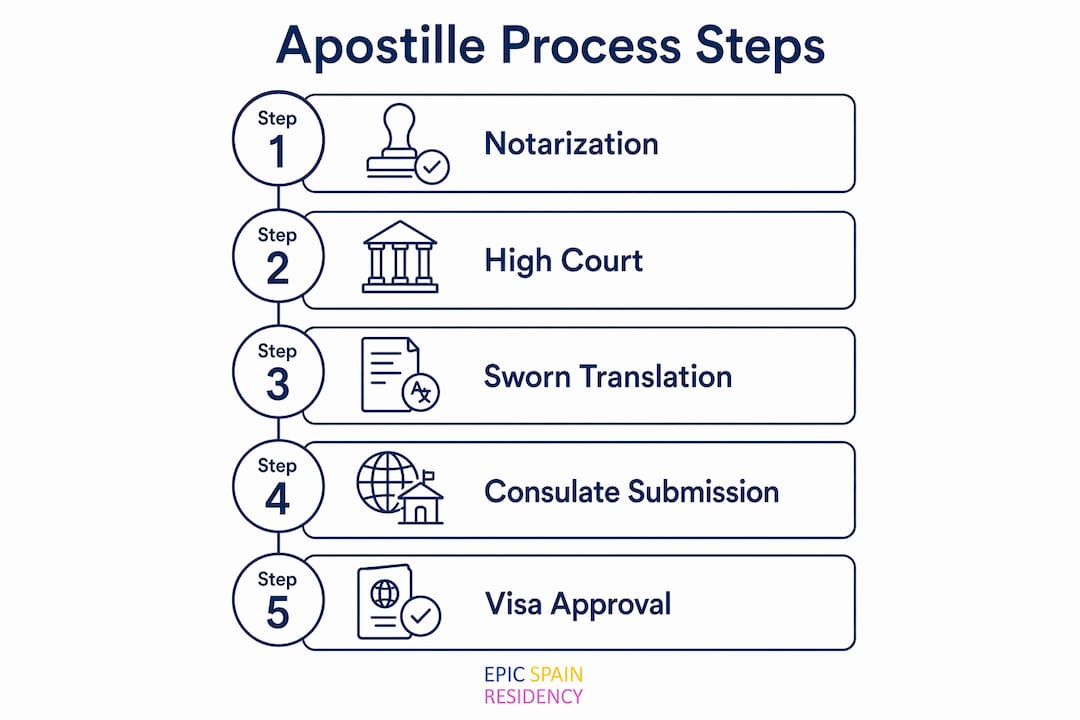
The Hong Kong to Spain document process follows a fixed legal sequence that cannot be reordered. Every public document you submit for a Spanish visa or residency application must pass through the Hong Kong High Court, receive an apostille certificate, and then go to a MAEC-registered sworn translator before it reaches the Spanish consulate. Skipping or reversing any step causes outright rejection.
Spain's legal requirements for foreign documents apply to all non-EU applicants equally. Hong Kong residents face the same rules as applicants from any other Hague Convention jurisdiction. The apostille confirms that the signature and official capacity on a document are genuine. It does not validate the accuracy of the document's content, which is why Spanish authorities also require a sworn translation that certifies the full text, including the apostille certificate itself.

Pro Tip: Start collecting your documents at least three months before your planned consulate appointment. Processing delays at any single step can push your entire timeline back by weeks.
Which Hong Kong documents require apostille for Spain?
Not every document in your application package needs an apostille. The distinction between public and private documents determines what authentication path each one follows.
Public documents that require apostille include:
- Birth certificates issued by the Hong Kong Registry of Births, Deaths and Marriages
- Marriage certificates from the same registry
- Criminal record checks from the Hong Kong Police Force
- Academic transcripts and degree certificates issued by recognized universities
- Death certificates when required for inheritance or family reunion applications
Private documents require notarization by a Hong Kong notary public before they can receive an apostille. A power of attorney, a commercial contract, or a privately drafted declaration falls into this category. The Hong Kong High Court apostille office will reject a private document that arrives without prior notarization.
Documents that do not require apostille include bank statements, private insurance policies, and employment letters from private companies. Spanish consulates accept these in their original form, sometimes with a certified translation but without apostille. Confirm the specific requirements for your visa category before assuming any document is exempt.
Pro Tip: Request multiple certified copies of each public document at the time of issue. Apostille offices accept only originals or certified true copies signed by a government officer or notary. Plain photocopies are refused.
How do you obtain an apostille for Hong Kong documents?
The step-by-step process at the Hong Kong High Court Registry is straightforward once you know what to bring.
- Prepare your documents. Gather original documents or certified true copies. Photocopies are not accepted under any circumstances.
- Notarize private documents first. Take any private document to a Hong Kong notary public before visiting the High Court. Public documents signed by recognized government officials skip this step.
- Submit to the High Court Apostille Service Office. You may attend in person or send documents via courier. The office is located within the High Court building in Admiralty.
- Pay the fee. The apostille fee is HKD 125 per document. Standard processing takes approximately two working days.
- Collect your apostilled documents. Each document receives a paper apostille certificate attached or affixed to it. Keep these in a secure folder and do not separate the apostille from the document it certifies.
Digital apostille availability in 2026
Hong Kong has introduced a digital apostille system accessible through the Judiciary portal. The e-Apostille system is currently available primarily to registered Notaries Public and issues electronically signed apostilles that carry the same legal weight as paper versions. For most individual applicants, the paper apostille remains the standard route. If your notary offers an e-Apostille, confirm with the Spanish consulate in Hong Kong that it will be accepted before proceeding, as acceptance practices vary by consulate and document type.
Why is sworn translation required after apostille?
Spain document legalization does not end with the apostille. Every apostilled document submitted to a Spanish consulate must be translated into Spanish by a sworn translator officially recognized by MAEC. This is a legal requirement, not a preference.
The mandatory sequence exists for a specific reason. Sworn translators certify the entire document package, including the apostille certificate attached to it. If you translate a document before obtaining the apostille, the translator's certification covers an incomplete document. Spanish authorities will reject it because the apostille, added afterward, was never part of the certified translation.
Common errors that cause rejection include:
- Translating documents before the apostille is attached
- Using a translator who is not on the MAEC official register
- Submitting a translation that covers only the main document text but not the apostille certificate
- Assuming a bilingual friend or a general translation agency qualifies as a sworn translator
The sworn translation requirement applies to all long-term Spanish visa categories, including the Non-Lucrative Visa and the Digital Nomad Visa. Costs for sworn translation vary by document length and translator, but budget for several days of processing time per document. For detailed guidance on translation requirements, the specific rules for each document type are worth reviewing before you commission any translation.
Pro Tip: Ask your sworn translator to confirm in writing that their certification covers the apostille certificate as well as the main document body. This one question prevents the most common rejection reason.
What are the most common pitfalls in the Hong Kong to Spain document process?
The correct document order is: original document, then notarization if required, then apostille, then sworn translation. Reversing any step forces you to restart from the point of error, which costs time and money.
The most frequent mistakes families make include:
- Wrong sequencing. Translating before apostilling is the single most common error. The sworn translator must see the final, apostilled document.
- Skipping notarization. Private documents submitted directly to the apostille office without prior notarization are rejected on the spot.
- Expired documents. Criminal record checks and some certificates carry expiration periods. A document apostilled six months ago may no longer be valid by the time your consulate appointment arrives.
- Relying on non-sworn translations. General translation agencies produce documents that Spanish consulates will not accept for visa purposes.
- Failing to verify apostille authenticity. You can verify any Hong Kong apostille through the e-APP database maintained by the Hague Conference on Private International Law. Use it before submitting.
Tracking your documents with a status table
Managing multiple documents across different stages is where applicants most often lose track. A document status table captures each document's current stage, authentication status, translation status, and expiry date in one place. This method prevents last-minute discoveries that a key document has expired or was never apostilled.
| Document | Notarized | Apostilled | Translated | Expiry date |
|---|---|---|---|---|
| Birth certificate | N/A | Yes | Pending | None |
| Criminal record check | N/A | Yes | Yes | 3 months |
| Degree certificate | N/A | No | No | None |
| Power of attorney | Yes | Yes | Yes | 1 year |
Keep this table updated every time a document moves to the next stage. Review it one week before your consulate appointment to catch any gaps.
Key Takeaways
The Hong Kong documents Spain apostille process requires strict sequencing: apostille from the Hong Kong High Court first, sworn translation by a MAEC-registered translator second, with no exceptions.
| Point | Details |
|---|---|
| Apostille comes first | Obtain the Hong Kong High Court apostille before commissioning any sworn translation. |
| Public vs. private documents | Public documents go directly to apostille; private documents need notarization first. |
| HKD 125 per document | The standard fee at the High Court Registry covers approximately two working days of processing. |
| MAEC-registered translators only | Spain accepts sworn translations only from translators on the official Ministry of Foreign Affairs register. |
| Track every document | Use a status table with authentication, translation, and expiry columns to avoid last-minute failures. |
What I've learned watching families get this wrong
The apostille process looks simple on paper. In practice, the sequencing requirement catches almost every first-time applicant off guard. The families I've seen struggle most are those who treat document preparation as something to handle in the final weeks before their consulate appointment. By then, there is no margin for error.
The most painful cases involve criminal record checks. These documents expire quickly, often within three months of issue. An applicant who apostilles a criminal record check in january and then waits until april to book a consulate appointment may find the document has expired before the appointment date. They then restart the entire cycle: new criminal record check, new apostille, new sworn translation.
The consular processing sequence rewards applicants who plan backward from their target move date, not forward from today. Set your consulate appointment date first. Then count back the weeks needed for sworn translation, apostille processing, notarization if required, and document collection. That backward calculation usually reveals that you need to start four to five months earlier than you assumed.
Professional help at the notarization and apostille stages is worth the cost for most families. A Hong Kong notary public who regularly handles Spain-bound documents knows exactly which format each document needs to be in before it reaches the High Court. That knowledge alone eliminates the most common rejection reasons before they happen.
— Living
How Epic-residency helps Hong Kong residents move to Spain
Preparing apostilled and translated documents for a Spanish visa is a process where one misstep can set your timeline back by months. Epic-residency works with Hong Kong residents and families at every stage of the Spain relocation process, from document preparation and apostille guidance to consular application submission.

Epic-residency specializes in the Non-Lucrative Visa and the Digital Nomad Visa, two of the most common pathways for Hong Kong families relocating to Spain. The team reviews your full document list, confirms which items need notarization, and coordinates with MAEC-registered translators to keep your application on track. If you want a clear plan for your move rather than a stack of paperwork to figure out alone, Epic-residency is the place to start.
FAQ
What is an apostille and why does Spain require it?
An apostille is an official certification issued under the 1961 Hague Convention that confirms the authenticity of a document's signature and official seal. Spain requires apostilles on foreign public documents because they serve as the internationally recognized proof that a document is genuine.
How long does the Hong Kong apostille process take?
The Hong Kong High Court Registry processes apostille applications in approximately two working days, with a fee of HKD 125 per document. Delays can occur if documents are incomplete or if private documents arrive without prior notarization.
Can I use a digital apostille for my Spain visa application?
Hong Kong's e-Apostille system is currently available primarily to registered Notaries Public. Confirm with the Spanish consulate in Hong Kong before submitting an e-Apostille, as acceptance depends on the consulate and the document type.
What happens if I translate my documents before getting the apostille?
Translating before apostilling produces an incomplete certified document. The sworn translator must certify the full package including the apostille certificate, so translating first results in a translation that Spanish authorities will reject.
How do I find a MAEC-registered sworn translator in Hong Kong?
The Spanish Ministry of Foreign Affairs publishes an official list of sworn translators authorized to certify documents for Spain. Search the MAEC register by language pair (Chinese to Spanish) and confirm the translator's registration is current before commissioning any work.