

Document translation for Spain visa requirements means securing sworn translations from Ministry-certified translators after authenticating your original documents. The standard industry term for this is traducción jurada, or sworn translation. Spanish consulates and immigration offices reject informal translations outright, regardless of how accurate they appear. Every non-Spanish document in your visa application must carry the signature, stamp, and legal attestation of a translator officially appointed by Spain's Ministry of Foreign Affairs. Getting this wrong is one of the most common and most avoidable reasons visa applications fail.
Which documents require sworn translation for a Spain visa?
The list of documents needing sworn translation is longer than most applicants expect. Spanish consulates apply this requirement broadly, and document translation Spain visa requirements cover nearly every official paper you submit.
The core documents that require sworn translation include:
- Criminal record certificates from your home country or any country where you have lived
- Birth and marriage certificates for you and any dependents included in the application
- Academic transcripts and diplomas for student visa or self-employment pathways
- Medical certificates confirming health status for certain visa categories
- Employment contracts and letters from current or former employers
- No Objection Certificates (NOCs) where applicable
- Bank statements and financial records, even when originally issued in English
The last item surprises many applicants. Financial documents require sworn translation because they contain official notations, stamps, and account codes that consulate officers must read in Spanish. An informal translation of a bank statement is treated the same as no translation at all.
Validity periods matter as much as the translation itself. Criminal records, bank statements, and similar documents carry a three-month validity window. Submitting documents older than three months typically causes automatic rejection. Plan your document gathering and translation timeline so everything lands within that window on your appointment date.

Pro Tip: Order your criminal record certificate and bank statements last, after all other documents are ready. This keeps them within the three-month validity period when you submit.
Who can provide sworn translations for Spanish visa applications?
Only a traductor jurado can provide legally valid translations for Spanish visa and residency applications. Sworn translators are officially appointed by Spain's Ministry of Foreign Affairs (MAEC) and carry legal public faith. Their translations are the only ones the Spanish administration recognizes as equivalent to official testimony.
This distinction matters. A certified translation from a language agency, even a reputable one, does not carry the same legal authority. Sworn translators attest with a personal signature and official stamp, functioning as officers of the court in the eyes of Spanish law. No agency certification replicates that status.
How to verify a sworn translator's credentials:
- Search the official MAEC registry at the Spanish Ministry of Foreign Affairs website
- Confirm the translator is listed for your specific language pair (e.g., English to Spanish, Mandarin to Spanish)
- Ask the translator to show their appointment letter or registration number before commissioning work
- Avoid translators who cannot provide a registry reference on request
On timing and cost: sworn translations typically take 3–7 days. Rush services exist but cost more. Budget for this lead time when scheduling your consulate appointment, since missing or incorrect translations are a frequent cause of delays and rejections.
Digital sworn translations are an emerging option. Some Spanish consulates accept digitally signed sworn translations, but acceptance varies by location. Always confirm with your specific consulate before submitting a digital version. Physical documents remain the safer default for most applicants.
Pro Tip: When you contact a sworn translator, ask specifically whether they have experience with visa and immigration documents. Translators who work regularly with consulates understand formatting and apostille inclusion requirements.
What is the correct order for legalizing and translating documents?
The sequence of legalization and translation is the single most misunderstood part of the Spain visa documentation process. Reversing the steps causes rejections that are entirely preventable.
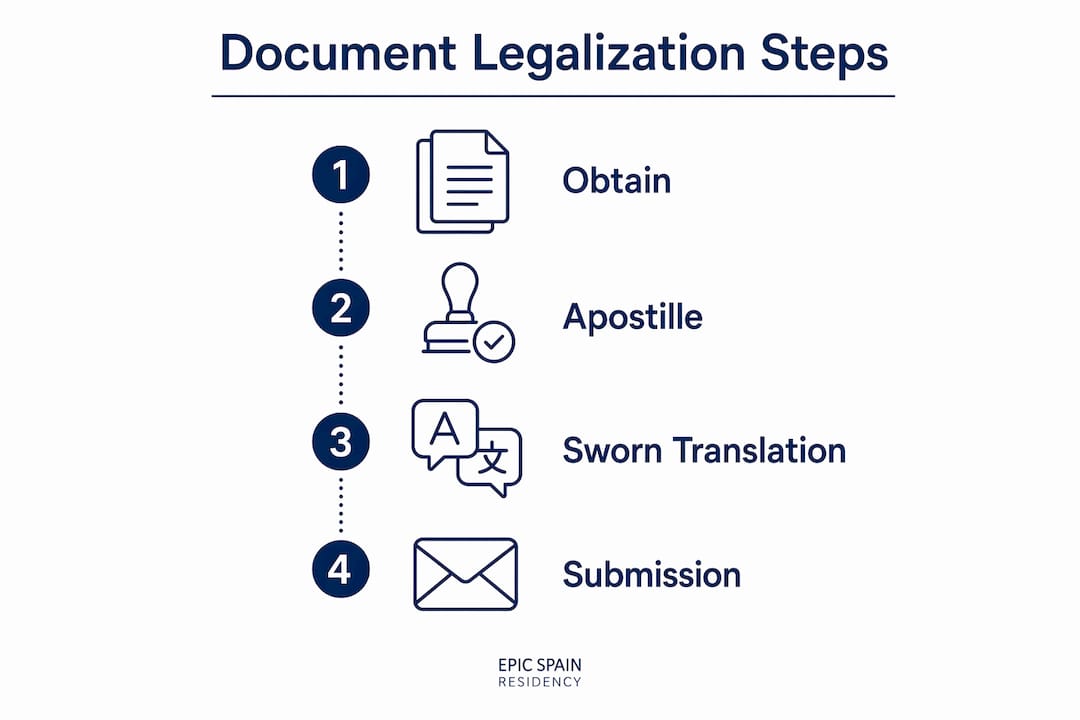
The correct order is:
- Obtain the original document from the issuing authority in your home country
- Apply the apostille or diplomatic legalization to authenticate the document's origin and the issuing official's signature
- Commission the sworn translation, which must cover both the original document text and the apostille page itself
- Submit the complete package to the consulate: original document, apostille, and sworn translation together
The sworn translation must include the full text of the apostille or legalization certificate, not just the main document. Submitting a translation that omits the apostille text is treated as an incomplete submission.
Translating before apostilling causes rejection because the sworn translator must translate the authenticated version of the document, including all official stamps and certifications added during legalization. If you translate first, the apostille is added afterward and the translation no longer covers the complete authenticated document.
Not every document requires an apostille. Documents issued in countries that are signatories to the Hague Convention use the apostille process. Documents from non-signatory countries require diplomatic legalization through the Spanish embassy or consulate in that country. Check your country's status before starting the process.
For a Non-Lucrative Visa or Digital Nomad Visa application, the Spain visa legal requirements apply this sequencing rule to every foreign document in the file. There are no exceptions based on document type or perceived simplicity.
Common mistakes in Spain visa document translation
Incomplete or informal translations are among the leading causes of visa application rejection. Most of these errors follow predictable patterns.
Using uncertified or agency translations. Standard language agencies produce accurate translations, but they lack the legal standing of a sworn translator. Consulates reject them without review.
Skipping translation on "simple" documents. Bank statements with only numbers, or certificates with minimal text, still contain official stamps, codes, and issuing authority details. Even minor documents with official stamps require sworn translation to avoid delays. Applicants who skip these often discover the problem only at the consulate window.
Reversing the apostille and translation order. As covered above, translating before apostilling produces an incomplete translation. The consulate will not accept it, and you will need to restart the translation process after apostilling.
Submitting outdated documents. Criminal records and financial statements older than three months fall outside the validity window. Applicants who gather documents early and then wait often find their paperwork has expired by appointment day.
Failing to confirm consulate preferences on digital translations. Digital sworn translations are valid in some jurisdictions and not in others. Submitting a digital translation to a consulate that requires physical documents results in rejection. Call or email your consulate directly to confirm their current policy.
For applicants applying through a family reunification pathway, the Spain family reunification visa requirements include additional documents such as proof of relationship and shared residence, all of which must follow the same sworn translation and apostille rules.
Key Takeaways
Sworn translations by MAEC-appointed translators are the only legally valid translations for Spain visa applications, and the apostille must always precede the translation.
| Point | Details |
|---|---|
| Sworn translation is mandatory | Only translators appointed by Spain's Ministry of Foreign Affairs produce legally accepted translations. |
| Apostille comes before translation | Legalize your document first, then commission the sworn translation to cover the full authenticated text. |
| Three-month validity window | Criminal records, bank statements, and similar documents expire after three months and must be current at submission. |
| Financial documents need translation too | Bank statements require sworn translation even in English due to official stamps and notations. |
| Confirm digital acceptance per consulate | Some consulates accept digital sworn translations; others require physical documents. Always verify in advance. |
The detail that separates successful applications from rejected ones
Most applicants focus on gathering the right documents. Fewer focus on the legal framework that makes those documents valid. After working with Spain visa cases across multiple visa categories, the pattern is clear: the applicants who struggle are almost always those who treated sworn translation as a formality rather than a legal requirement.
The traductor jurado system exists because Spanish law requires official documents to carry legal public faith. A sworn translator is not simply a bilingual professional. They are a state-appointed officer whose attestation gives your document legal standing in Spain. That distinction is not bureaucratic detail. It is the reason your application gets accepted or rejected.
My practical advice: budget for sworn translations from the start, not as an afterthought. A typical file for a Non-Lucrative Visa or Digital Nomad Visa includes five to eight documents requiring sworn translation. Each one takes 3–7 days and carries a cost. Starting this process two to three months before your intended consulate appointment gives you enough buffer for apostille processing, translation, and any corrections.
The trend toward digital sworn translations is real, but it is moving slowly and inconsistently across Spanish consulates. Do not assume your consulate has modernized. Confirm it directly. The five minutes you spend on that call can save you weeks of reprocessing.
— Living
How Epic-residency handles Spain visa document preparation
Preparing a complete, correctly translated visa file is the part of the Spain visa process where most applicants lose time and money.
Epic-residency manages the full document preparation process for non-EU applicants, including coordinating sworn translations, verifying apostille sequencing, and confirming consulate-specific requirements. The team works across visa categories including the Non-Lucrative Visa, the Digital Nomad Visa, and partner residency pathways. If you are preparing a Spain visa application and want to avoid the translation and legalization errors that cause most rejections, Epic-residency provides direct, hands-on support from document checklist to consulate submission.
FAQ
What is a sworn translation for a Spain visa?
A sworn translation is a legally certified translation produced by a traductor jurado appointed by Spain's Ministry of Foreign Affairs. It carries legal public faith and is the only translation format accepted by Spanish consulates and immigration offices.
Which documents need sworn translation for a Spain visa?
Criminal records, birth and marriage certificates, bank statements, academic transcripts, medical certificates, and employment documents all require sworn translation. Any official document not originally in Spanish must be translated by a sworn translator.
Does the apostille come before or after the sworn translation?
The apostille always comes first. You must legalize the document with an apostille or diplomatic certification before commissioning the sworn translation, which must then cover both the document text and the apostille itself.
Can I use a regular certified translation agency for my Spain visa?
No. Standard certified translations from language agencies do not carry the legal authority required by Spanish immigration law. Only a sworn translator appointed by Spain's Ministry of Foreign Affairs produces a legally valid translation for visa purposes.
How long does a sworn translation take?
Sworn translations typically take 3–7 days. Rush services are available from some translators but cost more. Build this timeline into your visa preparation schedule to avoid last-minute delays.