

Hong Kong professionals seeking to work legally in Spain have two primary pathways: the Highly Qualified Professional (HQP) permit and the Digital Nomad Visa (DNV). The HQP permit is a fast-track employment authorization under Law 14/2013, designed for senior professionals with a Spanish job offer. The DNV supports remote workers earning income from outside Spain. A third route, the Non-Lucrative Visa (NLV), is widely misunderstood. It strictly forbids all work, and violations carry severe legal consequences. Knowing which visa fits your situation before you apply is the single most important decision you will make.
What are the Hong Kong professional Spain work options in 2026?
Spain offers two legally sound work pathways for Hong Kong professionals: the HQP permit for those joining Spanish employers, and the DNV for those working remotely for overseas clients. Both routes bypass the standard Spanish work permit process, which requires a labor market test proving no EU candidate could fill the role. The HQP permit bypasses this test entirely under Law 14/2013, focusing on talent attraction rather than labor market protection. That distinction makes the HQP the preferred route for senior expatriates in law, finance, and technology.
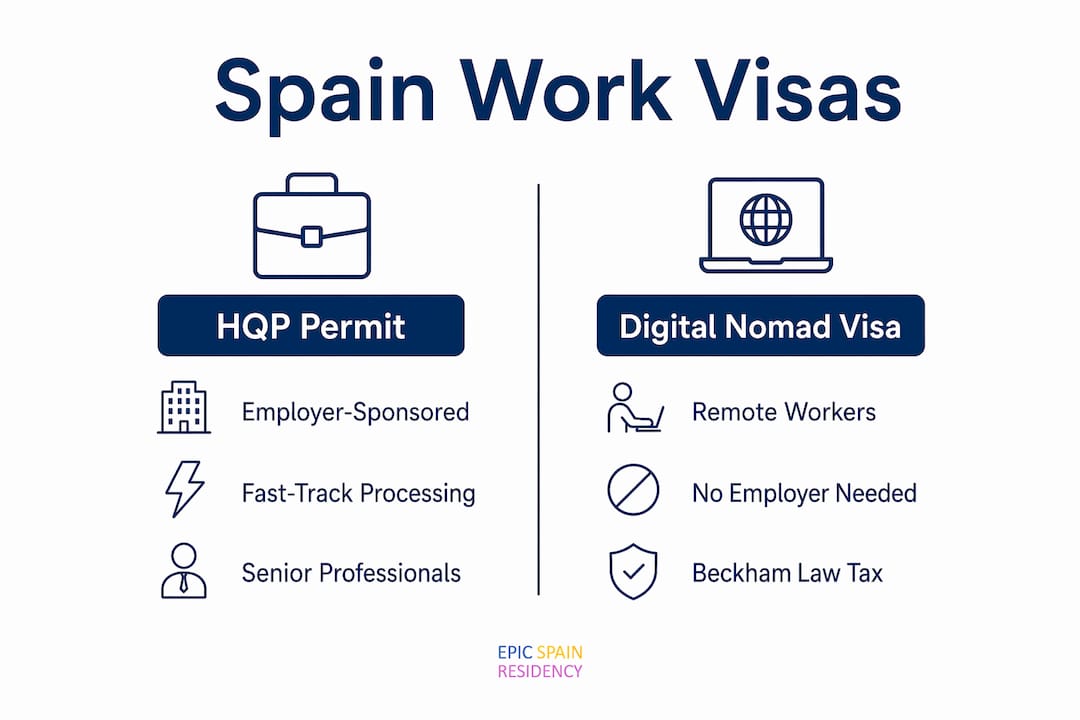
The DNV targets a different professional profile. If you work remotely for a company headquartered outside Spain, the DNV lets you live in Spain legally while keeping your existing employment or client base. Both visas are processed through Spain's immigration authority, and both offer pathways to long-term residency after five years of continuous legal residence.

Understanding the difference between these two routes is not just procedural. Choosing the wrong visa and then working in a way it does not permit can result in deportation and a permanent ban from Spanish residency.
What is the Highly Qualified Professional permit and who qualifies?
The HQP permit is Spain's dedicated fast-track visa for senior foreign professionals hired by Spanish employers. Eligibility requires three things: a confirmed job offer from a Spanish company, a university degree or at least five years of senior-level experience, and a salary that meets the threshold set by the employer's size category.
Applications go through the UGE-CE, Spain's central immigration unit for large businesses. The target processing time is 20 working days, which is fast by European immigration standards. The permit is initially valid for three years and is renewable. After five years of continuous legal residence, you become eligible for permanent residency.
One rule defines the entire process: the "silencio administrativo positivo" principle. If the UGE-CE issues no decision within 20 working days, the application is automatically deemed approved. The catch is that this clock stops the moment any document is missing. An incomplete file triggers a request for more information, which restarts the timeline entirely.
Pro Tip: Prepare a complete, certified document package before submitting. One missing translation or unsigned form can add weeks to your timeline and void the automatic approval benefit.
The HQP permit requires employer sponsorship. Your Spanish employer must hold UGE-CE status, which is typically held by large multinationals. Local SMEs rarely qualify for fast-track processing because they do not meet the large business threshold. This is why targeting multinational firms in Madrid and Barcelona is not just a career preference. It is a legal necessity for this visa route.
- Secure a job offer from a UGE-CE registered Spanish employer.
- Confirm your degree or five-plus years of senior experience is documented and certified.
- Verify your offered salary meets the applicable threshold for the employer's size.
- Submit a complete application package to the UGE-CE.
- Track the 20-working-day window and follow up on any document requests immediately.
How does the Digital Nomad Visa support remote work for Hong Kong professionals?
The Digital Nomad Visa is Spain's answer to the global shift toward location-independent work. It allows Hong Kong professionals to live in Spain while working remotely for employers or clients based outside the country. The income threshold is set at approximately €2,646 per month, which equals 200% of Spain's minimum wage. That figure applies in 2026 and is adjusted when the minimum wage changes.
The DNV also permits self-employment. Freelancers and consultants from Hong Kong can apply, provided their client base is primarily outside Spain. Up to 20% of income may come from Spanish sources without violating the visa terms. That flexibility matters for professionals who pick up local consulting work after settling in.
The most significant financial benefit is access to the Beckham Law tax regime. Under this rule, DNV holders pay a flat 24% income tax rate for up to six years. Spain's standard progressive income tax reaches up to 47% at higher income brackets. For a finance professional earning well above the minimum threshold, that difference is substantial.
- Income floor: approximately €2,646 per month (200% of Spanish minimum wage)
- Work scope: remote work for employers or clients outside Spain
- Spanish income allowed: up to 20% of total income
- Self-employment: permitted
- Tax benefit: flat 24% rate under the Beckham Law for up to six years
- Residency pathway: eligible for permanent residency after five years
Pro Tip: If you earn above €60,000 annually, model your tax liability under the Beckham Law before applying. The savings over six years can be significant enough to influence your overall relocation budget.
For Hong Kong professionals in technology or finance who already work remotely, the DNV is often the faster and more practical route. It does not require a Spanish employer, which removes the sponsorship dependency entirely. Full details on DNV eligibility criteria for Hong Kong nationals are worth reviewing before you begin your application.
Why does working without authorization carry serious risks in Spain?
Unauthorized work in Spain is not a minor administrative issue. Employers who hire foreign nationals without valid work authorization face fines up to €100,000 per case. For the employee, the consequences are immediate residency cancellation and potential deportation.
The Non-Lucrative Visa is the most common source of confusion. Many Hong Kong professionals apply for the NLV because it is relatively straightforward to obtain, then assume they can do some remote consulting on the side. That assumption is wrong. NLV holders are prohibited from all forms of work, including remote work, freelancing, and business management. Non-compliance results in immediate visa cancellation with no grace period.
"Many Hong Kong professionals mistakenly assume that all visas allow work. Only a few, including the Golden Visa and Partner Visa, grant full employment rights. Violations result in permanent residency revocation."
The distinction between visa types is not a technicality. It is the legal boundary between a successful relocation and a forced return. Before accepting any work while on a Spanish visa, confirm in writing that your specific visa category permits that activity.
- Non-Lucrative Visa: No work of any kind permitted, including remote work
- Digital Nomad Visa: Remote work for foreign employers permitted; up to 20% Spanish-source income allowed
- HQP Permit: Full employment rights with the sponsoring Spanish employer
- Partner Visa: Full employment rights once residency is granted
How to position yourself in Spain's job market as a Hong Kong professional
Multinational companies in Barcelona and Madrid are the most reliable sponsors for HQP permits. These firms hold UGE-CE status, which is the administrative requirement for fast-track processing. Local SMEs rarely sponsor HQP permits because they do not meet the large business classification. Targeting your job search toward global firms with Spanish operations is the most direct path to employer-sponsored authorization.
Your professional background as a Hong Kong professional carries specific value in the Spanish market. Multinationals actively seek candidates who can connect Asian and European markets, particularly in sectors like APAC e-commerce, global financial systems, and cross-border legal compliance. Framing your experience in those terms, rather than as purely local Hong Kong expertise, increases your attractiveness to sponsors significantly.
- Target multinationals with offices in Madrid or Barcelona that operate across Asia-Pacific and Europe.
- Highlight experience in cross-border roles: APAC market management, international finance, or global legal compliance.
- Confirm the employer holds UGE-CE status before investing time in the application process.
- Engage an immigration consultancy early to prepare your document package before the job offer is finalized.
Pro Tip: Ask your prospective employer directly whether they have sponsored HQP permits before. A company with prior experience moves faster and makes fewer errors in the sponsorship paperwork.
For professionals in law and finance, Madrid's financial district and Barcelona's technology corridor both host the density of multinational employers most likely to sponsor. For technology professionals, Barcelona's startup ecosystem also includes several large-scale firms with UGE-CE status. Reviewing Spain visa options for non-EU nationals gives you a broader picture of how the HQP fits within the full authorization framework.
Key Takeaways
Hong Kong professionals working legally in Spain must choose between the HQP permit for employer-sponsored roles and the Digital Nomad Visa for remote work, as the Non-Lucrative Visa prohibits all employment without exception.
| Point | Details |
|---|---|
| HQP permit is the top employment route | Requires a UGE-CE employer sponsor, a degree or 5+ years experience, and targets 20-day processing. |
| DNV suits remote workers and freelancers | Requires approximately €2,646/month income and allows up to 20% earnings from Spanish sources. |
| Beckham Law cuts tax significantly | DNV holders pay a flat 24% income tax for up to six years, versus Spain's standard rate of up to 47%. |
| NLV prohibits all work without exception | Working on an NLV, including remotely, triggers immediate cancellation and potential deportation. |
| Multinational employers are the key sponsors | Local SMEs rarely hold UGE-CE status; target global firms in Madrid and Barcelona for HQP sponsorship. |
The visa choice you make first defines everything that follows
Most professionals I speak with from Hong Kong arrive with a clear career plan but an incomplete picture of how Spanish visa categories interact with that plan. The most common mistake is not choosing the wrong visa. It is assuming the visa they already have covers the work they want to do.
The NLV is the clearest example. It is genuinely useful for professionals who have passive income and want to live in Spain without working. But it attracts applicants who think they can manage a consulting relationship or run a remote team on the side. They cannot. The legal exposure is real, and the consequences are permanent.
What I find works best is treating the visa decision as a career decision. If you have a Spanish employer willing to sponsor you, the HQP permit is the right tool. If your income comes from outside Spain and you work independently, the DNV is cleaner and faster to obtain. The two routes are not interchangeable, and trying to use one where the other applies is where professionals get into serious trouble.
The document preparation discipline required for the HQP's silencio administrativo positivo rule is also underestimated. A flawless file is not just a procedural goal. It is the mechanism that triggers automatic approval. Professionals who treat document preparation as an afterthought lose weeks and sometimes the job offer itself.
Spain's job market genuinely values the Asia-Pacific perspective that Hong Kong professionals bring. That is not a recruitment platitude. Multinationals with operations across both regions actively recruit for that bridge experience. Positioning yourself around that specific value, rather than general seniority, is what converts a job search into a sponsorship conversation.
— Living
How Epic-residency helps Hong Kong professionals work in Spain
Relocating from Hong Kong to Spain involves more than choosing the right visa. Document preparation, certified translations, employer coordination, and family logistics all run in parallel, and a single gap in any of them can delay your authorization by months.
Epic-residency specializes in Spain immigration for non-EU professionals and families. The team advises on the full range of Spain visa pathways, including the HQP permit, Digital Nomad Visa, Non-Lucrative Visa, and Partner Visa. Beyond the visa itself, Epic-residency supports relocating families with rental assistance and school placement services. If you are a Hong Kong professional ready to move from research to application, a consultation with Epic-residency is the most direct next step.
FAQ
What is the HQP permit and how fast is it processed?
The Highly Qualified Professional permit is a fast-track Spanish work authorization under Law 14/2013. The UGE-CE targets a 20-working-day decision, with automatic approval if no decision is issued within that window, provided the application is complete.
Can I work remotely on a Non-Lucrative Visa in Spain?
No. The Non-Lucrative Visa prohibits all forms of work, including remote work, freelancing, and business management. Violations result in immediate visa cancellation with no grace period.
What income do I need for Spain's Digital Nomad Visa?
The Digital Nomad Visa requires a minimum income of approximately €2,646 per month, equal to 200% of Spain's minimum wage. This threshold applies in 2026 and adjusts when the minimum wage is revised.
Does the Digital Nomad Visa offer tax benefits?
Yes. DNV holders qualify for the Beckham Law, which applies a flat 24% income tax rate for up to six years. Spain's standard progressive tax rate reaches up to 47% at higher income levels.
Do I need employer sponsorship to work legally in Spain?
The HQP permit requires a Spanish employer with UGE-CE status to sponsor your application. The Digital Nomad Visa does not require a Spanish employer, making it the independent route for remote workers and freelancers from Hong Kong.