

Spain offers no dedicated visa for BN(O) holders. British National (Overseas) passport holders who want to live in Spain must apply through standard Spanish immigration routes, primarily the Non-Lucrative Visa (NLV) or the Digital Nomad Visa (DNV). These are the two most practical BN(O) holders Spain residency options in 2026, and each carries distinct income requirements, work restrictions, and tax implications. Spain also requires 10 years of legal residency for citizenship, which is a longer commitment than most BN(O) holders expect when comparing it to the UK route.
What visa options are available to BN(O) holders for Spanish residency?
BN(O) holders have three realistic visa routes into Spain: the Non-Lucrative Visa, the Digital Nomad Visa, and work or entrepreneur permits. Each suits a different financial profile and lifestyle.
Non-Lucrative Visa (NLV)
The NLV is Spain's most popular residency route for retirees and passive income holders. It requires proof of approximately €2,400 per month in income for the main applicant, with income thresholds rising by roughly €600 per additional dependent per month. The critical restriction: NLV holders cannot work in Spain, either for a Spanish employer or remotely for a foreign company. That rule eliminates the NLV for anyone still earning a salary.

Digital Nomad Visa (DNV)
The DNV suits BN(O) holders who work remotely for non-Spanish clients or employers. The income requirement sits at approximately €2,646 per month, and holders can legally work while living in Spain. The DNV also unlocks access to the Beckham Law tax regime, which is a significant financial advantage covered in detail below. Epic-residency has a full breakdown of the DNV application process for non-EU nationals.
Work visas and entrepreneur permits
BN(O) holders with a Spanish job offer or a business plan can apply for a work authorization or the entrepreneur visa under Spain's Startup Act. These routes are less common for Hong Kong nationals but remain valid pathways. A broad overview of all routes appears in the Spain visa types guide for non-EU nationals.
What happened to the Golden Visa?
Spain ended the Golden Visa program effective april 3, 2025. The program previously allowed residency through a €500,000 real estate investment. That route no longer exists. BN(O) holders who planned to use property investment as their entry point must now qualify under the NLV or DNV income thresholds instead.
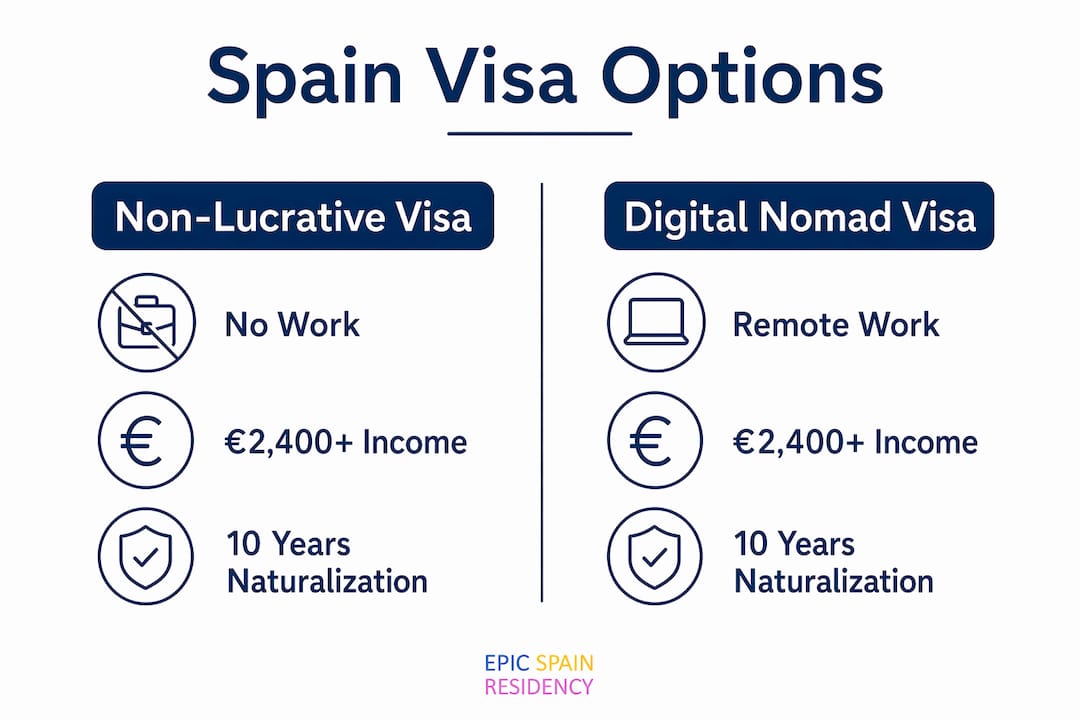
| Visa | Work allowed | Min. monthly income | Citizenship timeline |
|---|---|---|---|
| Non-Lucrative Visa | No | ~€2,400 | 10 years |
| Digital Nomad Visa | Yes (remote) | ~€2,646 | 10 years |
| Work/Entrepreneur | Yes | Varies | 10 years |
| Golden Visa | Yes | N/A (ended April 2025) | N/A |
Pro Tip: If you hold rental income, dividends, or a pension, the NLV is the cleaner route. If you still earn from remote work, apply for the DNV first. Switching visa categories later adds cost and delays.
How do Spain and UK BN(O) timelines compare?
The UK BN(O) route and Spanish residency serve different long-term goals. Understanding the gap matters before committing to either path.
Spain requires 10 years of legal residency for naturalization. The UK BN(O) route reaches citizenship in 6 years, with Indefinite Leave to Remain (ILR) available after 5 years. That four-year difference is significant for families prioritizing a second passport.
Work rights also differ sharply. The UK BN(O) visa grants work permission from day one. Spain's NLV prohibits work entirely. A BN(O) holder on the NLV who takes on freelance clients is technically in breach of their visa conditions.
Permanent residency in Spain becomes available after 5 years of continuous legal residence, which matches the UK ILR timeline. However, the absence rules differ. Spain requires physical presence for most of those years, and extended trips abroad can interrupt the residency clock.
The dual-residency risk is real. Managing both UK ILR and Spain residency simultaneously is legally complex. The UK's 180-day absence rule means spending significant time in Spain can jeopardize ILR eligibility. BN(O) holders cannot simply split their year between both countries without careful planning.
- UK BN(O) visa: citizenship in 6 years, work rights from day one, 180-day absence limit per year
- Spain NLV: citizenship in 10 years, no work rights, 5-year path to permanent residency
- Spain DNV: citizenship in 10 years, remote work permitted, Beckham Law tax access
- Both routes: continuous physical presence requirements that conflict if pursued simultaneously
Pro Tip: If your primary goal is a British passport, complete the UK BN(O) route first. Use Spain as a long-term plan after ILR, not a parallel track.
Financial and tax considerations for BN(O) holders in Spain
Spain's tax system catches many new residents off guard. The rules are strict, and the penalties for non-compliance are heavy.
Spanish tax residency triggers automatically after 183 days in a calendar year. Once you cross that threshold, Spain taxes your worldwide income. That includes Hong Kong rental income, dividends, and any overseas earnings. BN(O) holders with significant assets outside Spain need professional tax advice before applying.
The Beckham Law is the most discussed tax benefit in Spain's immigration world. It offers a flat 24% tax rate on Spanish-source income for six years, with foreign-source income exempt. The catch: it applies only to DNV holders. NLV holders cannot access Beckham Law because the NLV prohibits work, and the law is tied to employment or remote work income. Epic-residency's guide on reducing tax burden in Spain explains how BN(O) holders can structure this legally.
Overseas assets above €50,000 per category must be reported annually through Modelo 720. Failure to comply carries heavy financial penalties and can complicate future citizenship applications.
The Hong Kong Mandatory Provident Fund (MPF) creates a specific problem. Spain residency is not recognized as "permanent departure" by Hong Kong's MPF administrators. That means most BN(O) holders cannot access their MPF savings simply by showing a Spanish residency permit. Families counting on MPF funds to cover living costs in Spain need an alternative financial plan.
Regional wealth taxes add another layer. Spain's autonomous communities set their own wealth tax rates, and regions like Madrid offer near-full exemptions while others do not. Choosing where in Spain to live is partly a tax decision.
Pro Tip: File Modelo 720 in your first year of Spanish tax residency, even if you are unsure whether you qualify. Missing the deadline is far more costly than filing unnecessarily.
Common challenges when applying for Spanish residency as a BN(O) holder
The application process for Spanish residency has specific failure points that catch BN(O) holders repeatedly.
Visa denials often come down to documentation gaps rather than eligibility problems. The most common denial reasons include insufficient proof of income, missing apostilles on Hong Kong documents, and incomplete health insurance coverage. Spanish consulates apply requirements strictly, and a single missing document can result in rejection without the option to resubmit quickly.
The NIE (Número de Identificación de Extranjero) is Spain's foreigner identification number, and you need it for almost every administrative task: opening a bank account, signing a lease, registering with a doctor. Getting your NIE sorted early is not optional. Delays in obtaining it can block housing and healthcare access for weeks.
- Gather all income documents, bank statements, and pension letters before contacting the consulate.
- Apostille every Hong Kong document through the Hong Kong government's authentication service.
- Purchase a Spain-compliant health insurance policy before submitting your visa application.
- Apply for your NIE at a Spanish police station or through the consulate in Hong Kong or the UK.
- Register with your local town hall (empadronamiento) within 30 days of arrival to start your residency clock.
Language is a practical barrier that many BN(O) holders underestimate. Most Spanish administrative offices operate in Spanish only, and Cantonese or English support is rare outside major cities like Barcelona or Madrid. Hiring a local gestor (administrative agent) for paperwork is money well spent.
Healthcare registration requires empadronamiento proof. Private health insurance is mandatory for NLV applicants, but after one year of legal residency, NLV holders can register with Spain's public health system. That transition saves significant money over time.
Pro Tip: Read the BN(O) passport holders visa guide before booking your consulate appointment. The documentation checklist for BN(O) passports differs slightly from standard non-EU applications.
Key Takeaways
BN(O) holders must apply through Spain's standard visa routes, with the Non-Lucrative Visa and Digital Nomad Visa being the two most accessible and practical options in 2026.
| Point | Details |
|---|---|
| No dedicated BN(O) visa | Spain has no special route; NLV and DNV are the primary options for BN(O) holders. |
| Income thresholds matter | NLV requires ~€2,400/month; DNV requires ~€2,646/month, with increases per dependent. |
| Citizenship takes 10 years | Spain's naturalization timeline is four years longer than the UK BN(O) route. |
| Beckham Law is DNV-only | The 24% flat tax rate applies to Digital Nomad Visa holders, not NLV holders. |
| Dual residency is risky | Splitting time between Spain and the UK can interrupt both ILR and Spanish residency clocks. |
Spain's appeal is real, but the trade-offs are serious
Spain's growing popularity among Hongkongers is not surprising. Lower living costs, a warm climate, and EU access make it genuinely attractive compared to the UK. But I have seen too many BN(O) holders arrive in Spain without fully understanding what they are giving up or taking on.
The NLV is elegant in its simplicity: prove your income, don't work, live in Spain. But that "don't work" clause is a real constraint for anyone under 55 who still has earning years ahead. The DNV solves that problem, but it requires a specific employment structure that not every BN(O) holder has in place.
The tax picture is where most people get surprised. Spain's worldwide income taxation, Modelo 720 reporting, and the complexity of MPF access are not small administrative details. They are decisions that affect your financial life for years. I would not move to Spain on any visa without first spending two hours with a Spanish tax advisor who understands Hong Kong assets specifically.
The language barrier is also underrated as a challenge. Hong Kong's BN(O) community in Spain is growing, particularly in Barcelona and the Costa del Sol, but it is nowhere near the scale of the UK's Hongkonger community. Integration takes real effort, and that matters for families with children in Spanish schools.
Spain is a serious option. It deserves serious preparation.
— Living
How Epic-residency supports BN(O) holders with Spain visa applications
Epic-residency specializes in exactly the visa categories that matter most to BN(O) holders: the Non-Lucrative Visa, the Digital Nomad Visa, and partner residency routes. The team handles documentation preparation, consulate coordination, and post-arrival compliance so that nothing falls through the cracks.
Whether you qualify through passive income or remote work, Epic-residency maps your situation to the right visa from the start. The Non-Lucrative Visa service covers the full application from income verification to health insurance selection. For remote workers, the Digital Nomad Visa service includes Beckham Law guidance and tax structuring referrals. If you are moving with a partner, the partner visa route offers an additional pathway worth exploring.
FAQ
Does Spain have a dedicated visa for BN(O) holders?
No. Spain has no dedicated BN(O) visa. BN(O) holders must apply through standard Spanish visa routes such as the Non-Lucrative Visa or Digital Nomad Visa.
Can BN(O) holders work in Spain on the Non-Lucrative Visa?
No. The NLV explicitly prohibits employment, including remote work for foreign employers. BN(O) holders who work remotely must apply for the Digital Nomad Visa instead.
How long does it take to get Spanish citizenship as a BN(O) holder?
Spain requires 10 years of legal residency before naturalization. Permanent residency becomes available after 5 years of continuous legal residence.
What is the income requirement for Spain's Non-Lucrative Visa in 2026?
The NLV requires approximately €2,400 per month for the main applicant, with roughly €600 added per dependent per month.
Can BN(O) holders hold UK ILR and Spanish residency at the same time?
Technically yes, but it is legally complex. The UK's 180-day absence rule means extended time in Spain can interrupt the ILR residency clock and delay citizenship eligibility.