
Spain's school system for expat children includes four distinct pathways: free public schools, semi-private concertado schools, private schools, and international schools offering British, American, or IB curricula. Education is compulsory from age 6 to 16, with optional preschool available before that. The right choice depends on your child's age, your family's long-term plans, and how much Spanish immersion you want. Getting this decision right from the start saves families from costly and disruptive mid-year school changes.
What are the main types of schools available for expat children in Spain?
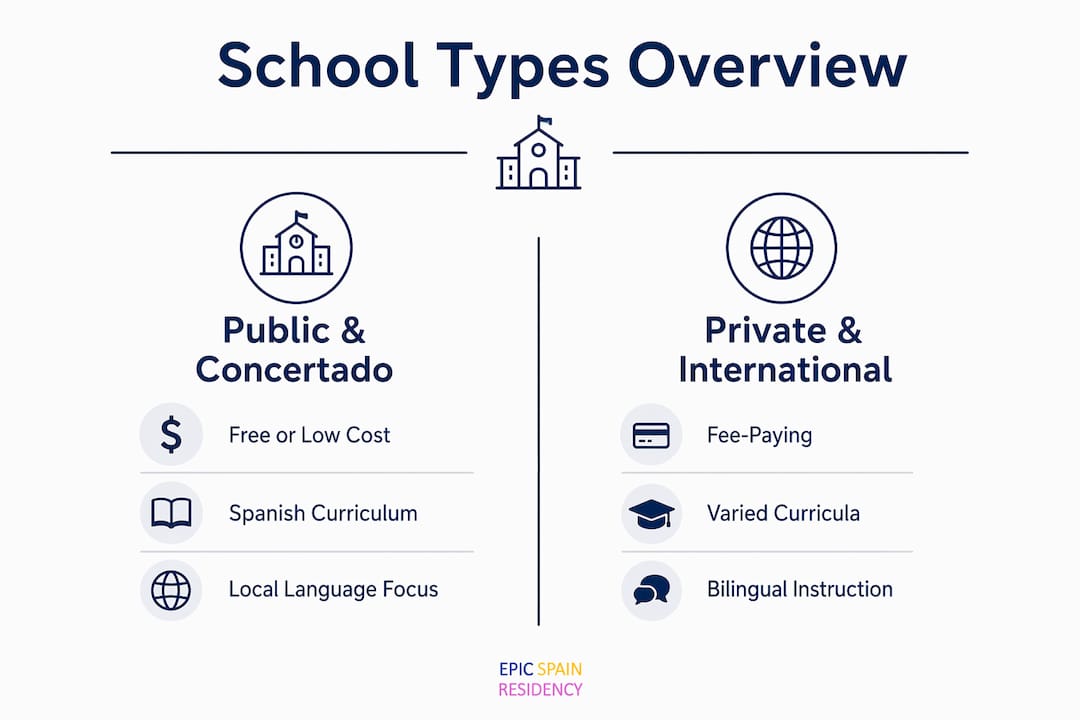
Spain's four school types serve very different family needs. Understanding each one prevents the most common mistake expat families make: choosing a school based on convenience rather than fit.
Public schools
Public schools are free and follow the national LOE/LOMLOE curriculum, which emphasizes Spanish language instruction from day one. Classes are taught almost entirely in Spanish, with some regions adding a second regional language such as Catalan, Basque, or Galician. This full immersion environment produces strong bilingual outcomes over time. Children under 9 achieve functional Spanish in roughly 6 months and near-native fluency within 2 years. That timeline is faster than most parents expect, and it makes public school a genuinely competitive option for younger children.
Concertado schools
Concertado schools sit between public and private. They receive government funding but charge small monthly fees, typically for materials, uniforms, or extracurricular activities. Many are affiliated with the Catholic Church, though secular concertado schools exist. They follow the same national curriculum as public schools, so the academic content is nearly identical. The main draw is often smaller class sizes and a more structured environment than some public schools.
Private schools
Private schools are fully fee-paying and set their own curriculum within Spanish regulatory guidelines. Some offer bilingual programs in English and Spanish. Fees vary widely by region and school reputation. These schools attract families who want more flexibility than the state system offers but are not committed to a fully foreign curriculum.
International schools
International schools deliver British, American, IB, or other foreign curricula, primarily in English, with Spanish taught as a daily subject. Annual fees range from €6,000 to €18,000 per child. That cost reflects smaller class sizes, familiar teaching methods, and curriculum continuity for mobile families. They are the clearest choice for families who expect to relocate again or whose children are entering secondary school mid-education.
| School type | Cost | Language of instruction | Curriculum |
|---|---|---|---|
| Public | Free | Spanish (or regional language) | LOE/LOMLOE national |
| Concertado | Small fees | Spanish | LOE/LOMLOE national |
| Private | Variable fees | Spanish or bilingual | Spanish-regulated, flexible |
| International | €6,000–€18,000/year | English (Spanish as subject) | British, American, or IB |
How does language and cultural integration affect schooling choices?
Language acquisition speed is the single biggest variable in the public school decision. The good news is that children are far faster language learners than adults give them credit for.
Children under 9 transition into Spanish-medium schools with minimal academic disruption. Younger children absorb language through play, social interaction, and routine, which makes the classroom environment itself the learning tool. Older children face a harder adjustment because they are simultaneously managing academic content and a new language. That double load creates real stress.
International schools provide structured Spanish lessons, but the depth of immersion varies significantly. Some international schools create English-dominant environments that limit how much Spanish children actually acquire day to day. If true bilingualism is your goal, you need to actively evaluate how much Spanish instruction each school delivers, not just what their brochure claims.
Cultural integration follows a similar pattern. Children in Spanish public schools build friendships with local kids, absorb Spanish social norms, and develop a genuine sense of belonging in the community. Children in international schools tend to socialize within a predominantly expat peer group. Neither outcome is wrong, but they produce different identities and social networks over time.
- Children under 9 adapt linguistically within 6–12 months in Spanish public schools
- Older children benefit from extracurricular activities in Spanish to supplement classroom learning
- International school Spanish programs vary widely in rigor and contact hours
- Social integration outside school, through sports clubs, neighborhood activities, and local friendships, accelerates language acquisition for all age groups
Pro Tip: Enroll your child in a local Spanish sports club or activity group within the first month of arrival. The informal social setting accelerates language pickup faster than any classroom program.
What factors should expat families consider when choosing a school?
The most important factor is age at arrival. Children under 9 generally experience near-seamless transitions into Spanish public schools. Children older than 10 face significant language and curriculum adjustment challenges that can set them back academically for a full year or more. That gap matters when you are making a decision with long-term consequences.
Beyond age, these four factors shape the right choice for most families:
- Long-term residency plans. Families who plan to stay in Spain for five or more years gain the most from Spanish public school immersion. Families who expect another international move within two to three years face real academic risk if they pull a child out of the Spanish system mid-stream.
- Curriculum continuity. Choosing a British or international curriculum early provides greater academic portability. A child educated in the IB or British system can transfer to equivalent schools in the UK, Singapore, or the US with minimal disruption. The Spanish national curriculum does not transfer as cleanly.
- Special educational needs. SEN support is more structured and earlier identified within British international schools than in Spanish public schools. Early identification in primary years is critical to secondary school success. If your child has a diagnosed or suspected learning difference, the international school system offers a more reliable support framework.
- Social environment. Spanish public schools build deep local roots. International schools build a global peer network. Think about which environment serves your child's long-term social identity, not just the next two years.
International schools reduce relocation stress by providing familiar systems, smaller classes, and curriculum continuity. They are specifically recommended for families worried about language barriers, planning another move, or enrolling children at secondary level. The higher cost is real, but so is the lower academic risk.
Pro Tip: If you are genuinely undecided, start younger children in a Spanish public school and reserve the option to switch to an international school at age 10 or 11. The language foundation they build in the early years is an asset in any future school system.
Many families regret impulsive school decisions made without thinking through future relocations or curriculum compatibility. The school choice you make in year one follows your child for years.
What are the practical steps for enrolling expat children in Spanish schools?
School enrollment in Spain requires specific documents and early action. Waiting lists for popular international schools can stretch six to twelve months, so planning ahead is not optional.
- Register at the local municipal office (empadronamiento). This registration proves your family's address and is required to access public schools in your zone. Without it, you cannot apply.
- Gather your documents. You need passports, proof of residency or visa status, previous school records (translated into Spanish if required), and health insurance documentation.
- Apply early. Public school enrollment periods typically open in march or april for the following september. International school applications should begin six to twelve months before your intended start date.
- Check regional language requirements. In Catalonia, the Basque Country, and Galicia, regional languages play a significant role in public school instruction. Factor this into your school zone decision.
- Plan for the transition period. Build in time for your child to adjust socially and linguistically before academic pressure peaks.
Homeschooling is not legally recognized in Spain. Families must enroll children in an officially recognized school. Compulsory education runs from age 6 to 16, with optional preschool available before age 6. This is a firm legal requirement, not a guideline.
Understanding your visa and residency status directly affects which schools your child can access and what documentation you need for enrollment. Families on a Non-Lucrative Visa, Digital Nomad Visa, or student visa each face slightly different administrative requirements.
Pro Tip: Request an official translation of your child's previous school records before you leave your home country. Getting certified translations done in Spain costs more and takes longer than doing it at home.
Key Takeaways
The Spain school system for expat children offers four distinct pathways, and the right choice depends on age, long-term plans, and language goals.
| Point | Details |
|---|---|
| Age determines fit | Children under 9 adapt to Spanish public schools with minimal disruption; older children face higher academic risk. |
| International schools cost more, risk less | Fees range from €6,000 to €18,000 annually, but curriculum continuity protects mobile families. |
| Language immersion is real | Children in Spanish public schools reach functional fluency in 6–12 months and near-native fluency in 2 years. |
| SEN needs favor international schools | British and international schools identify and support learning differences earlier and more consistently. |
| Enrollment requires early action | Municipal registration and document preparation must happen months before the school year starts. |
What I've learned from watching families get this wrong
The most common mistake I see is families treating the school decision as reversible. They pick the convenient option, tell themselves they can always switch later, and then discover that switching a 12-year-old from a Spanish public school into an English-medium international school mid-secondary is genuinely disruptive. The reverse is also true. Pulling a child out of an international school at age 10 to save on fees, when they have built their entire social world there, creates real emotional fallout.
The families who navigate this best share one trait: they make the decision based on a five-year horizon, not a one-year budget. They ask where their child will be at 14, not just at 9. That longer view changes the math on international school fees considerably.
Language immersion in Spanish public schools is genuinely impressive. I have watched children arrive speaking zero Spanish and hold full conversations with their classmates within eight months. That outcome is real, and it is worth something. But it requires the family to commit to the process, not just the enrollment. Supplemental Spanish exposure at home, local friendships, and extracurricular activities in Spanish all accelerate what the school starts.
The families who struggle are the ones who enroll in a Spanish public school but recreate an English-only bubble at home. The school does its job. The family undoes it every evening. Immersion only works if you let it.
— Living
How Epic-residency supports families relocating to Spain
Choosing the right school is only one part of relocating a family to Spain. The visa, the residency permit, and the enrollment paperwork all have to align before your child can walk through a school door.
Epic-residency specializes in exactly this process. The team handles family residency applications, student visa documentation, and the bureaucratic steps that trip up most families doing this alone. Epic-residency's education services in Spain include international school admissions support, enrollment paperwork, and personalized guidance matched to your family's specific visa status and timeline. If you are planning a move and want the school and residency pieces to work together from day one, Epic-residency is the place to start.
FAQ
Can expat children attend Spanish public schools for free?
Yes. Spanish public schools are free for all children registered as residents, regardless of nationality. Families must complete municipal registration (empadronamiento) to access their local school zone.
At what age should expat children start in a Spanish public school?
Children under 9 adapt most successfully to Spanish public school immersion. Children older than 10 face significant language and curriculum adjustment challenges, making international school enrollment a lower-risk option for that age group.
Is homeschooling legal in Spain?
No. Homeschooling is not legally recognized in Spain. All children between ages 6 and 16 must be enrolled in an officially recognized school.
How long does it take for expat children to learn Spanish in school?
Children in Spanish public schools typically reach functional conversational Spanish within 6–12 months and near-native fluency within 2 years, depending on age and immersion level outside school.
Do international schools in Spain teach Spanish?
Yes, but the depth varies. Some international schools create English-dominant environments that limit Spanish acquisition. Families should evaluate each school's Spanish instruction hours and teaching approach before enrolling.