

Legal guardianship for expat children in Spain is governed by the Spanish Civil Code, which establishes parental authority under Articles 154–171 and requires court procedures to appoint guardians when parents cannot act. Spain legal guardianship for expat children is not a single document you file. It is a legal status that flows from birth registration, family court decisions, and immigration compliance working together. For parents planning a move to Spain with minor children, understanding this framework before you arrive is the difference between a smooth relocation and months of legal delays.
How is legal guardianship established for expat children in Spain?
Parental authority is jointly held by both biological or adoptive parents from the moment of birth registration under Spanish law. That joint authority covers decisions about education, healthcare, travel, and residence. No separate guardianship appointment is needed as long as both parents are alive, capable, and present.

Guardianship becomes a court matter only when parental authority is restricted, suspended, or lost entirely. Spanish courts step in when a parent dies, becomes legally incapacitated, or is absent for an extended period. In those cases, a judge appoints a guardian, typically a close family member, to act in the child's best interests.
Unmarried parents face one additional step. Both parents must be listed on the birth certificate for joint parental authority to apply automatically. If only one parent is registered, the other must establish legal filiation through a court process or notarial act before claiming any parental rights in Spain.
Adoptive parents hold the same parental authority as biological parents once the adoption is legally recognized in Spain. Foreign adoption decrees must be validated by Spanish courts before they carry legal weight for immigration or school enrollment purposes.
- Joint parental authority applies automatically from birth registration for married and many unmarried parents.
- Court appointment of a guardian is required when parental authority is lost, suspended, or restricted.
- Foreign adoption decrees require Spanish court validation to be legally effective.
- Unmarried parents must confirm filiation for both names to appear on the birth certificate.
- Guardianship appointments must be formally notarized or authorized by Spanish courts to be accepted by immigration authorities.
Pro Tip: If you are relocating as a single parent, bring a certified and apostilled copy of the other parent's death certificate or a court order confirming sole parental authority. Spanish immigration offices will ask for it.
What are the residency requirements for expat children linked to guardianship?
Residency authorization for minor children in Spain is tied directly to the legal status of the parent or guardian applying on their behalf. The parent must demonstrate continuous residence, sufficient financial means, and adequate housing before a child's dependent residency is approved.
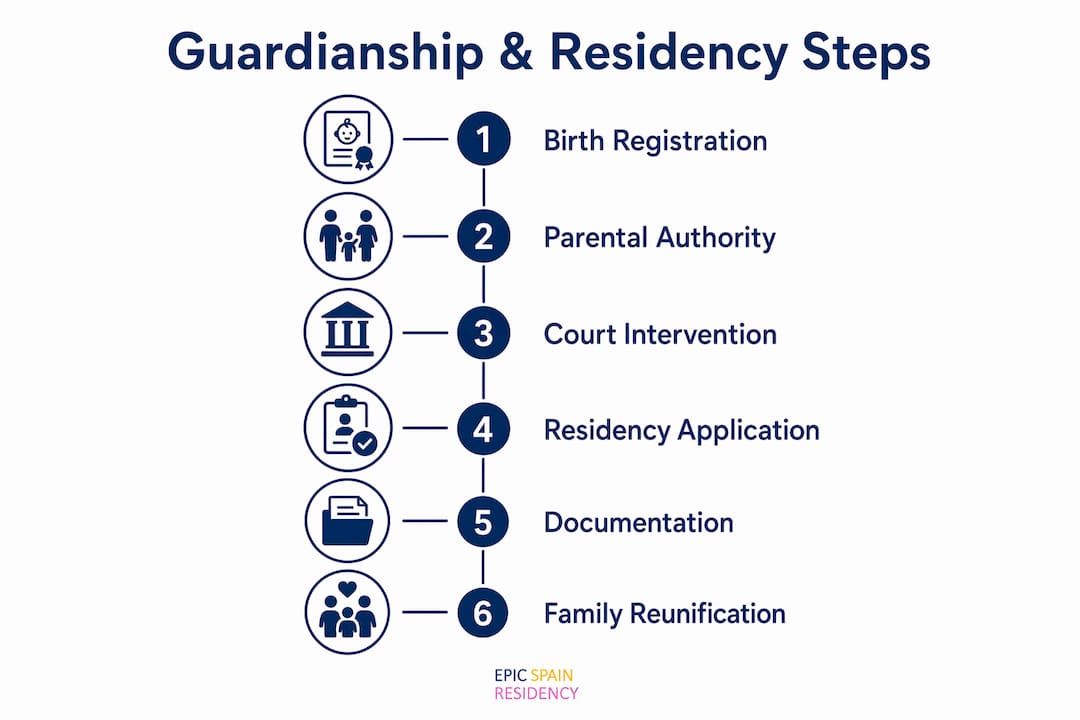
Non-resident minor children can obtain temporary residency only after two years of continuous presence in Spain, with strict financial and housing criteria applied to their parents or guardians. That two-year threshold catches many expat parents off guard. Planning your timeline around it from the start saves significant stress.
Spanish immigration authorities scrutinize financial documentation intensely to prevent children from becoming a public charge. Private health insurance without co-payments or waiting periods is mandatory for minors on most non-EU residency pathways. A policy that covers the child from day one of arrival is not optional. It is a hard requirement.
The steps for securing a child's residency card, known as the TIE (Tarjeta de Identidad de Extranjero), follow a clear sequence:
- Confirm the parent's own residency authorization is approved or in process.
- Gather proof of guardianship or parental authority (birth certificate, court orders, adoption decrees).
- Obtain a notarized consent letter from the absent parent if one parent remains outside Spain.
- Purchase qualifying private health insurance for the child with no co-payments or exclusions.
- Book the child's appointment at the local police station (Comisaría) for TIE issuance.
- Attend the appointment in person with the child, regardless of age.
Pro Tip: Children under six are generally not fingerprinted for their TIE card, but physical presence at the police station is still mandatory. Book the appointment early. Slots fill weeks in advance in major cities like Madrid and Barcelona.
For parents applying through the Non-Lucrative Visa pathway, the family reunification visa requirements set the financial thresholds you must meet for each dependent child added to your application.
How does shared custody work for expat families under Spanish family law?
Spanish courts favor shared custody where possible, prioritizing the child's best interests over automatic parental preferences. Shared custody is no longer treated as exceptional. Courts assess family stability, each parent's living situation, and the child's established routines before deciding on any arrangement.
The child's own voice carries legal weight from age 12 onward. Spanish judges are required to hear the child's wishes directly in custody proceedings once that threshold is reached. Younger children's preferences may also be considered, though with less formal weight.
"Courts look at the willingness of each parent to facilitate the child's relationship with the other parent. A parent who blocks contact damages their own custody position." — Spanish family law principle reflected in court practice.
One point that surprises many expat parents: shared custody does not eliminate child support. Spanish courts require support payments that maintain equivalent living standards for the child in both households. The financial obligation continues regardless of how time is divided.
Relocating a child internationally without the other parent's consent is treated as a serious legal offense. Moving a child abroad without approval constitutes child abduction under the 1980 Hague Convention. Spain enforces the Convention rigorously. Courts act quickly to order the child's return, and the parent who moved without consent faces significant legal consequences.
- Shared custody is the default preference of Spanish courts, not an exception.
- Children aged 12 and older have their wishes formally heard in custody proceedings.
- International relocation requires either the other parent's written consent or a court order.
- Spanish courts enforce the Hague Convention swiftly against unauthorized international moves.
- Parental cooperation is a factor courts actively weigh when deciding custody arrangements.
What documentation do expat parents need to appoint or adjust guardianship in Spain?
Getting the paperwork right is where most expat parents lose time. Spanish immigration and family courts each have their own document requirements, and they do not always align neatly.
The table below summarizes the core documents required for the most common guardianship and residency scenarios:
| Scenario | Key Documents Required |
|---|---|
| Both parents relocating together | Apostilled birth certificate, proof of joint parental authority |
| Single parent relocating | Court order confirming sole custody or death certificate of other parent |
| One parent remaining abroad | Notarized and apostilled parental consent letter |
| Guardian appointed by court | Court order of guardianship appointment, guardian's ID, proof of relationship |
| Foreign adoption | Validated adoption decree from Spanish court, apostilled original |
Notarization is not a formality. Notarized parental consent letters are required by Spanish immigration when one parent remains outside Spain. A letter that is notarized but not apostilled will be rejected. Both steps are mandatory.
Power of attorney is useful when one parent cannot attend appointments in person. A properly drafted power of attorney, notarized and apostilled in the country of origin, allows the present parent to act on behalf of the absent one for residency filings and TIE appointments.
Common pitfalls include submitting birth certificates without apostilles, using health insurance policies that contain co-payment clauses, and failing to translate documents into Spanish by a certified translator. Each of these errors triggers a rejection and restarts the clock on your application.
Pro Tip: Have all foreign documents apostilled and officially translated into Spanish before you arrive. Spanish consulates and immigration offices do not accept unofficial translations, and finding a certified translator after arrival adds weeks to your timeline.
Key Takeaways
Expat parents who establish legal guardianship and residency documentation before relocating to Spain face far fewer delays and legal complications than those who address it after arrival.
| Point | Details |
|---|---|
| Parental authority is automatic | Joint authority applies from birth registration; court action is only needed when it must change. |
| Two-year residency threshold | Minor children need two years of continuous presence before qualifying for independent temporary residency. |
| Notarization is mandatory | All foreign documents must be apostilled and officially translated into Spanish to be accepted. |
| Shared custody is the default | Spanish courts prefer shared arrangements and actively assess each parent's willingness to cooperate. |
| Hague Convention applies | Moving a child internationally without consent or a court order triggers immediate legal action under the 1980 Hague Convention. |
What I have learned advising expat families on guardianship in Spain
The single most common mistake I see expat parents make is treating legal guardianship as something to sort out after they land. By the time they realize the documentation gaps, school enrollment is blocked, the TIE appointment is weeks away, and one parent is fielding calls from a lawyer in their home country about a missing consent letter.
Spain's family law framework is actually well-designed for expat families. The joint parental authority system is clear. The courts are consistent about the child's best interests. The Hague Convention enforcement is fast and predictable. The problem is not the law. The problem is that parents arrive without apostilled documents, without qualifying health insurance, and without a notarized consent from the parent who stayed behind.
Shared custody arrangements work well in Spain when both parents commit to cooperation. Courts reward that cooperation visibly. A parent who facilitates the child's relationship with the other parent, even across borders, builds a stronger legal position than one who uses distance as leverage.
The one area where I urge real caution is international relocation after a custody order is in place. Even if you hold sole custody from a foreign court, moving a child out of Spain without Spanish court approval or the other parent's written consent puts you in Hague Convention territory immediately. The return orders are fast. The legal costs are high. The damage to the child is real. Get the court order first. Always.
For parents using the Non-Lucrative Visa pathway, the financial documentation for dependent children is more demanding than most expect. Private health insurance, proof of income, and housing evidence all need to cover every family member listed on the application. Build that file before you book flights.
— Living
How Epic-residency supports expat families relocating to Spain with children
Relocating to Spain with minor children means managing two parallel processes: the legal guardianship framework and the immigration paperwork. Getting both right at the same time requires specific knowledge of Spanish family law and immigration procedure.

Epic-residency works with non-EU families to handle dependent child residency applications, including document preparation, notarization guidance, and TIE appointment coordination. For families with more complex situations, such as single parents, split households, or foreign adoptions, Epic-residency provides tailored support across the full application process. Parents who want to understand their education services options in Spain can also get guidance on school enrollment alongside the visa process. Contact Epic-residency to discuss your family's specific situation before you start packing.
FAQ
What is legal guardianship for expat children in Spain?
Legal guardianship for expat children in Spain is the court-appointed authority to care for a child when parental authority is unavailable. Parental authority under the Spanish Civil Code (Articles 154–171) is the default status for biological and adoptive parents from birth registration.
Can one parent relocate a child to Spain without the other parent's consent?
No. Relocating a child internationally without the other parent's written consent or a court order constitutes child abduction under the 1980 Hague Convention, which Spain enforces rigorously.
What documents does a single expat parent need to bring a child to Spain?
A single parent needs an apostilled birth certificate, a court order confirming sole custody or the other parent's death certificate, and a notarized consent letter from the absent parent if applicable.
At what age does a child's opinion matter in Spanish custody cases?
Spanish courts formally consider a child's wishes from age 12 onward. Younger children's preferences may also be heard, but carry less formal legal weight in custody proceedings.
Does shared custody in Spain eliminate child support payments?
No. Spanish courts require child support payments even under shared custody arrangements to maintain equivalent living standards for the child in both households.