

Renouncing your US residency to move to Spain is a formal, legally binding process that requires in-person consular appointments, strict IRS tax filings, and coordination with Spanish immigration law. The technical term for ending your US citizenship is "expatriation," while giving up a green card is formally called "abandonment of lawful permanent residence." Both paths share overlapping tax obligations and procedural requirements. Getting either wrong costs real money and can leave you in legal limbo between two countries. This guide walks you through every step, from the US State Department appointment to your first Spanish residency card.
What are the official steps to renounce US residency outside the United States?
Renunciation of US citizenship must happen in person at a US embassy or consulate abroad. You cannot complete this process remotely, by mail, or through a third party. That single requirement shapes the entire timeline.
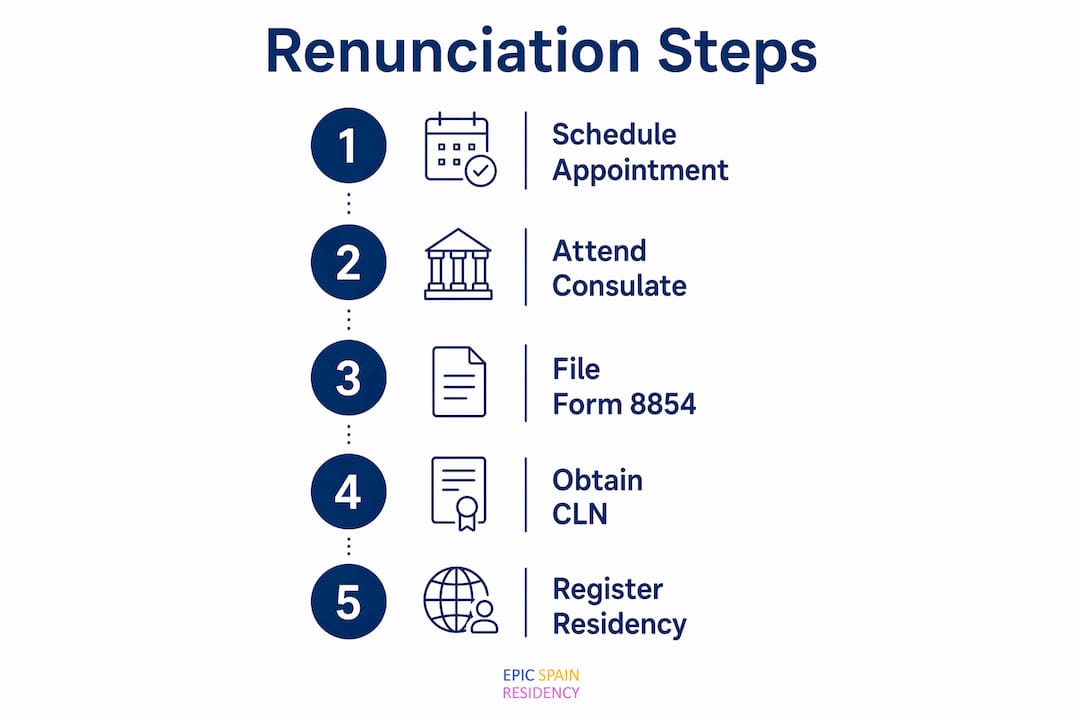
The process follows these steps:
- Schedule a consular appointment. Wait times vary widely by location. Some US consulates in Spain have backlogs of several months. Checking multiple consulate locations and booking the earliest available slot is standard practice.
- Gather required documentation. You need your US passport, birth certificate, any naturalization certificates, and a completed Form DS-4083 (Oath of Renunciation of Nationality of the United States).
- Attend the appointment and take the oath. A consular officer administers the Oath of Renunciation. This step is irrevocable once completed.
- Pay the government fee. The fee dropped to $450 in april 2026, down from $2,350 previously. That reduction removes a significant financial barrier for many applicants.
- Receive the Certificate of Loss of Nationality (CLN). Processing takes weeks to months after the appointment. The CLN is the official document that marks your renunciation date and is required for IRS filings.
Pro Tip: Book appointments at multiple US consulates across Spain and Europe simultaneously. Madrid and Barcelona fill quickly, but smaller consulates sometimes have earlier openings.
The CLN date matters for tax purposes. Your US tax obligations run through that date, not the date you physically left the country.
What are the tax implications when renouncing US residency to move to Spain?
Tax compliance is the most consequential part of giving up US residency. The IRS does not simply close your file when the State Department issues your CLN. You must actively terminate your tax relationship with the US government through a separate filing process.

The central document is Form 8854, which certifies that you have filed and paid US taxes for the five years preceding your renunciation. Filing it correctly is the only official mechanism to formally end US tax residency with the IRS. Missing this step triggers automatic "covered expatriate" status and significant ongoing liability.
Who qualifies as a covered expatriate?
The IRS labels you a covered expatriate if you meet any one of three conditions in 2026:
- Your average annual net income tax liability for the five years before expatriation exceeds $206,000
- Your net worth on the date of expatriation is $2 million or more
- You fail to certify five years of full US tax compliance on Form 8854
Most Americans who renounce do not meet the income or net worth thresholds. The documentation requirement, however, catches people who assumed their taxes were in order but never formally verified it.
"Renunciation is not a simple administration but a strategic tax event; professional advice and thorough preparation are essential to avoid costly mistakes." — expattaxonline.com
Covered expatriate status triggers the US exit tax, which treats your worldwide assets as if they were sold on the day before renunciation. The IRS calculates capital gains on that deemed sale and taxes them accordingly. Deferred income accounts, like certain IRAs and pension plans, face separate rules.
Failing to file Form 8854 carries a $10,000 annual penalty and locks in covered expatriate status regardless of your actual income or net worth. That penalty applies every year the form remains unfiled.
For the year of expatriation, you file a dual-status return. Form 1040 covers the period before your CLN date, and Form 1040-NR covers any US-source income earned after that date. If you continue to receive US-source income, such as rental income from US property or dividends from US companies, annual 1040-NR filings continue indefinitely.
How does one legally establish residency in Spain after renouncing US residency?
Spain's residency system is separate from the US renunciation process. Completing your consular appointment does not automatically grant you Spanish residency. You must qualify under Spanish immigration law independently.
Spain considers you a tax resident if you spend more than 183 days in the calendar year there, or if your primary economic interests or immediate family are based there. Tax residency triggers worldwide income taxation in Spain, so the timing of your arrival matters as much as the visa category you choose.
Common visa pathways for US nationals relocating to Spain
The right visa depends on your income source and personal situation. The most common options for Americans are:
- Non-Lucrative Visa (NLV): Designed for people with sufficient passive income or savings who do not plan to work in Spain. Retirees and those living on investments use this route most often. Epic-residency handles NLV applications as one of its core services.
- Digital Nomad Visa: Built for remote workers employed by non-Spanish companies. Spain launched this visa to attract location-independent professionals.
- Partner Visa (Pareja de Hecho): Available to unmarried partners of Spanish residents or citizens. Epic-residency also supports partner visa applications for couples navigating this route.
- Self-employed and business pathways: For those planning to work independently or establish a business in Spain.
For a full breakdown of Spanish residency permit categories, the legal distinctions between each type matter for long-term planning, including the path to permanent residency and eventual citizenship.
The Beckham Law window and why timing is critical
Spain's Beckham Law offers a flat 24% income tax rate on Spanish-source income for qualifying new residents, instead of the standard progressive rates that reach 47%. To access it, you must elect within six months of registering with Spanish Social Security. You also must not have been a Spanish tax resident in the five years before your arrival.
Missing that six-month window permanently closes the option for your current residency period. That single deadline has cost many expats years of tax savings.
Pro Tip: Register with Spanish Social Security as soon as you arrive and file your Beckham Law election immediately. Do not wait until you understand the full tax picture. You can always withdraw if it turns out not to benefit you.
After securing your visa, the remaining legal steps include registering with your local municipal office (padrón), and applying for your Foreigner Identification Card, known as the TIE. Both registrations are required to access public services, open bank accounts, and demonstrate lawful residence.
What are common mistakes in the renunciation and Spain relocation process?
The most expensive mistakes in this process are procedural, not conceptual. People understand the steps in theory but miss deadlines or submit incomplete paperwork.
The most common errors include:
- Not filing Form 8854 at all. Some people assume the CLN closes their IRS relationship automatically. It does not. The $10,000 annual penalty for non-filing compounds quickly.
- Underestimating consulate wait times. Embassy appointment backlogs can push your renunciation date months later than planned. That delay shifts your tax year, your Spanish arrival timing, and your Beckham Law eligibility window.
- Missing the six-month Beckham Law deadline. This is the single most common tax planning failure among Americans relocating to Spain. The timing of Social Security registration starts the clock immediately.
- Ignoring post-renunciation US tax obligations. Renouncing does not eliminate US tax liability on US-source income. Americans who own US rental property or hold US brokerage accounts still file Form 1040-NR annually.
- Skipping the padrón registration. Without municipal registration, you cannot access healthcare, enroll children in school, or demonstrate residency for future permit renewals.
"Advance planning of 12–18 months is recommended to coordinate US and Spanish tax years and social security registrations." — aiofinancial.com
The 12–18 month planning window is not conservative. It reflects the actual time needed to schedule a consulate appointment, complete IRS filings, arrive in Spain, register locally, and file the Beckham Law election before the window closes.
Key takeaways
Renouncing US residency to move to Spain requires completing both the State Department's consular process and the IRS's Form 8854 filing, while simultaneously qualifying for and applying under Spanish immigration law.
| Point | Details |
|---|---|
| Form 8854 is mandatory | Filing certifies five years of tax compliance; missing it triggers a $10,000 annual penalty and covered expatriate status. |
| The CLN date controls your tax year | US tax obligations run through your Certificate of Loss of Nationality date, not your departure date. |
| Beckham Law has a hard deadline | You must elect within six months of Spanish Social Security registration or lose the favorable tax rate permanently. |
| Spain residency requires separate steps | Visa approval, padrón registration, and TIE card application are all required after renunciation. |
| Plan 12–18 months in advance | Consulate backlogs and overlapping US and Spanish deadlines make early planning the single most important factor. |
What I've learned from watching Americans get this wrong
Most people who contact a Spain immigration consultancy after starting the renunciation process on their own have already made at least one costly mistake. The pattern is consistent. They researched the consular steps thoroughly, booked the appointment, took the oath, and then assumed the hard part was over.
The IRS filing is where things fall apart. Form 8854 is not intuitive. The five-year tax compliance certification requires pulling records that many people have not organized in years. The dual-status return for the expatriation year requires a tax professional who understands both US expatriate tax law and Spanish tax residency rules. That combination is rarer than it sounds.
The Beckham Law timing issue is the second major failure point. Americans arrive in Spain, spend the first few months finding an apartment, enrolling kids in school, and opening a bank account. By the time they think about tax planning, the six-month window has closed. That mistake can cost tens of thousands of euros over a five-year residency period.
My honest recommendation: treat the renunciation and relocation as a single coordinated project, not two separate processes. The US tax exit and the Spanish tax entry are linked by timing. A mid-year arrival in Spain, combined with immediate Social Security registration and a Beckham Law election, produces the best outcome for most Americans. That coordination requires planning well in advance and professional advice from people who work at the intersection of both systems.
Patience with documentation is not optional. Every delay in gathering US tax records or Spanish registration paperwork has a downstream cost. The people who move through this process cleanly are the ones who treated it like a legal project with real deadlines, not an administrative formality.
— Living
How Epic-residency supports your move from the US to Spain
Moving from the US to Spain involves more than packing boxes. The visa application, residency registration, and timing decisions all affect your legal and financial standing for years.

Epic-residency is a boutique Spain-focused immigration consultancy that specializes in helping non-EU individuals and families establish legal residency in Spain. Whether you are pursuing the Non-Lucrative Visa as a retiree or passive income earner, or the Digital Nomad Visa as a remote professional, Epic-residency handles the application process from document preparation through submission. The team works with US nationals at every stage of the relocation, including timing advice that connects your renunciation timeline to your Spanish visa application.
FAQ
What is the difference between renouncing citizenship and abandoning a green card?
Renouncing US citizenship is a permanent, irrevocable act completed at a US consulate abroad. Abandoning a green card (lawful permanent residence) is a separate process that ends US residency without giving up citizenship.
Do I owe the exit tax when I renounce US citizenship?
The exit tax applies only if you are a covered expatriate, meaning your net worth exceeds $2 million, your average annual tax liability exceeded $206,000 over the past five years, or you failed to certify five years of tax compliance on Form 8854. Most Americans do not meet these thresholds.
How long does it take to get a Spanish residency permit after renouncing?
Processing times vary by visa type and consulate, but most Spanish residency permits take two to six months from application submission. Starting the Spanish visa process before or alongside your renunciation appointment reduces total transition time.
Can I lose my Spanish residency if I spend too much time outside Spain?
Yes. Most Spanish residency permits require you to spend a minimum number of days in Spain each year to maintain valid residency. Spending more than six consecutive months outside Spain can trigger a review or loss of residency status.
What happens if I still have US-source income after renouncing?
Renouncing citizenship does not eliminate US tax obligations on US-source income. You must file Form 1040-NR annually for any income sourced from the United States, including rental income, dividends from US companies, and certain retirement distributions.